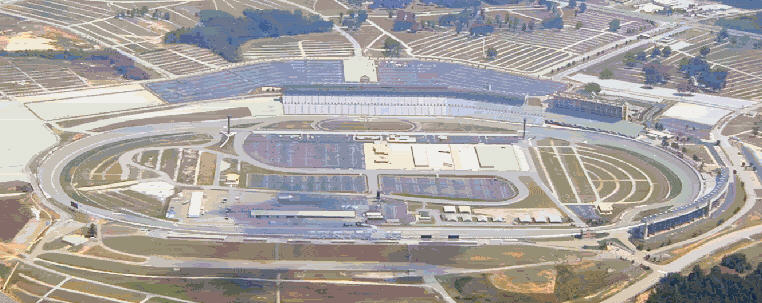
Atlanta Motor Speedway
When journalist Furman Bisher visited Atlanta International Raceway on opening day in 1960, his verdict was blunt: "Nothing was ready, there was dirt everywhere. It was like a county fair in the boondocks." Sixty-five years later, the facility -- now called EchoPark Speedway, though most still know it as Atlanta Motor Speedway -- covers 850 acres in Hampton, Georgia, and hosts some of NASCAR's most thrilling racing. The distance between that dusty debut and the modern quad-oval superspeedway is measured not just in decades but in bankruptcies survived, boardroom coups endured, and a track surface torn up and rebuilt three times over.
A Million-Dollar Dream, Built on Stalling Stock
On April 8, 1958, the Atlanta Constitution reported that the First Georgia Securities Corporation planned to build a $1 million, 50,000-seat racing facility south of Atlanta along U.S. Route 41. The ambition was to rival the Indianapolis Motor Speedway itself. Reality proved harder to fund. Of the 479,550 shares offered at $4 each, only $40,000 worth sold by end of July. Racing directors Curtis Turner and Joe Weatherly threatened lawsuits when the company failed to pay them. Weatherly captured the mood perfectly: "They painted us a pretty picture... that picture isn't so pretty anymore." Twenty days of rain in October 1959 left construction half-finished, and the planned opening race was postponed again and again. The track finally opened on July 31, 1960, with Edwin "Fireball" Roberts winning the inaugural Dixie 300 before 25,000 fans -- though runner-up Cotton Owens went to his grave insisting a scoring error robbed him of the victory.
Five Years Under Court Order
Financial trouble stalked the track from the start. Rain delays gutted revenue. Mismanagement drove away drivers and fans alike. After president Nelson Weaver died in 1968, using his personal finances to keep the lights on, the facility spiraled. A disastrous merger with American Raceways brought in executives who, as Bisher recalled, "knew nothing about racing." The IRS demanded $35,000 in delinquent taxes just days before a major race. On January 19, 1971, Atlanta International Raceway filed for Chapter 10 bankruptcy with $1.4 million in debt. Former general manager Hal Hamrick laid out the stakes: "If the fans don't turn out for this one, it is the end of major league auto racing in Atlanta." The fans came, but not in the numbers needed. The track spent five years under court supervision before a reorganization plan finally transferred control to new owners in March 1976.
The Bruton Smith Transformation
Motorsports mogul Bruton Smith purchased the track on October 24, 1990, paying $19.8 million. He renamed it Atlanta Motor Speedway and announced $75 million in planned renovations. Smith delivered. New grandstands went up. A road course -- or "roval" -- was carved through the infield in 1992. In 1997, the track underwent its first major reconfiguration, transforming from a true oval into a quad-oval with 24-degree banking. The renovation cost $30 million, added 37,000 seats and 44 luxury suites, and drew criticism from drivers including Dale Earnhardt. At its peak, the facility held 124,000 spectators. A 2005 tornado spawned by Hurricane Cindy caused an estimated $40 million in damage to the grandstands and condominiums but left the racing surface untouched. By 2015, capacity had been reduced to 71,000 as the era of massive NASCAR crowds receded.
Superspeedway in Disguise
In 2021, the track was repaved for the first time since 1997 and fundamentally reconfigured again. Banking in the turns increased from 24 to 28 degrees while the racing surface was deliberately narrowed. The goal was audacious: to produce the kind of drafting-dependent pack racing normally seen only at Daytona and Talladega. The gamble worked. Races at Atlanta became some of the most unpredictable on the NASCAR calendar, with cars running in tight packs at speeds that turned a conventional intermediate track into something resembling a superspeedway. In June 2025, the track was renamed EchoPark Speedway under a seven-year sponsorship deal, ending 35 years under the Atlanta Motor Speedway name. The facility also serves its community in unexpected ways, opening its gates as an evacuation center during Hurricanes Irma, Florence, Michael, Dorian, Ian, and Idalia. It has been a film set too, standing in for Charlotte Motor Speedway in the 2017 movie Logan Lucky.
From the Air
Atlanta Motor Speedway (EchoPark Speedway) is located at 33.383N, 84.318W in Hampton, Georgia, about 25 miles south of downtown Atlanta. The quad-oval track is unmistakable from the air, covering 850 acres adjacent to U.S. Routes 41 and 19. The Tara Place condominium complex sits within the track's perimeter. Look for the distinctive infield road course layout. Nearest airports: Atlanta Regional Airport-Falcon Field (KFFC) approximately 12nm northwest, Henry County Airport (4A7) roughly 5nm east, and Hartsfield-Jackson Atlanta International Airport (KATL) about 20nm north-northwest.