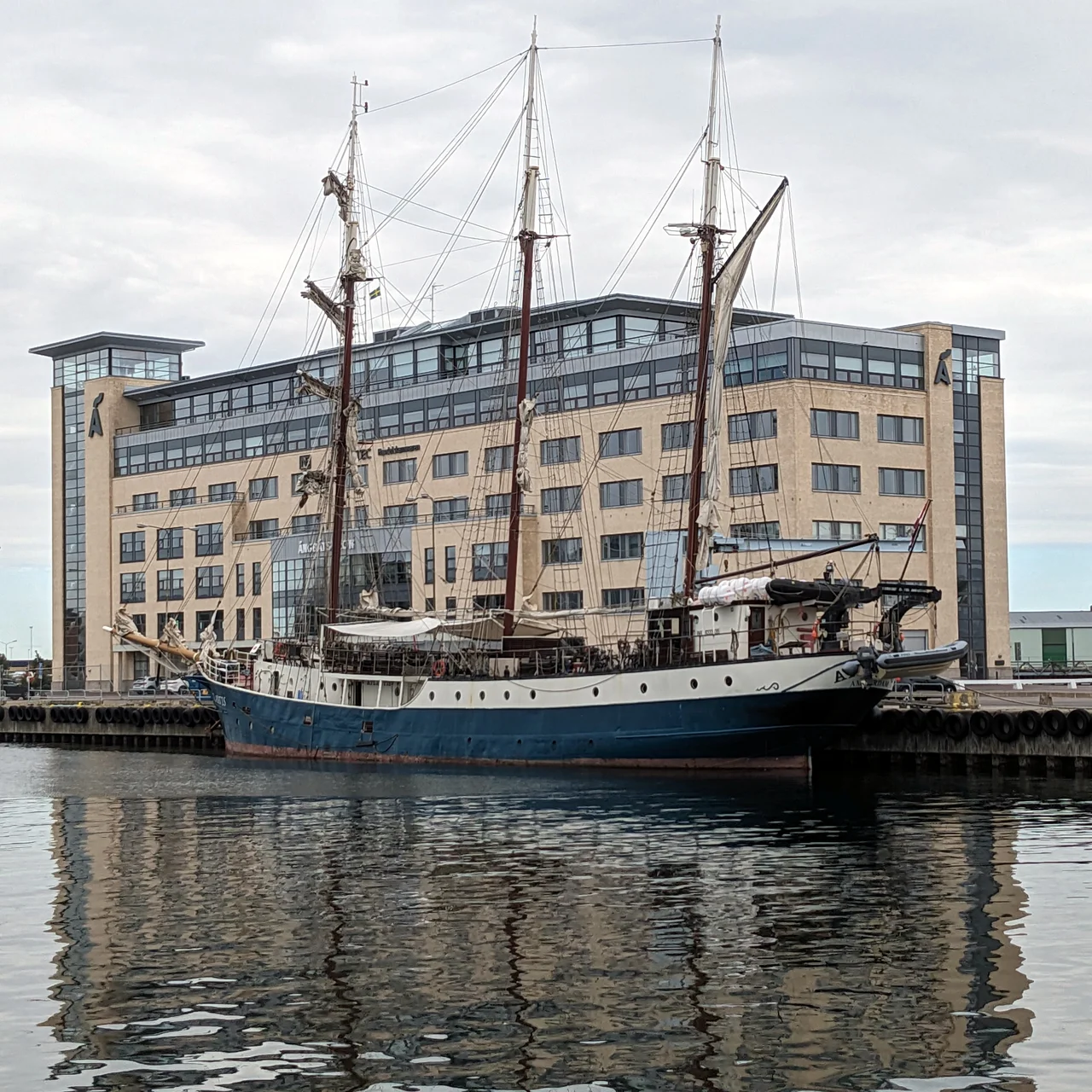

Atlantis (Barquentine)
For most of her life, this ship was anchored. Built in 1905 as the lightship Buergermeister Bartels, she spent decades fixed in place off the mouth of the Elbe, her rotating beacon at sixteen meters carving slow circles through North Sea fog while every other vessel in sight had somewhere to go. She was a landmark, not a traveler. Today, she travels for a living - the three-masted barquentine Atlantis, chartered out to passengers who pay to feel the deck heel beneath them off the Cote d'Azur. The same hull. A completely different life.
Anchored by Design
The shipyard J.H.N. Wichhorst launched her in Hamburg in 1905 with a strange brief: build a ship that does not go anywhere. Lightships were the lighthouses of places no lighthouse could stand - mid-channel sandbanks, river mouths, the soft drowned edges of coast where rock could not be found. Forty-two meters long, seven and a half wide, fitted with a 200-horsepower steam engine for repositioning rather than voyaging, she carried her name in white block letters on her red hull: Buergermeister Bartels, after the Hamburg mayor who served from 1820 to 1850. She took up station at Elbe 3 first, then moved to the Elbe 2 anchorage in 1919. There she stayed, with her beacon turning sixteen meters above the deck, for two full decades.
Wartime Drift
When the Second World War came, even the stationary ships were pressed into motion. The German navy pulled the Buergermeister Bartels off Elbe 2 in 1939 and sent her to the Baltic as a barrier guard ship and outpost security vessel. She survived - many of her contemporaries did not. In 1945, with the war over, she returned to her old anchorage and resumed the quiet duty she had been built for. For another twenty-nine years she rocked at Elbe 2, until 1974 brought a collision and a tow back to Hamburg. The lightship era was ending across Europe; satellites and lighted buoys did the same job for less money. She was decommissioned and laid up. For four years she sat at a Hamburg quay, waiting to be cut up for scrap.
Second Life Under Canvas
In 1979 a Hamburg firm bought her for firefighter training - the kind of practical end that most superannuated vessels meet. But around 1984, someone with a different imagination took her on. The squat lightship hull was stripped down, raised, rerigged. Three masts went up. Square yards crossed the foremast; gaff sails climbed the main and mizzen. The Buergermeister Bartels became Atlantis, a three-masted barquentine fit for paying guests. She started worldwide charter work in 1985 - the Mediterranean in spring, the Baltic in summer, the Caribbean in winter. Renovated again in 1997, taken over by a new owner in 2006, she now operates under the Dutch flag of the Tallship Company in Franeker, slipping through the Balearics and along the Cote d'Azur with passengers on her teak deck.
Memory in the Lines
Look at her now in Kiel or Malmoe and you can still read the lightship beneath the schooner. The hull shape is wrong for a sailing vessel - too short, too beamy, too full at the bow. She was built for stability in storm, not speed in trade. Her masts work, but they sit on a platform that was never meant to fly canvas. That is part of the charm. She is the maritime equivalent of a converted lighthouse keeper's cottage: not what she was made to be, but somehow more interesting for the conversion. Lightship and tall ship are usually opposite vocations. Atlantis is both, in sequence.
From the Air
Atlantis is a moving vessel; her position varies seasonally. The home coordinates reference the Elbe 2 anchorage at 53.99 N, 8.41 E, off the mouth of the Elbe between Cuxhaven and the open North Sea. Cuxhaven sits at the southern edge of the German Bight. Nearest airports: Cuxhaven/Nordholz (ETMN) just inland, with Hamburg (EDDH) the major hub southeast. Cruising altitude of 4,000-6,000 feet gives a clear view across the Elbe estuary, the Wadden Sea mudflats to the south, and the red cliffs of Heligoland twenty-five nautical miles northwest. Atlantis herself may be at sea anywhere from the Baltic to the western Mediterranean depending on the season.
Nearby Stories
- Spiekeroog 3.1 km away
- Hohe Weg Lighthouse 9.8 km away
- SM UC-45 15 km away
- Growian 18 km away
- Friedrichstadt 21 km away
- Amrumbank West 23 km away
- MV Pallas 25 km away
- Stalag X-B 48 km away