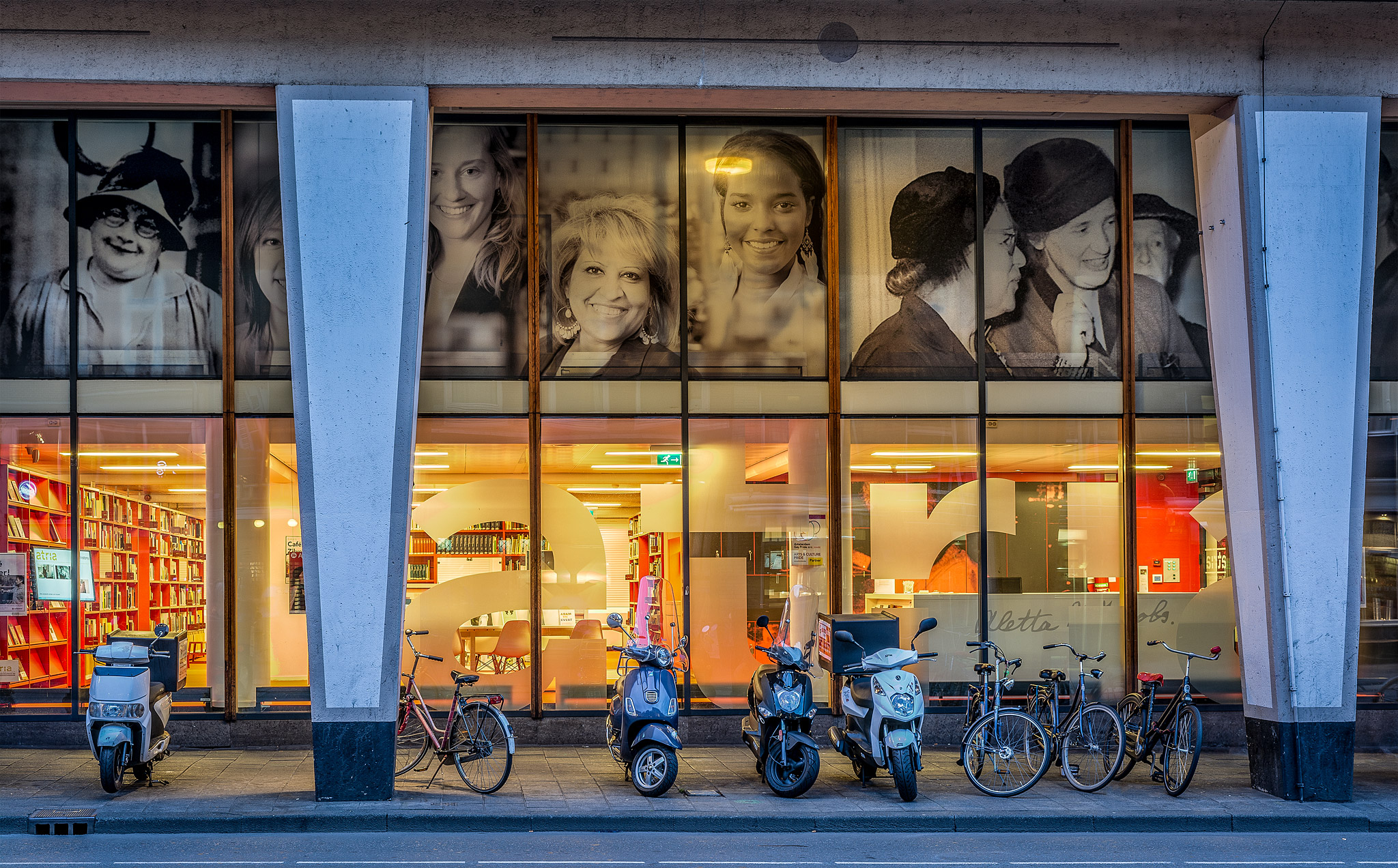
Atria Institute on Gender Equality and Women's History
In 1935, three women rented two rooms at Keizersgracht 264 and began stacking boxes. The papers inside - letters, pamphlets, minutes of meetings, the personal archive of Aletta Jacobs, the first woman in the Netherlands to earn a medical degree - constituted the documentary memory of the Dutch women's movement. Rosa Manus, Johanna Naber, and Willemijn Posthumus-van der Goot understood exactly what they were doing. They were not just collecting paper. They were arguing, against the prevailing instinct of every archive on earth, that ordinary women's lives were worth preserving. Five years later, the Nazis came for the boxes.
Three Women, Two Rooms
The International Archives for the Women's Movement (IAV) was the kind of project that sounds modest until you consider what it was up against. In 1935, no national institution in Europe was systematically preserving women's history. The three founders had lived through the First Wave themselves - Naber was born in 1859, Posthumus-van der Goot in 1897 - and had watched as the materials of their movement got thrown out, lost, or quietly destroyed when their owners died. They negotiated for space at the International Institute of Social History on the Keizersgracht because no one else would give it to them. Two rooms felt like a beginning.
Plundered
When the Germans occupied Amsterdam in 1940, the IAV archive was an obvious target. Nazi ideology classified feminism as degenerate, but the more practical reason was that the SS-affiliated Einsatzstab Reichsleiter Rosenberg looted entire libraries across occupied Europe for ideological research. The boxes were seized and disappeared. Rosa Manus was deported to Ravensbrück and then transferred to the Bernburg euthanasia center, where she was killed in March 1942. Johanna Naber survived the war but died in 1941. Only Posthumus-van der Goot lived to see liberation, and she became president of the IAV almost by default - the only founder left. The library stayed closed until 1947. When it reopened, the archive was essentially a ghost of itself.
A Librarian in Czechoslovakia
What came back came back in fragments, sometimes through extraordinary luck. In 1947, a small number of boxes were returned. Then in 1966 - twenty-one years after the war ended - a librarian named Ivo Krikava in Hradec Kralove noticed an IAV stamp on four books in his stacks. He sent them back to Amsterdam. The largest recovery took the longest. In 1992, researchers discovered that another portion of the looted archive had ended up in Moscow's Osobyi Archive, the secret repository where the Soviets had stored Nazi plunder seized at the end of the war. It took eleven years of negotiations to get the papers home. They arrived in Amsterdam in 2003.
The Star Atria
In 2013, the institute took a new name. Atria is the brightest star in the constellation Triangulum Australe, the Southern Triangle. It is a variable star - its brightness changes over time - and it is in motion. The founders of the renamed institute chose it deliberately. The relationship between men and women, they wrote, is not fixed. It varies. It moves. The symbolism is unusual for a research library - most settle for a logo of an open book - but it suits a place built on the conviction that what counts as worth remembering is itself a political question.
What Is Kept
Today, in a building on the Vijzelstraat, Atria holds more than 100,000 books, 30,000 photographs, 6,000 periodical titles, and 1,500 linear meters of archival material. The oldest book on the shelves is a 1578 Dutch translation of a treatise on the virtues and vices of women. On a wall hangs a quote from the eighteenth-century Dutch writer Belle van Zuylen, taken from a letter to James Boswell: "I lack talent for subservience." The reading room is open to anyone. After 1992, the collection policy was deliberately expanded to include Black, migrant, and refugee women, on the recognition that earlier acquisitions had reproduced the same gaps the founders had set out to close. The work of remembering is never finished.
From the Air
Atria sits at 52.366N, 4.893E on the Vijzelstraat in central Amsterdam, just south of the Rembrandtplein and a short walk from the Keizersgracht where the original IAV began. From the air, the building is one anonymous block among thousands in the Grachtengordel. Nearest airport: Amsterdam Schiphol (EHAM), about 14km southwest. The light over Amsterdam is flat and northern - midmorning is best for picking out the canal rings.