Atsuta Shrine
Somewhere beneath the innermost sanctum of Atsuta Shrine lies a sword that no living person has ever seen. Kusanagi no Tsurugi, the Grass-Cutting Sword, is one of the Three Sacred Treasures of Japan, the imperial regalia whose possession has legitimized rulers for over a thousand years. The shrine that houses it stands not in some remote mountain fastness but in the middle of Nagoya, Japan's fourth-largest city, where nine million pilgrims arrive each year to pray at its gates. Known affectionately as Atsuta-Sama, or simply Miya, this is one of the only shrines in Japan that rivals the prestige of Ise Grand Shrine itself.
A Sword from the Age of Myth
The story of how Kusanagi came to rest in Nagoya reaches back into Japanese mythology. According to the Nihonshoki, the legendary prince Yamato Takeru carried the divine sword on his campaigns. When he died, his widow gathered his possessions and venerated them at a shrine in her home. The sacred sword eventually migrated to its current resting place, an event that shrine tradition dates to the reign of Emperor Chuai, sometime in the second century CE. The Owari clan established the shrine in 192 and held the hereditary position of high priest for nearly a thousand years, until 1114, when the role passed to the powerful Fujiwara clan. Five deities are enshrined alongside the sword, all connected to its mythology: Amaterasu, the sun goddess; Susanoo, her storm-god brother; Yamato Takeru himself; his wife Miyazu-hime; and her father, Take Inadane.
Battleground of Rival Emperors
Because the sword symbolized imperial legitimacy, Atsuta Shrine became a political flashpoint during the Northern and Southern Courts Period of the fourteenth century. When Emperor Go-Daigo was ousted by the Ashikaga, the shrine's attendant Atsuta Masayoshi fled with the deposed emperor to Mount Hiei in 1336 and later commanded troops on his behalf. The rival claimant, Ashikaga Takauji, appointed his own shrine attendant and made a point of praying at Atsuta while advancing on the capital, deliberately echoing Minamoto no Yoritomo, who had done the same before founding the Kamakura shogunate. In 1338, the Southern Court general Kitabatake Akiie marched a large army south and also prayed at the shrine, but he was killed in battle shortly after, and the Ashikaga cemented their control over Atsuta for good. Even the sword itself was once stolen during the reign of Emperor Tenji, remaining missing until it was recovered under Emperor Tenmu.
Warlords and Wooden Gates
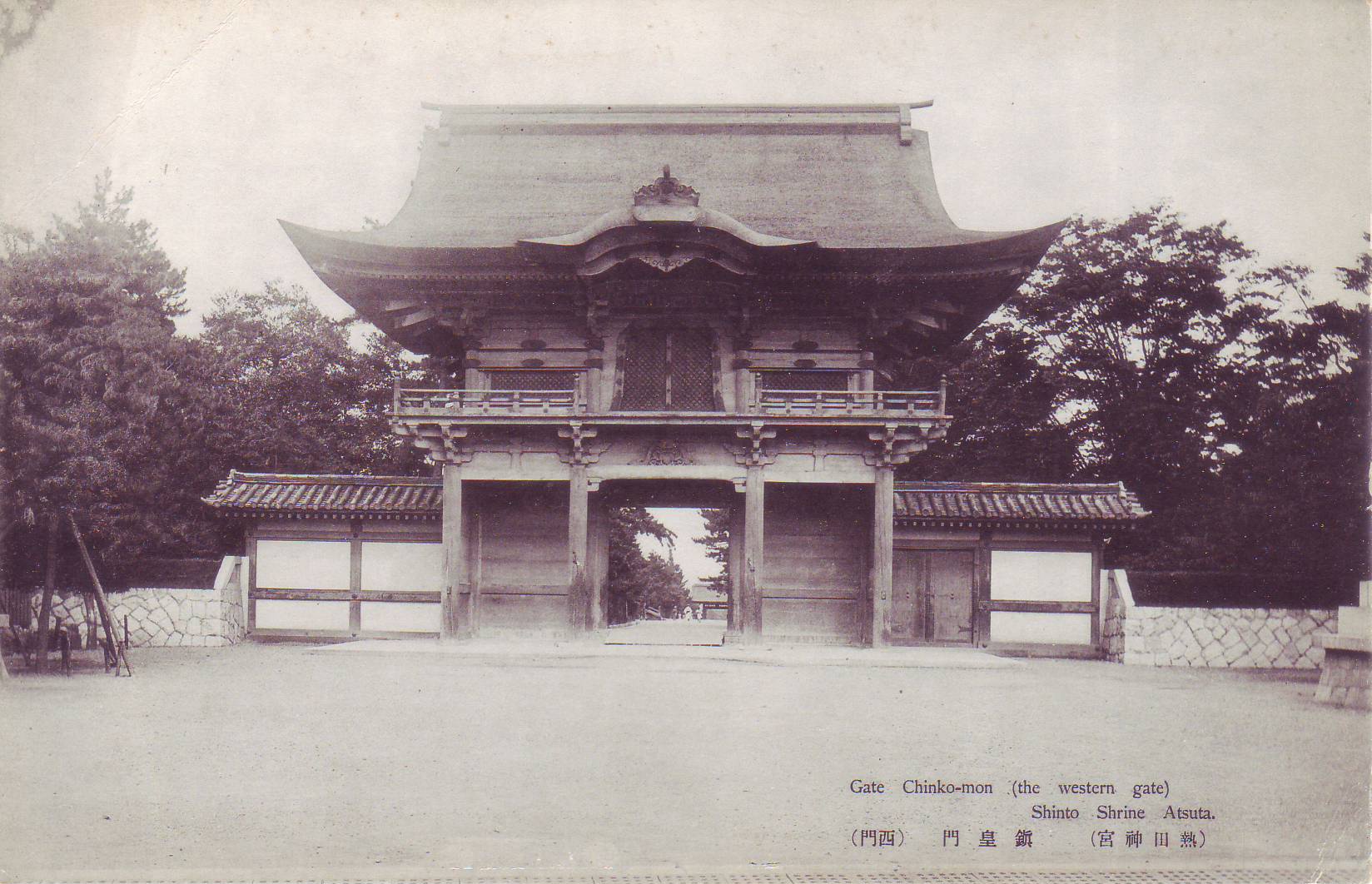
Japan's greatest warlords left their mark on the shrine's architecture. Oda Nobunaga donated the Nobunaga-Bei, a 7.4-meter-high roofed mud wall, in 1560 as thanks for his stunning upset victory at the Battle of Okehazama. Alongside it stood the Kaijo-mon, a wooden Sea Gate that was designated a National Treasure. The warrior-lord Kato Kiyomasa dedicated the western gate, Chinko-mon, used for imperial processions, and the eastern gate Shunko-mon was linked to the legend of Yang Guifei, the Chinese imperial consort who supposedly found refuge at the shrine. The Tokugawa shoguns also contributed to the complex. But the firebombing of Nagoya during the Pacific War destroyed many of these treasures: the Kaijo-mon was lost on May 17, 1945, and the Chinko-mon on July 29 of that same year. In 1893, the shrine had already been remodeled in the Shinmeizukuri style matching Ise Shrine, and a major rearrangement in 1935 further updated the complex. Today, a simple wooden torii marks where the great gates once stood.
A Calendar of Living Ritual
Over seventy ceremonies and festivals fill the shrine's calendar each year. On January 5, the Hatsu-Ebisu festival brings crowds seeking good fortune from Ebisu, the kami of prosperity. Two days later, priests perform the Yodameshi Shinji, a rainfall divination ritual in which water levels in a pot kept beneath the floor of the Eastern Treasure House are measured to predict the coming year's rain. During the Meiji and Taisho eras, this ceremony was carried out in sober silence, the mikoshi portable shrine processed and returned within just twenty minutes. The Rei Sai grand festival on June 5 fills the shrine approaches with portable tabernacles carried by chanting bearers, and at nightfall, 365 lanterns called makiwara blaze at the gates. Shogun Ashikaga Yoshimasa himself provided a new mikoshi and full set of ceremonial robes for this festival during shrine repairs in 1457.
The Hidden Treasure of Nagoya
The shrine grounds once extended far beyond their current boundaries, with vast rice fields stretching to the northeast that were eventually swallowed by the Sanbonmatsu-cho and Mutsuno neighborhoods. The Jingu Higashi Park, established in the 1980s, represents a partial restoration of green space to the site. The shrine's Bunkaden treasure hall safeguards 174 items designated as important cultural assets by Aichi Prefecture, from ancient Bugaku dance masks to historical documents. But the sword remains unseen, locked away in layers of ritual secrecy that have held for centuries. No photographs exist. No emperor has unwrapped it in living memory. Kusanagi endures as perhaps the most powerful invisible object in Japan, a blade whose authority rests entirely on faith.
From the Air
Atsuta Shrine sits at 35.1275N, 136.9083E in central Nagoya, Japan. From the air, look for a dense grove of ancient trees amid Nagoya's urban grid in Atsuta-ku ward, south of the city center near Ise Bay. The shrine complex is identifiable by its distinctive forested enclosure contrasting with surrounding development. Nearest major airport is Chubu Centrair International Airport (RJNA/NGO) approximately 30 km to the south across Ise Bay. Nagoya Airfield (RJNA/NKM), also known as Komaki Airport, lies about 15 km to the north. Recommended viewing altitude: 3,000-5,000 feet for the urban-forest contrast.