Attack on Broome
On the morning of 3 March 1942, the tiny pearling town of Broome in Western Australia held an unlikely concentration of aircraft. Flying boats bobbed at anchor in Roebuck Bay. Bombers and transports sat on the airfield. Over the previous two weeks, more than a thousand people -- mostly military personnel but also some 250 Dutch civilian refugees, many of them women and children fleeing the Japanese invasion of Java -- had passed through this remote refueling stop between the Netherlands East Indies and the Australian mainland. Then, just after 9:20 AM, nine Mitsubishi A6M2 Zeros appeared from the direction of Timor.
Sixty Minutes Over Roebuck Bay
Lieutenant Zenjiro Miyano, commander of the Imperial Japanese Navy's 3rd Air Group, led the attack from the Japanese base at Kupang, Timor. His nine Zeros, accompanied by a Mitsubishi C5M2 reconnaissance plane, carried only their guns -- no bombs were dropped, though witnesses reported explosions that were likely the pilots releasing their external drop tanks. For roughly an hour, the fighters strafed the flying boat anchorage at Roebuck Bay and the Royal Australian Air Force base at Broome Airfield. There were no Allied fighter planes in Broome to oppose them. The Japanese destroyed at least 22 aircraft in the attack: fifteen flying boats at anchor, two B-17E Flying Fortresses, a B-24 Liberator, two Lockheed Hudsons, and a Lockheed Lodestar. Among the flying boats lost were eight PBY Catalinas, two Short Empires, and five Dornier Do 24s belonging to the Royal Netherlands Navy.
The Human Cost
The aircraft were not empty. Many of the flying boats at anchor still held Dutch refugees who had not yet disembarked. The exact number killed aboard them remains unknown to this day, though the names and ages of some were recorded when their remains were relocated from Broome to the Perth War Cemetery at Karrakatta in 1950. Among the identified casualties were nine children, the youngest just one year old. In the air, a USAAF B-24A Liberator called the Arabian Knight, carrying wounded personnel, was shot down and crashed into the sea about 16 kilometres offshore. Nineteen of the twenty Americans aboard died. A KLM Douglas DC-3 airliner carrying refugees from Bandung was pursued by three Zeros 80 kilometres north of Broome. Its pilot managed to crash-land on a beach, but the fighters strafed the downed aircraft, killing four people. A package of diamonds worth between 150,000 and 300,000 pounds -- the equivalent of roughly 20 to 40 million Australian dollars today -- was lost in the wreckage.
Defiance with a Borrowed Gun
With no fighter aircraft and minimal ground defenses, individuals improvised their own resistance. Dutch ML-KNIL pilot First Lieutenant Gus Winckel removed a 7.9-millimetre machine gun from his Lockheed Lodestar, balanced it on his shoulder, and opened fire on the attacking Zeros. He burned his left forearm on the barrel but kept shooting. For years, Winckel was credited with downing Warrant Officer Osamu Kudo's Zero -- the only Japanese aircraft lost over Broome that day. Research published in 2010 revised the account, finding that Kudo's plane was actually hit by tail guns from the B-24A Arabian Knight, in a grim exchange: Kudo's attack brought down the Liberator, and the Liberator's gunners brought down Kudo. A second Zero ran out of fuel on the return flight to Timor and ditched in the sea, though its pilot survived. Sergeant Melvin Donoho, one of the crew aboard the downed B-24, swam approximately 16 kilometres to shore -- a journey that took him more than 36 hours.
What the Tide Reveals
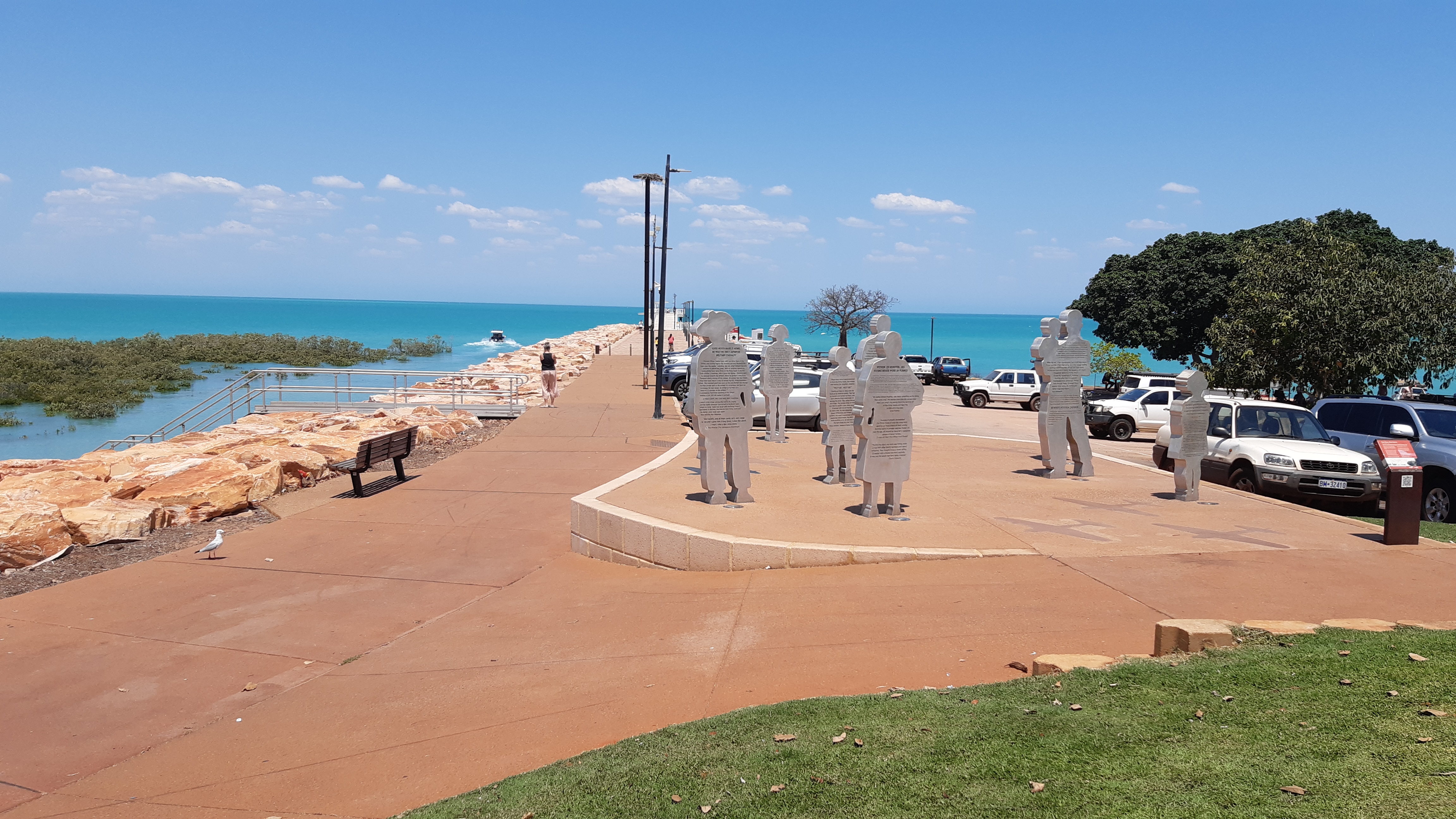
The Japanese returned to bomb Broome's airfield on 20 March 1942, killing one civilian, and made smaller attacks through August 1943. But it was the single hour on 3 March that left the deepest scar. At least 88 people died -- the deadliest attack on Australian soil after the bombing of Darwin two weeks earlier. On Anzac Day 2000, the Allied War Memorial was dedicated at Town Beach in Broome, acknowledging the British, American, and Dutch military personnel and civilians who perished. The wrecks of the flying boats still appear in Roebuck Bay at very low tides, skeletal fragments of fuselage emerging from the mud. They are legally protected as war graves under state law, though part of a Catalina's fuselage was believed stolen by November 2020. All the flying boats attacked in the water caught fire and burned to the waterline, so what remains is fragmentary -- ribs of metal in the mud, marking the spot where people who thought they had escaped the war discovered it had followed them.
From the Air
Located at approximately 17.98S, 122.22E over Roebuck Bay and Broome Airfield. Broome International Airport (YBRM) occupies the site of the original RAAF airfield that was attacked. The flying boat anchorage was in Roebuck Bay, directly east of the town center at Town Beach. At very low tides, wreckage of the flying boats is still visible in the bay. The Allied War Memorial stands at Town Beach. From the air, the bay's shallow turquoise waters contrast with the red pindan cliffs, and the layout of the attack -- airfield to the southeast, flying boat anchorage in the bay -- is clearly readable.