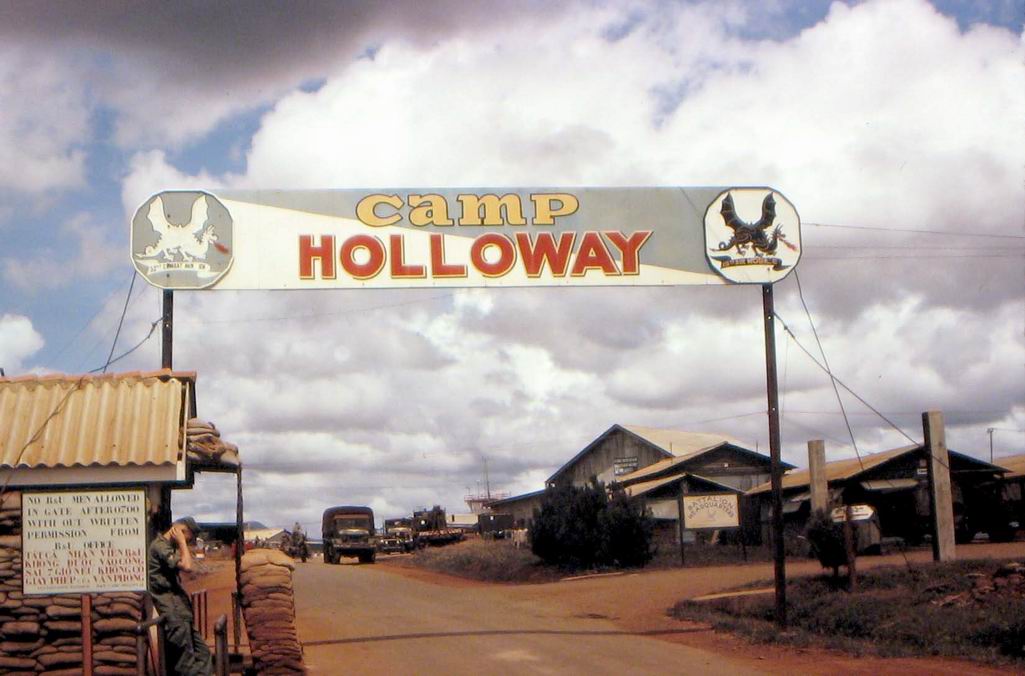
Attack on Camp Holloway
A local Viet Cong commander made a decision on the night of February 6, 1965, that would reshape the trajectory of a war and the foreign policies of three world powers. The target was Camp Holloway, a modest helicopter facility four kilometers east of Pleiku in Vietnam's Central Highlands, named for Chief Warrant Officer Charles E. Holloway, killed in action in December 1962 during a helicopter assault in Phu Yen Province. The attack itself lasted minutes. Its consequences would last decades.
A Convergence of Shadows
The geopolitical stage was already set before a single shot was fired. In Hanoi, Soviet Premier Alexei Kosygin had arrived on February 6 with a team of missile experts, seeking to rebuild ties that had frayed under Khrushchev's disengagement from Vietnam. In Saigon, National Security Adviser McGeorge Bundy was assessing the political chaos consuming South Vietnam's government. And in the White House, President Lyndon Johnson, freshly reelected, was weighing how far to commit American military power in Southeast Asia. The Gulf of Tonkin Resolution had given him the legal authority to act since August 1964, but Johnson had hesitated through his campaign, unwilling to appear as a wartime president to American voters. Now, with his presidency secured, the calculus had changed. Into this web of deliberation stepped the Viet Cong 409th Battalion, operating under orders for a spring offensive but acting, as it would later emerge, without direct authorization from Hanoi.
Through the Wire
Camp Holloway was home to roughly 400 soldiers of the U.S. Army's 52nd Combat Aviation Battalion, commanded by Lieutenant Colonel John C. Hughes. The base supported helicopter operations across the I Corps and II Corps tactical zones, and its advisory compound was ringed by layers of concertina wire standing ten meters high. Commander Nguyen Thanh Tam of the 409th Battalion sent his 30th Company to breach those defenses. Around 11 p.m. on February 6, some 300 Viet Cong soldiers began cutting through the wire barriers in darkness. Their combat engineers tripped an electrical wire after the third fence, but the American military police on patrol failed to detect it. At 1:50 a.m. on February 7, the attackers opened fire with AK-47s, having penetrated the perimeter. They struck the airfield and the advisory compound simultaneously, placing explosive charges against the barracks wall. A U.S. sentry's fire prevented them from breaching the barracks entrance. Among those on base that night was editorial cartoonist Bill Mauldin, visiting his son, who escaped injury.
The Decision That Followed
Bundy called Johnson from Vietnam that morning. Within hours, the president convened the National Security Council, pulling in the Speaker of the House and the Senate majority leader. The recommendation was unanimous: retaliation. Johnson ordered Operation Flaming Dart, sending approximately 49 American and South Vietnamese aircraft against military targets in North Vietnam in the initial strike, with follow-up raids bringing the total to roughly 148 sorties, striking sites at Đồng Hới and Chanh Hoa just north of the 17th parallel. In Pleiku, South Vietnamese General Nguyen Khanh reportedly opened a bottle of champagne when Westmoreland and Bundy informed him of the strikes. But the escalation cut both ways. With Kosygin still in Hanoi during the bombing, the Soviet government reversed Khrushchev's policy of disengagement and committed to substantial military aid for North Vietnam. By April 1965, Communist Party General Secretary Le Duan traveled to Moscow and signed a missile agreement that would equip North Vietnam to resist Operation Rolling Thunder, the sustained American bombing campaign that followed.
The Irony of Spontaneity
Three decades later, in 1997, senior American and Vietnamese officials met and the truth of that February night came into sharper focus. Dang Vu Hiep, a Vietnamese official, acknowledged that the Camp Holloway attack was a spontaneous decision by the local commander. Hanoi had not ordered it and was unaware that American State Department officials were even in Saigon. Kosygin, Hiep noted, "was not pleased, but he couldn't say anything." Robert McNamara, who as Secretary of Defense had helped set the escalation in motion, reflected on what might have been. Had Washington understood the attack was a local initiative rather than a coordinated provocation from Hanoi, he said, "I think we'd have put less weight on it and put less interpretation on it as indicative of North Vietnam's aggressiveness." A single battalion commander's decision in the Central Highlands, disconnected from the deliberations of presidents and premiers, had provided the spark that turned a simmering conflict into a full-scale war.
The Highlands Remember
Today the site of Camp Holloway sits in Gia Lai Province, part of the landscape that witnessed some of the Vietnam War's earliest and most consequential engagements. The Central Highlands, where Pleiku overlooks rolling terrain of red earth and dense vegetation, would become a crucible of the conflict. Within months of the Camp Holloway attack, the Battle of Ia Drang unfolded just to the southwest, establishing the patterns of air mobility and close-quarters combat that defined the American war. The helicopter base that Charles Holloway died to support, and that bore his name for barely three years before the attack that made it famous, was one small installation in a vast landscape. But history does not always pivot on grand strategy. Sometimes it turns on a wire tripped in darkness, a sentry's rifle, and the chain of reactions that no one in Washington, Hanoi, or Moscow fully controlled.
From the Air
Located at 13.98°N, 108.00°E, approximately 4 km east of Pleiku in Vietnam's Central Highlands. The terrain is rolling plateau at roughly 800 meters elevation. Nearest significant airport is Pleiku Airport (VVPK). The Ia Drang Valley lies to the southwest. Visibility is typically good in the dry season (November-April), though the highlands can produce afternoon cloud buildup.