Attack on Reginald Denny
Reginald Denny was driving 27 tons of sand through South Los Angeles on the evening of April 29, 1992, when the verdicts in the Rodney King trial were announced and the city began to burn. He had no radio in his cab. He did not know what was happening around him when he reached the intersection of Florence and Normandie Avenues at 5:39 p.m. He did not know that the intersection had become the flashpoint of what would become the deadliest urban uprising in American history. The helicopter that filmed what happened next was already overhead.
The Intersection
The acquittal of the four Los Angeles police officers charged with beating Rodney King — an event captured on video and broadcast nationally — produced immediate rage in neighborhoods that had accumulated decades of grievances against the LAPD. Florence and Normandie, in the South Central neighborhood, became a site of confrontation within minutes of the verdicts. Police who had been stationed nearby withdrew. What followed was filmed in real time by freelance journalist Zoey Tur and photographer Marika Gerrard, circling overhead in a helicopter: rocks, bottles, and debris thrown at passing vehicles; drivers dragged from their cars. When Reginald Denny's 18-wheeler pulled through, his cab door was opened from outside.
The Assault
Damian Williams threw a cinder block at Denny's head from a distance of a few feet. The blow fractured Denny's skull in 91 places. He was kicked, beaten, and left in the intersection as rioters around him continued attacking other motorists. The helicopter footage, broadcast live on television stations across Los Angeles, showed the attack in real time. Four Black residents — Bobby Green Jr., Lei Yuille, Titus Murphy, and Terri Barnett — saw the broadcast from their homes, recognized the intersection as being near them, and drove to the scene. They pulled Denny from the street, put him in his truck, and drove him to Daniel Freeman Memorial Hospital. The doctors who treated him said he would not have survived without the intervention.
The Trial and Its Outcome
Damian Williams was charged with attempted murder, along with other offenses related to attacks on several victims at the intersection. The trial — and its outcome — added another layer to Los Angeles's tangled relationship with justice and race. Williams was acquitted of the most serious charges. He was convicted of simple mayhem and a misdemeanor assault charge, serving about four years before his release. Reginald Denny, who had suffered brain damage and required reconstructive surgery on his skull, appeared at the sentencing and hugged Williams's mother. He expressed sympathy for her. Williams told reporters he had nothing against Denny personally.
27,000 Get-Well Cards
Denny received more than 27,000 get-well cards during his recovery — letters from strangers across the country who had seen the footage and felt compelled to respond. The attack had become one of the defining images of the riots, partly because it had been broadcast live and partly because of the clarity of what was visible in the footage: a man in the wrong place at the wrong moment, and four strangers who chose to intervene at risk to themselves. The riots overall killed 63 people, injured more than 2,000, and caused over $1 billion in property damage across Los Angeles.
Florence and Normandie Today
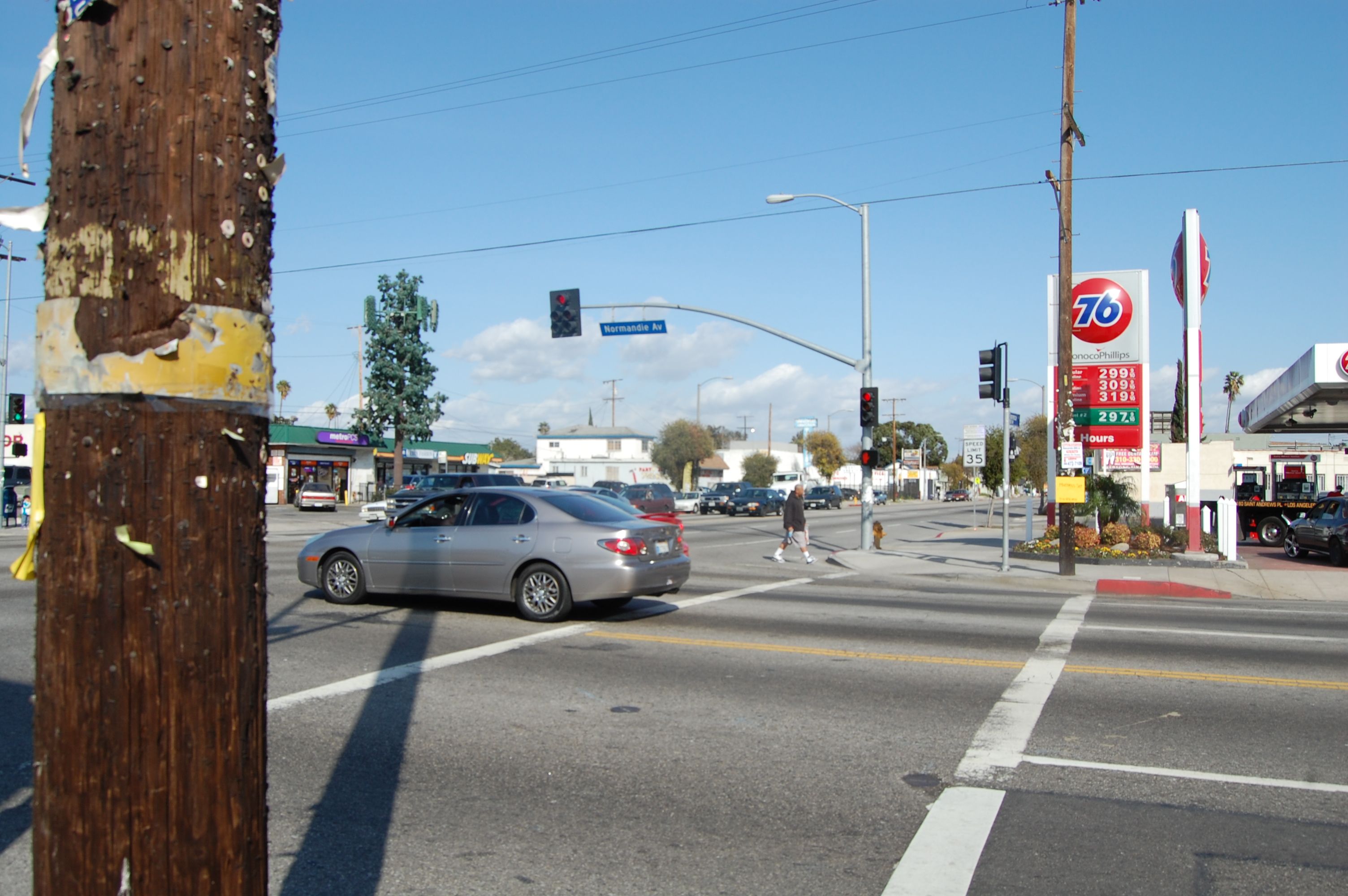
The intersection of Florence and Normandie remains a working-class neighborhood corner in South Los Angeles, unremarkable in its physical appearance. There is no historical marker. The commercial buildings around the intersection have changed hands multiple times in the decades since 1992. The neighborhood, like much of South Los Angeles, has seen demographic shifts as Latino immigration reshaped communities that were predominantly Black in 1992. What happened at this corner is known to anyone who was alive and watching television in Los Angeles on April 29, 1992, and to most people who studied that era afterward. The intersection itself offers no reminder.
From the Air
Florence and Normandie is located at approximately 33.9746°N, 118.3000°W in South Los Angeles. The intersection sits within the dense residential and commercial grid of South Central, about 7 miles south of downtown Los Angeles. From the air at low altitude, the flat urban grid of South LA stretches in all directions; the intersection is not visually distinctive. Nearest airports: Hawthorne (KHHR) 5 miles southwest, Los Angeles International (KLAX) 7 miles west, Compton/Woodley (KCPM) 3 miles south.