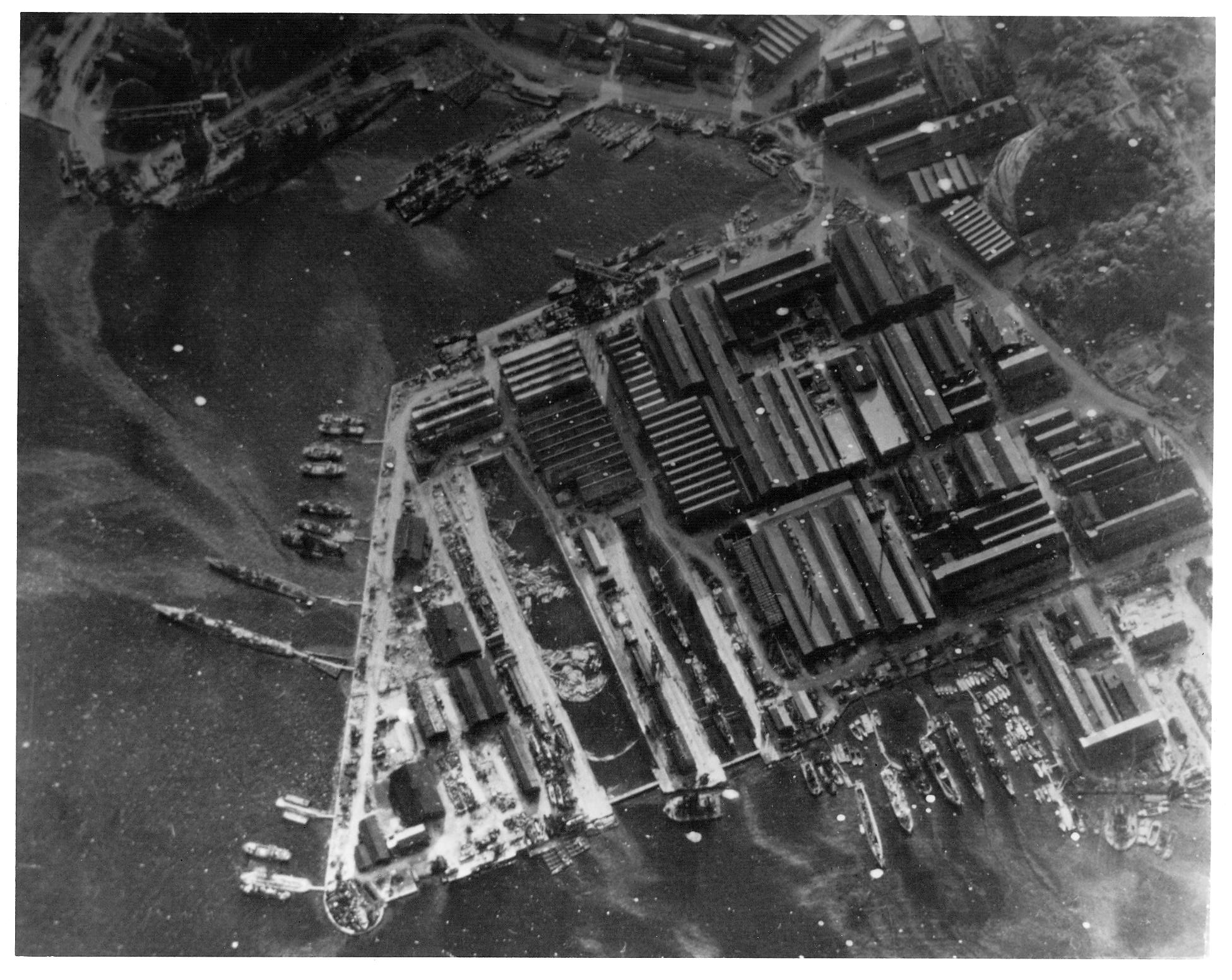
Attack on Yokosuka
A 500-pound bomb punched through the bridge of the battleship Nagato at 3:30 in the afternoon, killing Rear Admiral Otsuka Miki and his executive officer instantly. It was July 18, 1945, and nearly a thousand American aircraft were swarming over Tokyo Bay. The once-mighty flagship of the Imperial Japanese Navy sat camouflaged at a pier in Yokosuka Naval Arsenal, her boilers cold, half her anti-aircraft guns stripped and mounted on the surrounding hills. She could not run, could barely fight back. The war that Japan had started with Nagato's guns -- she had served as Admiral Yamamoto's flagship when the order was given to attack Pearl Harbor -- was now coming home to her doorstep.
Halsey's Summer of Fire
By July 1945, Admiral William Halsey's Third Fleet had turned the waters off Japan into a shooting gallery. Task Force 38, commanded by Vice Admiral John S. McCain Sr., carried nine fleet carriers, six light carriers, and almost a thousand aircraft. On July 10, those planes struck airfields around Tokyo and claimed 340 Japanese aircraft destroyed on the ground. Not a single Japanese fighter rose to meet them -- the Imperial Japanese Navy was hoarding its remaining planes for kamikaze attacks against the expected Allied invasion. Raids on Hokkaido and northern Honshu followed on July 14 and 15, sinking dozens of ships and destroying 25 more aircraft. On July 16, the British Pacific Fleet's Task Force 37 joined the Americans, adding three carriers to the armada. The combined Allied fleet then turned its attention south, toward Tokyo Bay and the naval base at Yokosuka.
A Battleship in Hiding
Nagato was once the pride of the Japanese fleet -- the world's first battleship armed with 16-inch guns when she was commissioned in 1920. By mid-1945, she was a hollow shell. Fuel shortages kept her tied to the pier at Yokosuka, facing northwest, draped in camouflage netting to confuse aerial spotters. Her secondary armament had been completely removed and repositioned on the hills overlooking the harbor. She drew steam and electrical power not from her own engines but from a submarine chaser lashed alongside and an auxiliary boiler on the dock. The destroyer Hanazuki stood nearby, contributing her 25mm anti-aircraft guns to the battleship's defense. Third Fleet planners studied the harbor's defenses and concluded that any torpedo run requiring straight, level flight would cost too many aircraft. They chose dive bombing instead.
Three-Thirty in the Afternoon
Weather delayed the attack by a day. On July 18, conditions finally cleared enough for flight operations, and at 11:30 that morning, aircraft began launching. British planes from Task Force 37 headed for airfields around Tokyo, though their effort was diminished when fuel contamination aboard one carrier limited its contribution to just six Corsair fighters. The main American strike force vectored toward Yokosuka, with Nagato as the primary target. The attack began around 3:30 p.m. Dive bombers screamed down through anti-aircraft fire that the Japanese defenders had been rehearsing for days. The bomb that struck Nagato's bridge was devastating in its precision, decapitating the ship's command in a single blow. Across the harbor, American aircraft sank a destroyer, a submarine, and two escort vessels, and damaged five smaller ships. Allied pilots reported destroying 43 Japanese aircraft and damaging another 77. Japanese gunners shot down twelve American and two British aircraft in return.
The Ruse and the Bomb
Nagato's surviving crew pulled casualties from the wreckage and patched what they could. Then they did something clever: they flooded some of the ship's ballast tanks, settling her lower in the water to create the impression she had been sunk. The deception apparently worked. On August 2, Nagato received orders to sortie and intercept a reported Allied force, but the operation was canceled when the sighting proved false -- a phantom fleet that existed only in a jittery radar operator's imagination. Two weeks later, Japan surrendered. On August 30, the U.S. Navy took possession of Nagato. Her final chapter would be written not in Tokyo Bay but at Bikini Atoll, where she was used as a target in the Operation Crossroads nuclear tests of July 1946. She survived the first aerial detonation on July 1 but sank during the night of July 29-30, five days after the underwater Baker shot. The battleship that had survived carrier strikes and dive bombings could not survive the atom.
From the Air
Located at 35.29N, 139.67E at the site of Yokosuka Naval Arsenal on the western shore of Tokyo Bay. The naval base remains active today as JMSDF Yokosuka and United States Fleet Activities Yokosuka. From the air, the base is identifiable by the large drydocks and piers along the waterfront. Nearby airports include Tokyo Haneda (RJTT) approximately 25nm north and Naval Air Facility Atsugi (RJTA) approximately 15nm west. Yokosuka sits at the neck of the Miura Peninsula where Tokyo Bay narrows before opening to Sagami Bay. The Uraga Channel, the main shipping lane into Tokyo Bay, passes just east of the arsenal.