Attempted Assassination of Ronald Reagan
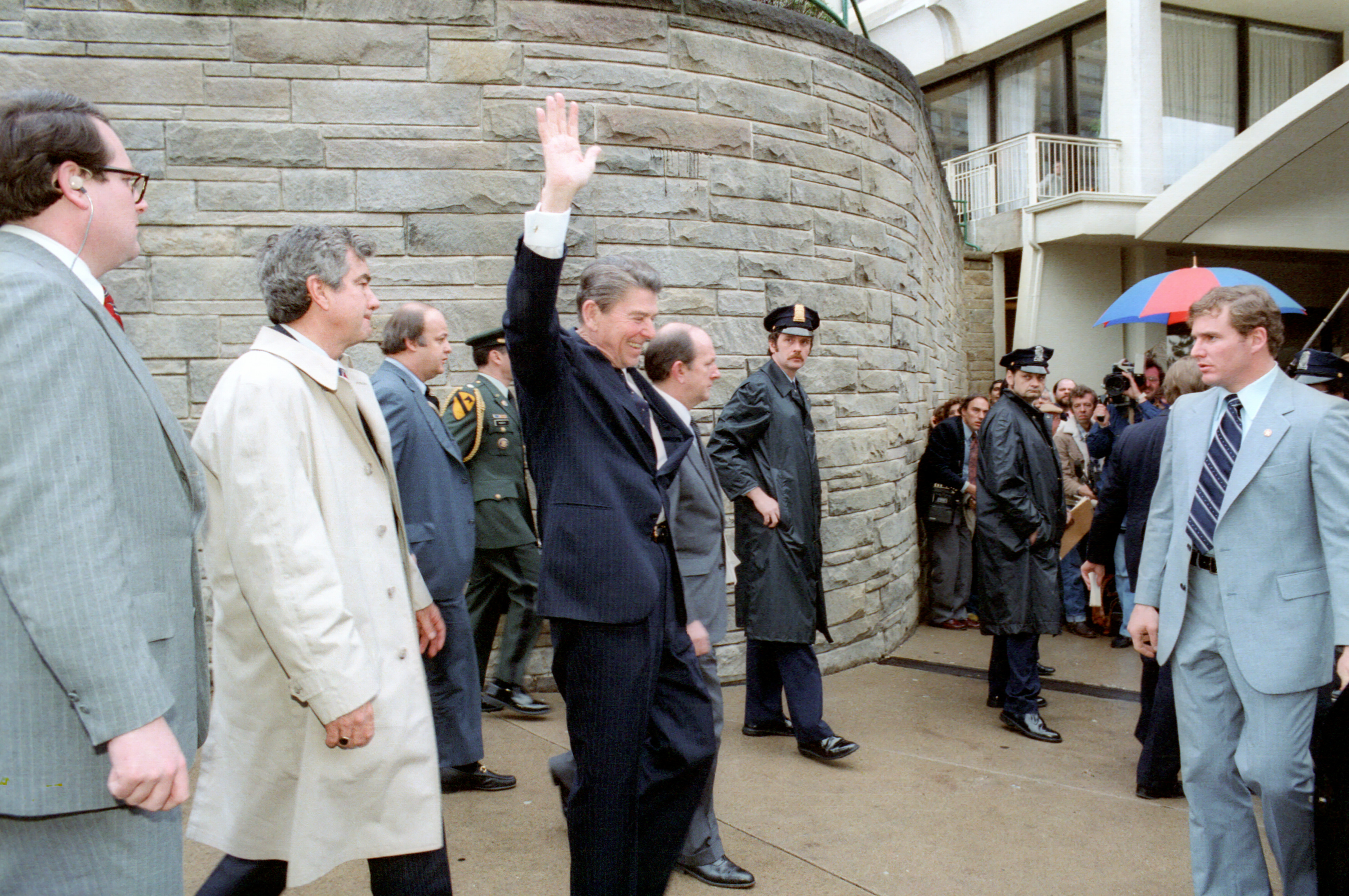
The Washington Hilton was supposed to be the safest venue in the capital. After the assassination of John F. Kennedy in 1963, the hotel had built a secure enclosed passageway called "President's Walk" so that commanders-in-chief could enter and exit without public exposure. The Secret Service had inspected the hotel more than 100 times for presidential visits. On March 30, 1981, the only vulnerability was a 30-foot stretch of sidewalk between the hotel exit and the presidential limousine. Ronald Reagan was not wearing a bulletproof vest -- the Secret Service did not think one was necessary for those few seconds in the open. At 2:27 p.m., as reporters shouted questions and several hundred people applauded, John Hinckley Jr. assumed a crouch and fired a Rohm RG-14 .22 caliber revolver six times in 1.7 seconds.
A Movie-Born Obsession
Hinckley's motivation had nothing to do with politics, ideology, or policy. He had watched the film Taxi Driver at least 15 times while living in Hollywood in the late 1970s, developing an obsessive identification with its protagonist, Travis Bickle, who attempts to assassinate a presidential candidate. More critically, Hinckley became erotomanically fixated on Jodie Foster, who played a child prostitute in the film. When he read in People magazine that Foster was a student at Yale, he enrolled in a writing course there in 1980. He wrote her dozens of letters and called her twice. She was not interested. His parents placed him under psychiatric care. Two hours before he shot the president, Hinckley wrote Foster a letter he never mailed, explaining that he hoped to impress her with the magnitude of his action and that he would "abandon the idea of getting Reagan in a second if I could only win your heart and live out the rest of my life with you." He had loaded his revolver with Devastator brand cartridges -- bullets containing small explosive charges of aluminum and lead azide designed to detonate on impact.
1.7 Seconds of Chaos
The first shot struck White House press secretary James Brady above his left eye, the explosive bullet detonating on impact and shattering his brain cavity. The second hit D.C. police officer Thomas Delahanty in the back of the neck, ricocheting off his spine. A Cleveland labor official named Alfred Antenucci, standing nearby, saw Hinckley fire and immediately struck him on the head, wrestling him from behind. Secret Service agent Jerry Parr grabbed Reagan by the shoulders and dove with him toward the open rear door of the limousine. The third shot overshot both men and hit a building across the street. Agent Tim McCarthy then pivoted toward the gunfire and deliberately spread his arms and legs wide, making himself a human shield. The fourth bullet hit McCarthy in the lower chest, traversing his right lung, diaphragm, and liver. The fifth struck the armored glass of the limousine. The sixth ricocheted off the limousine's side panel and hit Reagan under his left arm, breaking a rib, puncturing a lung, and stopping just inches from his heart. No one -- not even Reagan himself -- knew the president had been shot.
"Rawhide Is OK" -- Except He Wasn't
Inside the limousine, code-named "Stagecoach," Agent Parr searched Reagan's body and found no blood. He radioed that "Rawhide is OK" and directed the motorcade toward the White House. Then Reagan coughed up bright, frothy blood. Parr instantly diverted to George Washington University Hospital, arriving less than four minutes after leaving the hotel. Reagan insisted on walking into the emergency department unassisted, smiling at onlookers. Once inside, his knees buckled and he collapsed. His systolic blood pressure had dropped to 60 -- less than half of normal -- indicating severe internal hemorrhaging. The medical team cut through his custom-made suit to examine him. While intubated, Reagan scribbled a note to a nurse: "All in all, I'd rather be in Philadelphia" -- borrowing a line from W.C. Fields. The chief of thoracic surgery, Benjamin L. Aaron, performed a 105-minute thoracotomy. Reagan ultimately lost over half his blood volume. Most 70-year-olds in his condition would not have survived, but Reagan was in exceptional physical health and had been hit by a small .22 caliber round rather than the larger .38 initially feared.
"I Am in Control Here"
While Reagan was in surgery, the White House descended into confusion. Within five minutes of the shooting, Cabinet members gathered in the Situation Room, unsure whether the attack was part of a larger terrorist operation or a foreign intelligence strike -- tensions with the Soviet Union were high over the Solidarity movement in Poland. Secretary of Defense Caspar Weinberger ordered the Strategic Air Command placed on alert after discovering a Soviet submarine patrolling unusually close to the American coast. The Gold Codes card -- needed to authorize a nuclear launch -- was in Reagan's wallet, which the FBI had confiscated as evidence and would not return for two days. When CBS reporter Lesley Stahl asked deputy press secretary Larry Speakes who was running the government, Speakes answered: "I cannot answer that question at this time." Secretary of State Alexander Haig rushed to the briefing room and declared: "I am in control here." He was constitutionally wrong -- he was fourth in the line of succession, behind Vice President George H.W. Bush, Speaker Tip O'Neill, and Senate President pro tempore Strom Thurmond. Those in the Situation Room reportedly laughed. Bush, returning from Texas aboard Air Force Two, refused to land on the White House South Lawn: "Only the president lands on the South Lawn," he said.
The Wounds That Kept Changing America
Reagan returned to the Oval Office on April 25, 1981, and received a standing ovation from his staff. His physician, Daniel Ruge, believed full recovery did not come until October. Privately, Reagan came to believe God had spared him for a greater purpose. Nancy Reagan, terrified by what had happened, began consulting astrologer Joan Quigley about her husband's schedule. Reagan never again walked across an airport tarmac or stepped out of his limousine onto a public sidewalk as president. James Brady survived but suffered permanent brain damage that left him in a wheelchair with slurred speech. He and his wife Sarah became the country's most prominent gun control advocates. The Brady Handgun Violence Prevention Act, requiring background checks for firearm purchases, passed in 1993. Brady died in 2014, and the D.C. medical examiner ruled his death a homicide -- caused by wounds sustained 33 years earlier. Hinckley was found not guilty by reason of insanity, a verdict that so dismayed the public that Congress and multiple states rewrote their insanity defense laws. He was released from St. Elizabeths Hospital in 2016. The Washington Hilton, where it all began, still stands on Connecticut Avenue. Washingtonians call it the "Hinckley Hilton."
From the Air
Located at 38.92N, 77.05W in northwest Washington, D.C. The Washington Hilton sits on Connecticut Avenue NW near Dupont Circle, identifiable from the air by its distinctive curved modernist facade. George Washington University Hospital is approximately 1nm to the south. Recommended viewing altitude: 2,000-3,000 feet AGL. Nearest airports: KDCA (Reagan National, 4nm south), KIAD (Dulles International, 23nm west). This area falls within P-56 restricted airspace -- observe all TFRs.