Augusta Arsenal: From Fever Refuge to College Campus
Freeman Walker sold his summer estate for $6,000, minus one acre he kept for the family cemetery. That 1826 transaction turned the Belle Vue plantation in Augusta's Summerville neighborhood into a federal arsenal -- and set in motion two centuries of transformation that would see the same grounds serve as a military fortification, a Confederate munitions complex, a World War II supply depot, and finally a university campus. The Augusta Arsenal's story is not one of a single purpose, but of a place that kept reinventing itself as the nation's needs changed around it.
Belle Vue's Second Life
The Augusta Arsenal was originally established in 1816, with its first buildings completed on the Georgia bank of the Savannah River by 1819. But deadly fever epidemics forced a rethinking. Soldiers were dying -- over 100 troops from Cantonment Oglethorpe near Savannah had perished from seasonal fevers. The government purchased the Belle Vue estate from Freeman Walker and relocated the arsenal to higher ground in 1827. Four large brick buildings connected by walls twenty-two inches thick were completed by 1829. The estate had been founded by George and Eliza Talbot Walker and was the birthplace of their granddaughter Octavia Walton Le Vert in 1811. From 1829 to 1831, troops from Cantonment Oglethorpe made seasonal retreats to Augusta Arsenal during the fever months of May through November, a strategy that reduced deaths until permanent barracks were built in Savannah in 1835. Troops stationed here also took part in campaigns involving the Cherokee, Muscogee, and Seminole peoples, and in the Mexican-American War.
The Confederacy's Workshop
When the Civil War began, Confederate Chief of Ordnance Josiah Gorgas recognized Augusta's potential. By summer 1861, he laid plans to build a 'great arsenal of construction where ammunition, field and siege artillery projectiles and ordnance stores in general would be made in large quantities.' In April 1862, Lieutenant Colonel George Washington Rains took command, overseeing a massive expansion of the arsenal and the erection of the enormous Confederate Powderworks at the original 1816 riverside site. From 1863 to 1865, the arsenal produced war materiel on an industrial scale. When Sherman's March to the Sea threatened in November 1864, workers prepared equipment for evacuation. But Sherman's forces turned toward Savannah, leaving Augusta untouched. The arsenal was finally surrendered to Federal control on May 3, 1865, when Union troops entered the city.
Wars and Workers
The arsenal proved its value again during the Spanish-American War, manufacturing equipment and serving as a supply and repair depot. During World War I, it became a center for small arms repair. But it was World War II that truly transformed the site. Roughly fifty new buildings went up as activity expanded enormously. Over 1,000 workers maintained and supplied weapons and ammunition flowing to the war effort. The arsenal had evolved from a fortified compound into a functioning industrial facility, its brick walls and parade grounds surrounded by the infrastructure of modern logistics. Yet postwar military consolidation would soon render even this busy installation obsolete.
Swords into Diplomas
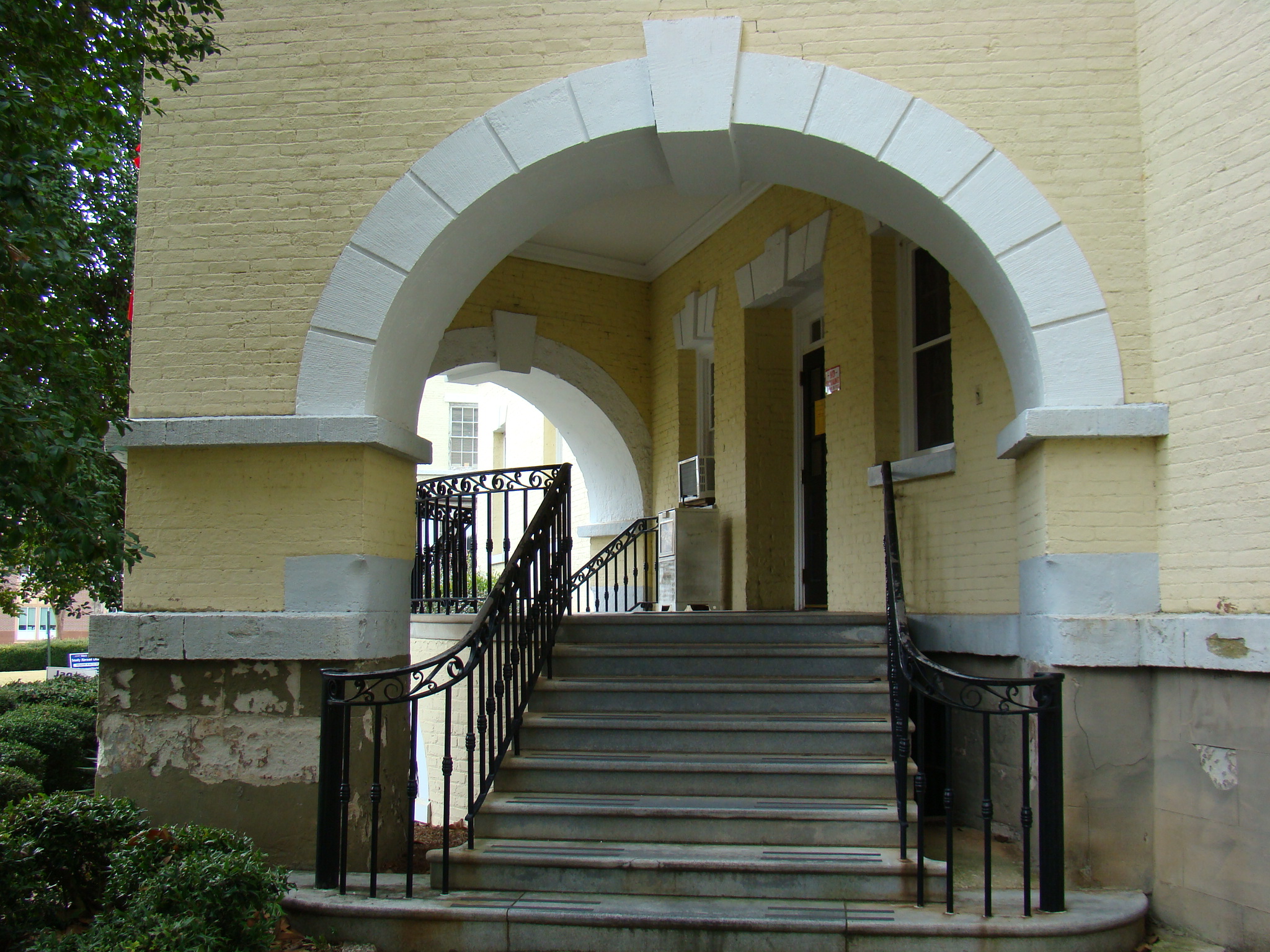
In 1955, the military closed the Augusta Arsenal for good. Most of the property was transferred to the Georgia Board of Education, and in 1957 it reopened as the Junior College of Augusta. The name changed to Augusta College in 1958, then Augusta State University. The campus retained the arsenal's historic architecture -- thick-walled brick buildings and tree-shaded grounds that had once echoed with cannon repair and ammunition production now served as classrooms and administrative offices. In 2012, Augusta State University merged with Georgia Health Sciences University to form Georgia Regents University. Public and alumni discontent over the name led to another renaming: Augusta University, adopted in 2015. The Walker family cemetery -- that single acre Freeman Walker held back from the federal sale -- remains on the grounds, a quiet reminder that the campus was once a plantation before it was an arsenal, and an arsenal before it was a school.
From the Air
Located at 33.48°N, 82.02°W in the Summerville neighborhood of Augusta, Georgia. The former arsenal grounds are now the Summerville campus of Augusta University, visible as a cluster of historic buildings amid tree-lined grounds in the residential western part of the city. The Savannah River runs to the northeast, forming the Georgia-South Carolina border. Augusta Regional Airport (KAGS) lies approximately 7 nm to the south. Daniel Field (KDNL) is about 3 nm to the southeast. Best viewed at 2,000-3,000 feet AGL; the historic brick buildings and campus layout are distinguishable in clear conditions.