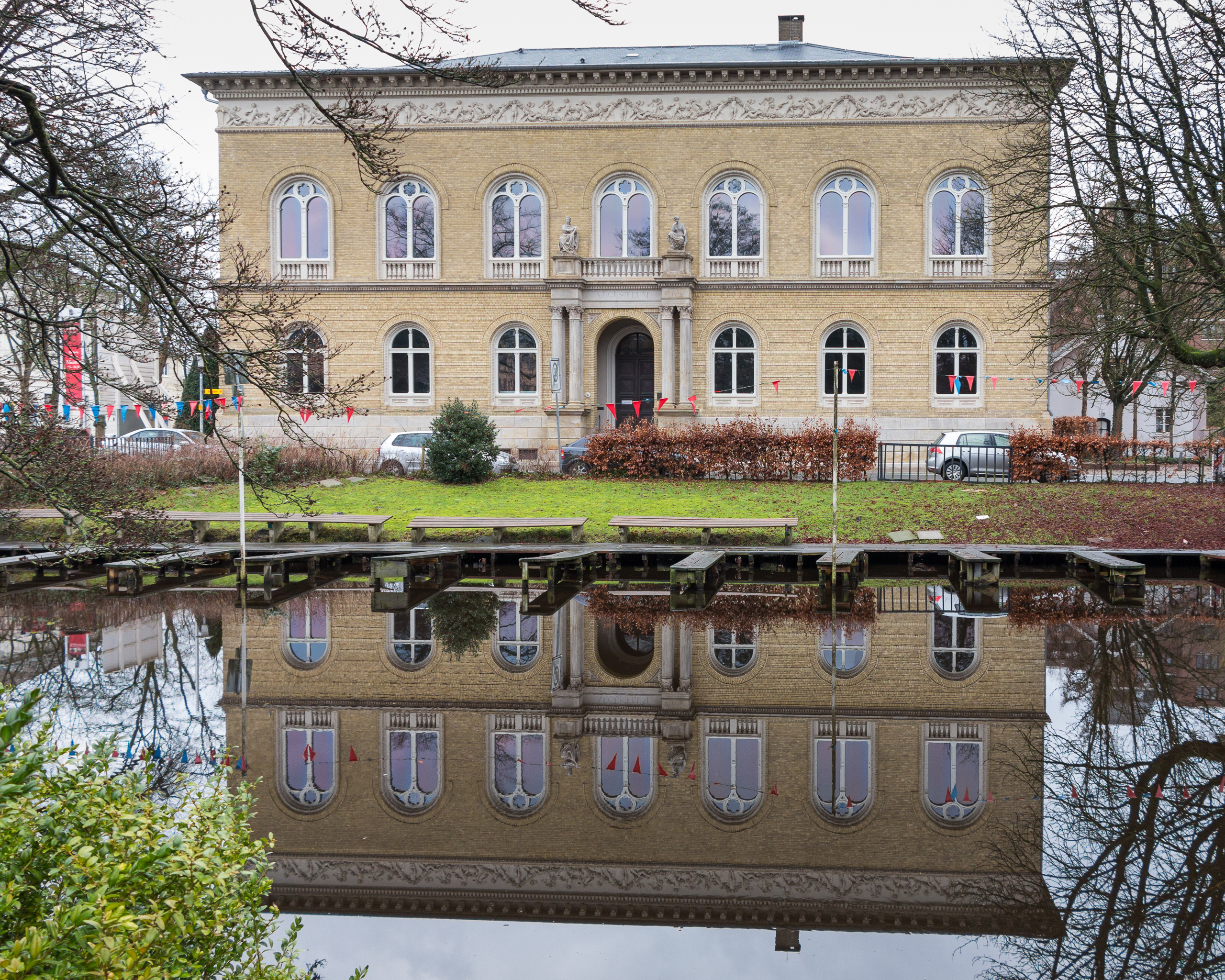
Augusteum, Oldenburg
In 1919, a deposed German Grand Duke crossed the border into the Netherlands with a Rembrandt under his arm. Or rather, with the help of an industrialist named Georg Bolts, Frederick Augustus II carried off a third of the Grand Ducal Picture Gallery. The Old Masters that had filled the Augusteum in Oldenburg for half a century were scattered into private hands across the Dutch border, and the people of Oldenburg were left with what no one had bothered to take. A century later, the curators are still buying back what they can. The Augusteum is a museum defined as much by what is missing as by what hangs on its walls.
A Palace for Paintings
Grand Duke Nikolaus Friedrich Peter II commissioned the building in 1873 and named it in honor of his father, Paul Friedrich August. The architect Ernst Klingenberg designed it in the Florentine palace style: a confident block of neo-Renaissance stonework that announced to a small north German residence town that art now had its own civic address. Inside, a grand staircase rose under ceiling paintings by Christian Griepenkerl, with allegorical scenes including Venus Urania and Prometheus stealing fire from Zeus and Ganymede. The Grand Duke paid for all of it. When the doors opened in 1876 the Augusteum became Oldenburg's first art museum and one of the earliest purpose-built museum structures in northern Germany.
How the Collection Began
The pictures had arrived before the building. In 1804, Duke Peter Friedrich Ludwig acquired eighty-six paintings from the private collection of the artist Johann Heinrich Wilhelm Tischbein, a one-time portraitist of Goethe. That single purchase laid the foundation of what would become the Oldenburg State Museum of Art and Cultural History. Each successive ruler added to it, until Nikolaus Friedrich Peter II inherited a princely picture gallery and decided it deserved to be seen. In 1908, in a flash of modernist daring, the Expressionists Karl Schmidt-Rottluff and Erich Heckel held their first joint exhibition here, hanging their raw new work in the same neo-Renaissance halls where Dutch Old Masters watched on from the walls.
The Abdication and the Rembrandt
Then the war ended, the monarchy fell, and everything changed. In November 1918 Grand Duke Frederick Augustus II abdicated alongside the other German princes. The following year he crossed into the Netherlands, and the paintings that had been his family's private property under the old order followed him out. With assistance from the industrialist Georg Bolts, a third of the former Grand Ducal Picture Gallery was sold off in a series of transactions, the works exported to Dutch collectors. Among them were paintings by Rembrandt van Rijn. The town that had paid taxes to support its Grand Duke was left with the secondary pictures, the ones the dealers and the abdicated prince had judged unworthy of the journey.
The Long Quiet Crusade
Few museums begin their permanent acquisitions program in defense rather than offense. Oldenburg has spent more than a century quietly trying to reverse a single theft. The curators have bought back works as they have surfaced at auction and through estates, slowly reconstituting a collection that an abdicated duke broke up in a season. The Augusteum today still holds the Old Masters Gallery of the state museum, with Dutch, Italian, German and French paintings ranging from the fifteenth to the eighteenth centuries. There is a Gerrit Willemsz Heda still life of breakfast from 1645, a stormy sea by Ludolf Backhuysen, a portrait of a boy by Francesco Salviati. None of them are the Rembrandt. The crusade continues.
The Quarter Around It
The Augusteum stands at Elisabethstrasse 1, near the northeast corner of the Schlossgarten Oldenburg. Walk a few minutes in any direction and the rest of the Grand Ducal residence reveals itself: the Prinzenpalais, the Elisabeth-Anna-Palais and the Schloss Oldenburg itself, all within easy reach. The conservator Richard tom Dieck once lived and worked in the basement of the Augusteum, looking after the pictures by day and sleeping under them by night. The neo-Renaissance facade still does exactly what Klingenberg designed it to do: announce, in a town that no longer has a grand duke, that here is the place where the surviving art lives.
From the Air
Located in central Oldenburg at 53.136 N, 8.217 E, in the Schlossgarten cultural quarter. From a slow low pass over the city center the museum is visible as a substantial neo-Renaissance building near the palace gardens. Nearest aviation reference is Bremen Airport (EDDW) about 25 nautical miles east-southeast. Best visibility in spring and early summer; the surrounding gardens and palace ensemble are most photogenic in late afternoon light.