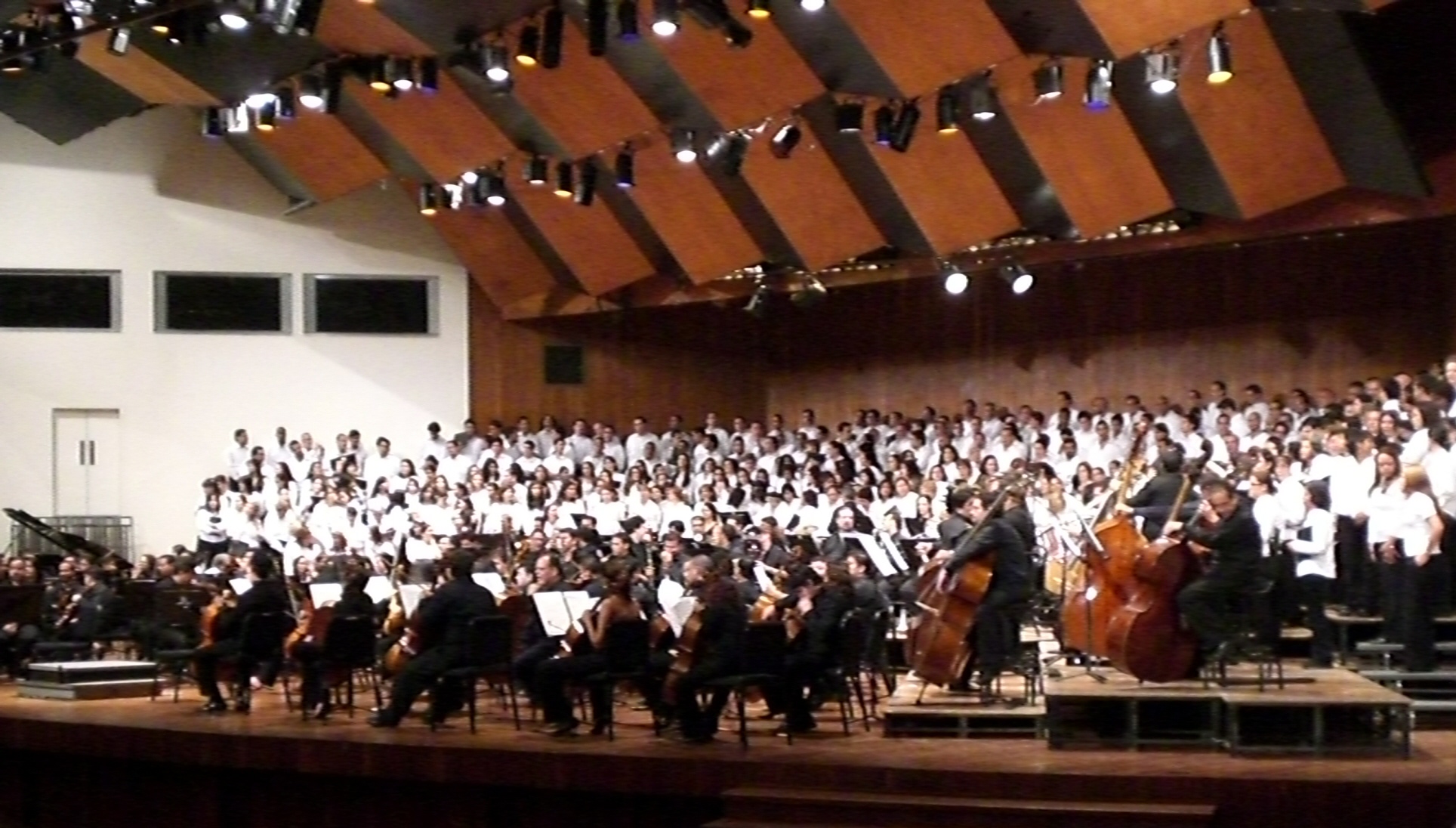
Aula Magna (Central University of Venezuela)
Walk into the Aula Magna when the houselights are on, and art critic Phyllis Tuchman says you will feel as if you have entered "a multihued, three-dimensional abstract painting." Darken the room, and the shapes overhead resemble clouds scattered across a night sky. These are Alexander Calder's Floating Clouds -- enormous panels of steel and laminated wood, colorfully curving above the auditorium of the Central University of Venezuela in Caracas. When asked which of his works was his favorite, Calder did not hesitate. He named the clouds. They are among the least remembered pieces in his oeuvre, yet they solved a problem no one else could and helped advance the science of architectural acoustics in the process.
Built in Four Months Flat
Architect Carlos Raul Villanueva began designing the central campus complex in 1944, but the Aula Magna took shape only after substantial revisions in 1949, with the final design complete by 1952. Villanueva had an unconventional approach: he described the buildings on campus not as objects but as "movements," and the Aula Magna was Movement IV. The Danish construction firm Christiani & Nielsen received the contract on November 28, 1952, with a deadline of March 31, 1953 -- just four months to build an entire auditorium. They finished on time. In an account that has taken on the character of campus legend, when Villanueva first walked into the completed hall and saw the freshly installed acoustic clouds overhead, he threw his arms up and shouted that it was tremendous.
When the Sculptor Changed the Plan
Calder's clouds were never supposed to hang inside the auditorium. He had originally been commissioned to create a structure for the outdoor Plaza Cubierta. But as he became aware of the complexity of the project, he proposed something more ambitious: integrating his panels into the interior of the hall to serve "an artistic, decorative and acoustic purpose" all at once. Each panel is a steel frame containing two pieces of thick laminated wood, and together they do what conventional acoustic treatments could not -- they scatter and balance sound throughout the space with a precision that influenced the broader field of interior space acoustics. Tuchman noted a paradox: the clouds are "colorfully curving and thus archetypically 'Latin American,'" yet they were designed by one of the few non-Latin Americans working on the project. That tension between origin and expression is part of what makes them compelling.
A Stage for History and Unrest
The Aula Magna has hosted far more than concerts and lectures. The Tenth Pan-American Conference was held there in 1954. In 1959, Fidel Castro spoke from its stage during his first visit to Venezuela after the Cuban Revolution. Decades later, in February 2019, student president Rafaela Requesens used the hall to rally students during the Venezuelan presidential crisis, opening her speech by describing the space itself: "This is a space of ideas, of knowledge, of plurality of thought, of freedom, of democracy, of justice." Not all events have been peaceful. In 2010, a production of Jesus Christ Superstar was attacked before the show by masked assailants with tear gas, an act of political intimidation that harmed the actors. The hall's original cashmere wool aisle carpets, chosen for their acoustic properties, were replaced with synthetic material during 1990s renovations -- a practical decision that subtly altered the room's character.
Preserving a World Heritage Interior
In 2000, UNESCO designated the University City of Caracas as a World Heritage Site, with special consideration for the Aula Magna's interior, which received individual protected status. But UNESCO's own assessment flagged concerns: growing student numbers, aging mosaics and concrete, and vulnerability to social unrest. Those fears proved well founded. During a protest in July 2013, a bus was set on fire in the square outside the hall, damaging an adjacent mural by Venezuelan artist Oswaldo Vigas. Students and the volunteer preservation group Copred launched a campaign called UCV SOS and raised funds to restore it, with donors including Banco Mercantil and Telefonica. Copred continues to lead guided tours of the hall to fund its upkeep. As the university puts it, the Aula Magna's "continued reason for being" is to see new generations of students graduate each year beneath Calder's clouds -- art and ceremony, still intertwined.
From the Air
The Aula Magna sits at 10.491N, 66.891W within the University City of Caracas campus, a UNESCO World Heritage Site. From the air, look for the sprawling university campus south of the city center, distinguished by its modernist buildings, covered walkways, and open plazas. The campus occupies a large green area amid Caracas's dense urban fabric. Nearest airport: Simon Bolivar International Airport (SVMI/CCS) approximately 20km north across the coastal mountains. Recommended viewing altitude: 3,000-5,000 feet to appreciate the campus layout and its integration of architecture and art.