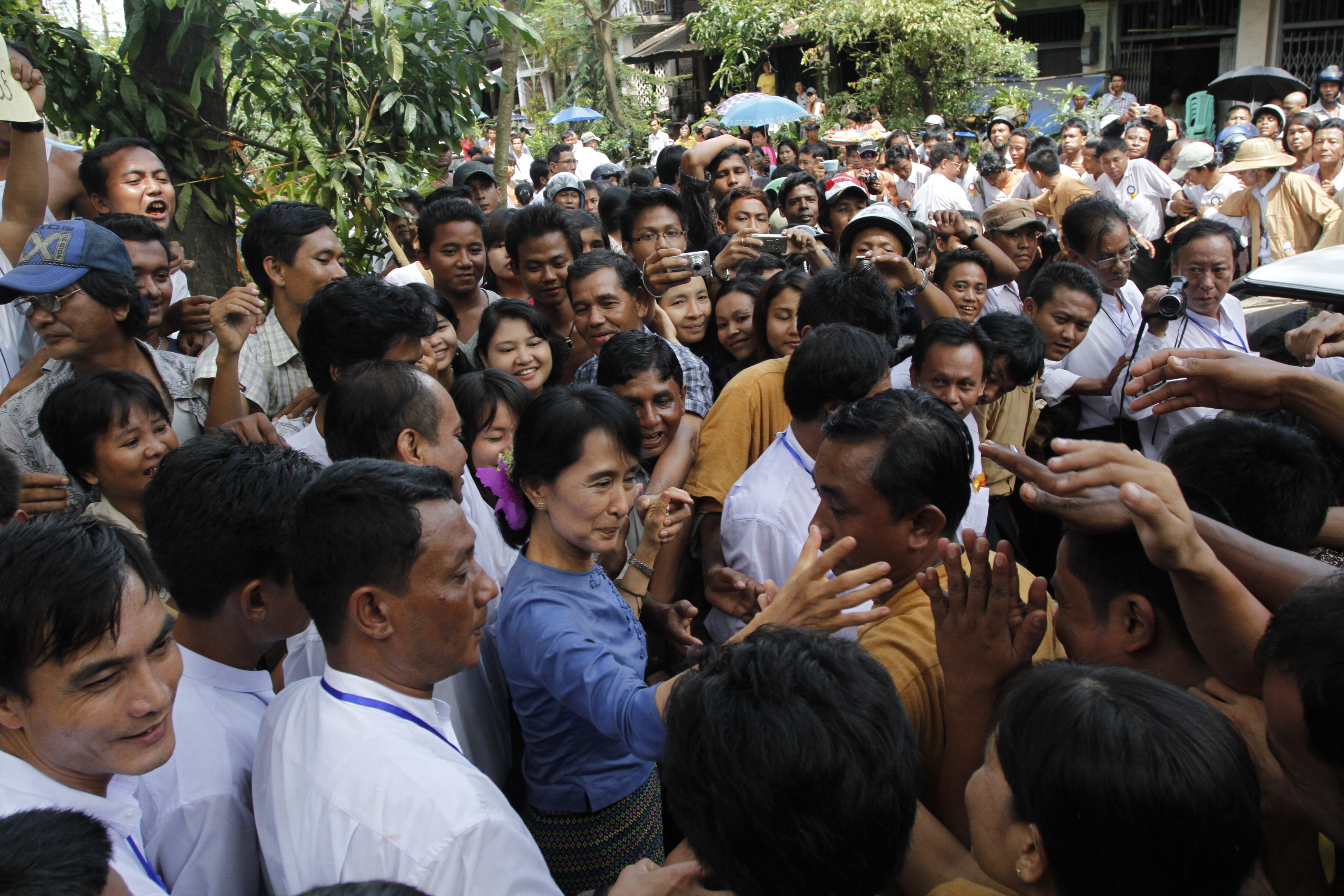
Aung San Suu Kyi
For nearly fifteen years, a lakeside house on University Avenue in Yangon held one of the world's most famous prisoners. Aung San Suu Kyi, daughter of Burma's independence hero Aung San, chose confinement over exile when Myanmar's military junta offered her freedom on the condition that she leave the country. She refused. Behind the rusting iron gates of her family compound, she became a Nobel laureate, a global symbol of democratic resistance, and the focal point of a struggle that would define Myanmar's politics for decades.
A Father's Shadow, A Daughter's Burden
Aung San Suu Kyi was born on June 19, 1945, in Rangoon, the youngest daughter of Aung San, the nationalist leader who negotiated Burma's independence from Great Britain. She was only two years old when her father was assassinated in July 1947, just months before independence was achieved. Her mother, Khin Kyi, served as Burma's ambassador to India, and the young Suu Kyi grew up between cultures, eventually studying philosophy, politics, and economics at St Hugh's College, Oxford. She married the British academic Michael Aris in 1972, and for years lived a quiet scholarly life in England, far from the turmoil brewing in her homeland. It was a phone call in 1988 that changed everything: her mother had suffered a stroke. Suu Kyi flew home to care for her, arriving just as mass pro-democracy protests were erupting across the country.
The Choice That Defined a Movement
What began as a family visit became a political awakening. The 1988 uprising, known as the 8888 Uprising for its start date of August 8, was met with a brutal military crackdown that killed thousands. Suu Kyi, drawing on her father's legacy and inspired by the nonviolent philosophies of Mahatma Gandhi and Martin Luther King Jr., co-founded the National League for Democracy in September 1988. Her speeches drew enormous crowds. The military junta placed her under house arrest in July 1989, but when elections were held in 1990, the NLD won more than eighty percent of contested parliamentary seats. The junta ignored the results. Suu Kyi remained confined to her compound on University Avenue, its crumbling colonial facade visible from Inya Lake, while the world watched and waited.
The Nobel Behind the Gate
In 1991, while still under house arrest, Aung San Suu Kyi was awarded the Nobel Peace Prize. Her sons, Alexander and Kim, accepted the honor on her behalf in Oslo. The award amplified international pressure on the junta, but the generals did not relent. Over the following two decades, she would spend nearly fifteen of twenty-one years in detention, communicating with the outside world only sporadically. During those long years of isolation, she practiced piano, meditated, and listened to the BBC World Service on a small radio. U2 wrote the song "Walk On" in her tribute; Luc Besson's 2011 film "The Lady," starring Michelle Yeoh, brought her story to cinema screens worldwide. Her quiet defiance transformed a house arrest into a moral argument that military power could not answer.
Power, Compromise, and Reckoning
Released in November 2010, Suu Kyi reentered political life with the force of decades of accumulated moral authority. The NLD swept the 2015 elections, and she became State Counsellor in 2016, effectively leading the country despite a constitutional provision that barred her from the presidency. Yet her time in power brought a painful reckoning. International condemnation mounted as the military conducted a violent campaign against the Rohingya Muslim minority in Rakhine State, and Suu Kyi's reluctance to criticize the army tarnished the icon's image. Amnesty International stripped her of its Ambassador of Conscience award. Canada revoked her honorary citizenship. The woman who had embodied moral clarity now found herself defending the institution that had once imprisoned her.
Behind the Gates Again
On February 1, 2021, the military staged a coup, arresting Suu Kyi and other NLD leaders. She was tried in closed proceedings on charges widely regarded as politically motivated, ultimately receiving a prison sentence totaling twenty-seven years. Reports from inside Myanmar paint a troubling picture: her son Kim Aris has spoken publicly about concerns over her deteriorating health, including a heart condition, while her requests for medical care have reportedly been denied or delayed. The house on University Avenue, the compound where she once chose captivity over capitulation, stands as a silent witness to Myanmar's unfinished democratic struggle. Whether Suu Kyi's legacy will ultimately be defined by her years of sacrifice or by the compromises of power remains an open question, one that Myanmar itself has not yet resolved.
From the Air
Located at 16.83°N, 96.15°E in northern Yangon, Myanmar. The University Avenue compound sits near Inya Lake, which is visible from the air as a large body of water in the northern part of the city. Nearest major airport is Yangon International Airport (VYYY), approximately 15 km to the north. The golden spire of Shwedagon Pagoda, roughly 3 km to the south, serves as a prominent visual landmark. Recommended viewing altitude: 2,000-3,000 feet AGL for city detail.