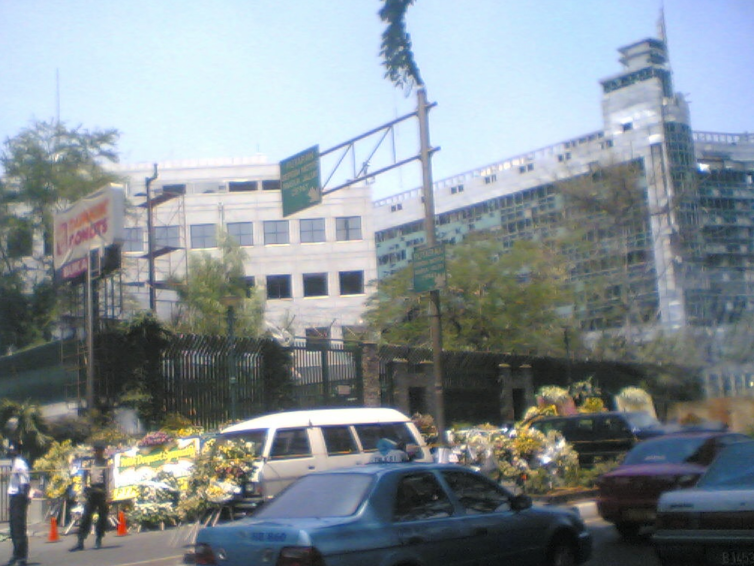
Australian Embassy Bombing in Jakarta
Forty-five minutes before the blast, a text message arrived on an Indonesian official's phone. Release the leader of Jemaah Islamiyah, it demanded, or face consequences. The warning never reached the Australian Federal Police. At 10:30 on the morning of September 9, 2004, a small Daihatsu delivery van packed with a one-tonne bomb exploded in front of the Australian embassy in Jakarta's Kuningan District, killing nine people and wounding more than 150. Windows shattered in buildings half a kilometer away. The Greek embassy, twelve floors up in an adjacent tower, was gutted. The Chinese embassy nearby sustained damage. This was not the first time Australians had been targeted in Indonesia, and everyone involved knew it would not be the last.
The People Who Were Lost
The dead were not diplomats behind bulletproof glass. They were the people who made the embassy function and the ordinary Indonesians who happened to be near it. Anton Sujarwo, a 23-year-old security guard, died at his post. Four Indonesian policemen on duty outside the gates were killed. Suryadi, the embassy gardener, was 34. Two embassy workers, a visa applicant waiting in line, and a pedestrian also perished. Every Australian staff member inside survived. A dispute arose over the final count -- Jakarta health authorities reported nine dead, while Australian officials counted eleven -- but the human reality behind either number was the same: families shattered, lives ended in an instant of violence that targeted a building but struck the people around it.
A Pattern of Escalation
The embassy bombing was the third major attack on Australian interests in Indonesia in barely two years. The 2002 Bali bombings had killed 202 people, including 88 Australians, in nightclub explosions that shook the conscience of both nations. The 2003 Marriott Hotel bombing in Jakarta had followed. Each attack bore the signature of Jemaah Islamiyah, the Southeast Asian militant network with alleged links to al-Qaeda. Australian Prime Minister John Howard expressed "utter dismay," while Foreign Minister Alexander Downer stated bluntly that there was no question the embassy had been the target. The timing raised its own questions: Indonesia's presidential election was eleven days away, and Australia's federal election loomed a month after that. Whether the bombers intended to influence either contest remained unclear, but the political reverberations were immediate and sharp.
Unraveling the Network
Indonesian police identified two men as the likely masterminds: Azahari Husin and Noordin Mohammed Top, both Malaysian nationals who had become Jemaah Islamiyah's most prolific bomb makers. DNA evidence identified the suicide bomber as Heri Golun. The investigation revealed a chilling operational timeline. On August 5, an operative named Rois -- also known as Iwan Dharmawan -- had been dispatched to retrieve Golun and purchase the Daihatsu van. Weeks of frantic preparation followed, punctuated by idle hours in internet cafes. On August 23, Rois began teaching Golun to drive. Seventeen days later, the novice driver steered his vehicle into the embassy compound and detonated the bomb. When arrested in November 2004, Rois claimed the operation had been funded by Osama bin Laden through a Malaysian courier, motivated by Australia's involvement in the Iraq war.
Justice and Its Complications
The trial of Rois produced its own drama. Sentenced to death in September 2005, he recanted his earlier confession in the courtroom, declaring himself innocent. His appeal was rejected by the Indonesian High Court in December of that year. Irun Hidayat, the first person tried in connection with the bombing, received three years for providing shelter to Azahari and Noordin after the attack. The masterminds themselves met violent ends: Azahari was killed in a police raid in Batu, East Java, in November 2005, and Noordin was killed in Surakarta, Central Java, in September 2009. A 2006 International Crisis Group report, "Terrorism in Indonesia: Noordin's Networks," detailed how the cell had operated -- a small group of men moving between safe houses, raising funds, and preparing a young man to die, all within the sprawling anonymity of a megacity.
What Remains at Kuningan
The damaged Australian coat of arms that once hung on the embassy building is now held in the collection of the National Museum of Australia -- a piece of twisted metal that represents both vulnerability and resilience. The embassy was repaired and continues to operate in the Kuningan District, a densely built area of South Jakarta where glass towers crowd against one another and the blast radius of 2004 has long since been absorbed into the city's relentless growth. For Jakarta, a city of more than ten million people that has endured bombings, floods, and political upheaval, the scars of a single morning in September are easily buried beneath new construction. But the names of those who died -- the guard, the gardener, the policemen, the applicant, the passerby -- belong to the permanent record of what terrorism costs the people who happen to be standing in its path.
From the Air
Located at 6.22S, 106.83E in the Kuningan District of South Jakarta. From above, the embassy compound sits among the dense high-rise office towers south of the Semanggi interchange. Nearest major airport is Soekarno-Hatta International (WIII), approximately 25 km northwest. Halim Perdanakusuma Airport (WIHH) is closer at roughly 12 km southeast. The Kuningan area is identifiable by its cluster of embassy compounds and corporate towers along Jalan H.R. Rasuna Said.