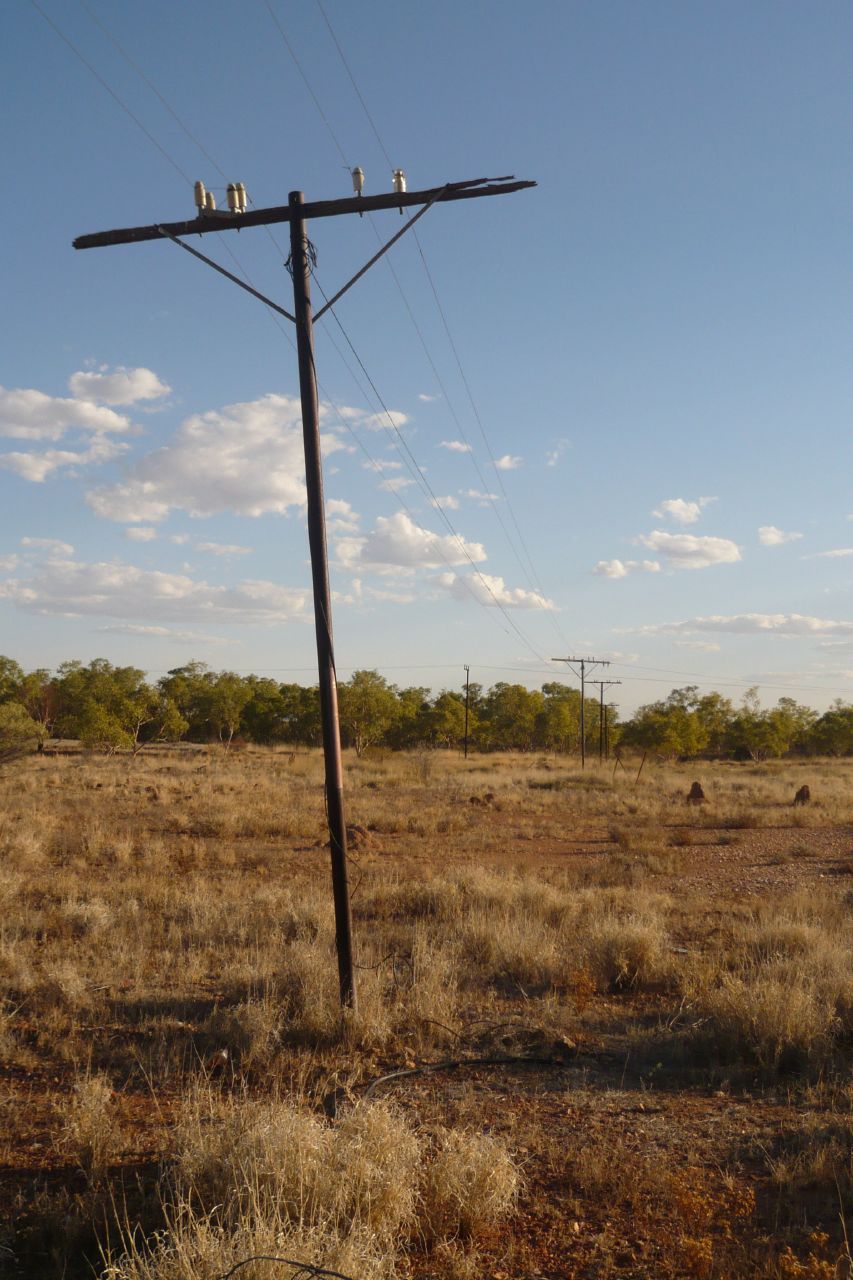
Australian Overland Telegraph Line
The first message sent along the completed line was triumphant and capitalized, as telegrams tended to be: "WE HAVE THIS DAY, WITHIN TWO YEARS, COMPLETED A LINE OF COMMUNICATIONS TWO THOUSAND MILES LONG THROUGH THE VERY CENTRE OF AUSTRALIA, UNTIL A FEW YEARS AGO A TERRA INCOGNITA BELIEVED TO BE A DESERT." Charles Todd, the Superintendent of Telegraphs who had staked his career on this line, had reason to shout. Before 1872, a message from London to Adelaide traveled by ship and took months. After the Overland Telegraph connected to the submarine cable from Java, the same message took hours.
A Race Between Colonies
The idea was straightforward: connect Australia to the telegraph cable running through Java, and from there to Europe. The execution was anything but. By 1855, several colonies were competing fiercely over which route the connection would take. Victoria sent the ill-fated Burke and Wills expedition north from Menindee to the Gulf of Carpentaria in 1860, hoping to establish a route through their territory. The expedition crossed the continent but ended in disaster and death. South Australia took a different approach, offering a reward for anyone who could find a viable path from Adelaide to the north coast. Explorer John McDouall Stuart answered, crossing the continent and reaching Chambers Bay in 1862. His meticulous notes on river crossings, timber sources, and water supplies would largely determine the telegraph's route. In 1863, the Northern Territory was transferred to South Australian control specifically to secure the telegraph connection, and by 1870 the final contract was signed: South Australia would build 3,200 kilometers of line to Darwin.
Wire Through the Heart
Todd divided the line into three sections and set a punishing deadline. The British-Australian Telegraph Company was laying the submarine cable from Banyuwangi in Java to Darwin, due for completion by the end of 1871, and severe financial penalties would apply if the overland connection was not ready. The southern section progressed smoothly. The central section, surveyed by explorer John Ross and Alfred Giles, pushed through difficult country. The northern section nearly broke the project entirely. Contractors Darwent and Dalwood arrived in Darwin in September 1870 with 80 men, 80 draught horses, and supplies, but the wet season halted progress after only 225 miles of poles and 129 miles of wire. Their contract was cancelled. The South Australian government was forced to build an additional 700 kilometers itself, purchasing horses from New South Wales and sending engineer Robert C. Patterson to take command. Patterson divided the remaining work into four sub-sections and concentrated most men on the northernmost stretch. By May 1872 the line was substantially operational, with horsemen and cameleers carrying messages across the last unfinished gaps.
Repeater Stations and Desert Life
Nineteenth-century telegraphy required repeater stations every 250 to 300 kilometers to boost the signal. Each station was powered by banks of Meidinger cells, a variation of the Daniell cell that was recharged by replacing its electrolyte, with Leclanche cells running the local equipment. A typical station employed four to six people: a station master, telegraphists who recorded and relayed each message with the time of day, and a linesman responsible for maintaining the wire. Within the first year of operations, 4,000 telegrams were transmitted. The southern stations at Beltana, Strangways Springs, and the Peake survive today as ruins along the Oodnadatta Track. The central section included Alice Springs and Charlotte Waters, the latter operational until the 1930s. The northern section ran through Barrow Creek, Tennant Creek, Daly Waters, Powell Creek, and Katherine before reaching Darwin, where substantial infrastructure managed the undersea cables to Europe.
Fishing Hooks, Floods, and Flares
Maintaining the line was an unending battle. Aboriginal people discovered that the galvanized iron wire made excellent fishing hooks, that insulator shards could be fashioned into spearheads, and that the iron baseplates on some poles worked as hatchets. Linemen were kept perpetually busy. Solar flares induced interfering signals along some sections, and lightning strikes were routine. But the greatest single disruption came in January 1895, when Warrina Creek flooded and washed away the line near Strangways Springs. Full service was not restored for four days, during which paper copies of messages were carried by rail between the Peake and Oodnadatta. Todd responded by authorizing the replacement of steel poles with 30-foot poles set in concrete and reinforced with struts. When Darwin was bombed during World War II, the line was deliberately cut just before the attack, a final strategic use for infrastructure that had by then been largely superseded by radio.
The Cable That Changed Distance
On 19 November 1871, the submarine cable from Banyuwangi reached Darwin, and the first direct message from London to Adelaide was transmitted on 22 October 1872. A second submarine cable was laid in 1880 for redundancy, and a third reached Cable Beach in Western Australia in 1889, running overland to Perth. The site where the original cables came ashore in Darwin, still visible at very low tides, was heritage-listed in 2020. The Overland Telegraph Line did more than carry messages. It opened the interior to permanent European settlement, established the route that the Central Australia Railway would later follow, and created the chain of outback towns, from Alice Springs to Tennant Creek to Katherine, that still define the corridor through Australia's center. Todd's wire through the heart of a continent believed to be a desert proved that the desert was crossable, livable, and worth connecting to the world.
From the Air
Located at 25.93S, 134.97E in central Australia. The telegraph line ran 3,200 km from Adelaide to Darwin along what is now the Stuart Highway corridor. Repeater station ruins are visible along the Oodnadatta Track and at Alice Springs Telegraph Station. The line is best appreciated from the air by following the Stuart Highway north from Adelaide through the Red Centre. Nearest airports: Alice Springs Airport (YBAS) and Oodnadatta Airstrip (YOOD). Best viewed from 5,000-10,000 ft AGL to trace the corridor through the desert landscape.