Australian Square Kilometre Array Pathfinder
Three million galaxies in 300 hours. That was the result of ASKAP's first rapid survey of the southern sky -- a census of the radio universe so fast and so deep that a million of the galaxies it catalogued had never been observed before. The Australian Square Kilometre Array Pathfinder sits on a former cattle station in one of the emptiest corners of Western Australia, 800 kilometres north of Perth, and it is rewriting what we know about the cosmos from a patch of red dirt where the nearest town barely registers on a map.
Silence as a Resource
ASKAP's location at Inyarrimanha Ilgari Bundara -- the CSIRO Murchison Radio-astronomy Observatory -- was chosen for one quality above all others: quiet. Radio telescopes do not gather light. They gather radio waves, and those waves are drowned out by the electromagnetic noise of modern life -- mobile phones, television transmitters, even car ignitions. The Murchison Shire has almost no permanent residents, and the Australian government has declared a radio quiet zone extending 260 kilometres around the observatory. Within 70 kilometres, no radio apparatus can operate without approval. No mobile phones ring. No CB radios crackle. The silence is not a limitation of this landscape but its most valuable natural resource, protected by law as deliberately as any national park.
Thirty-Six Eyes on the Universe
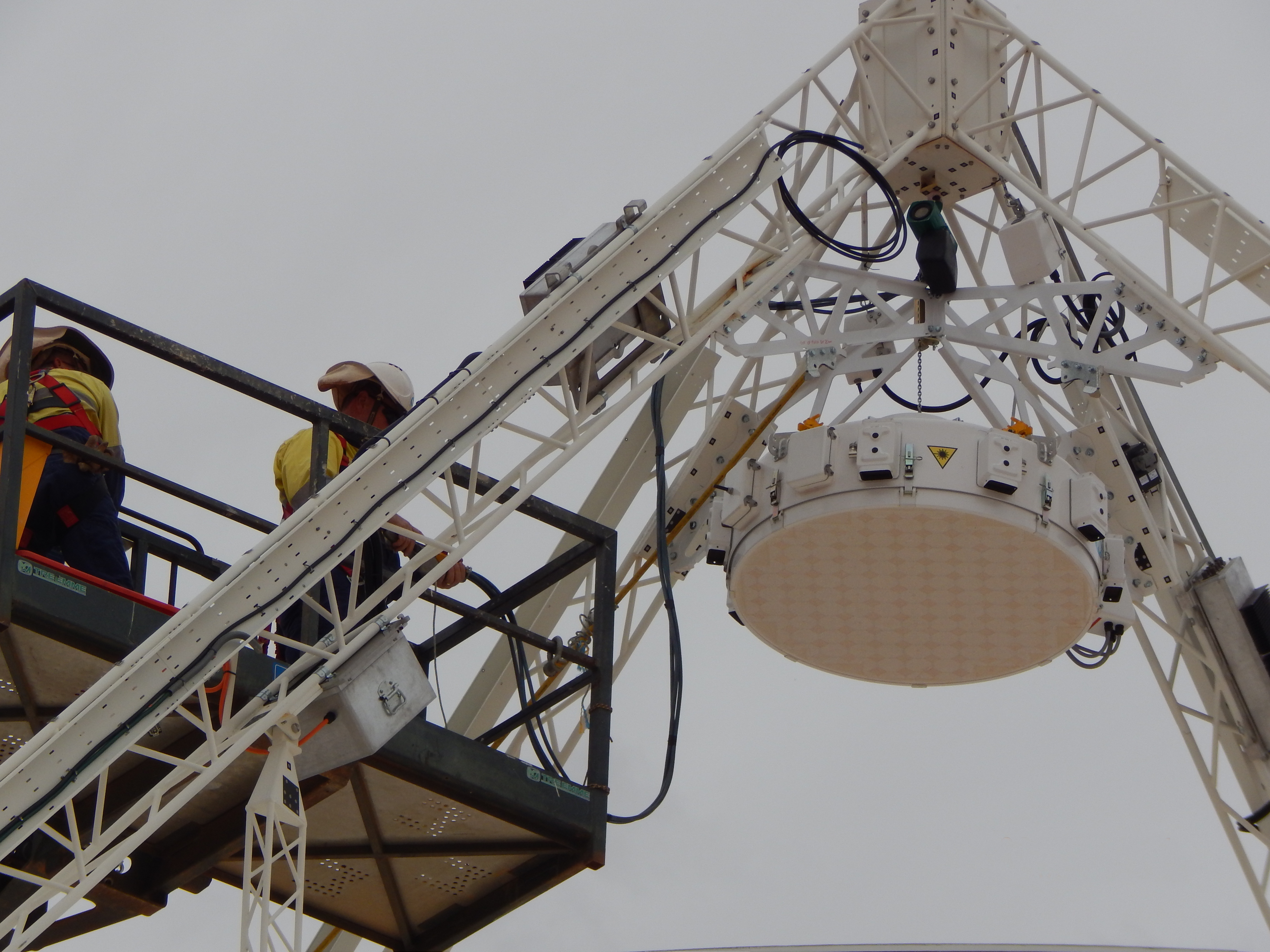
ASKAP consists of 36 identical parabolic antennas, each 12 metres in diameter, working in concert as a single astronomical interferometer. What makes them unusual is their phased-array feeds -- receivers containing 188 individual elements that give each dish a field of view of 30 square degrees, far wider than conventional radio telescopes. This combination of wide vision and high sensitivity means ASKAP can survey the sky faster than any comparable instrument. Construction began in 2009, and the telescope achieved first light in October 2012. Operated by CSIRO as part of the Australia Telescope National Facility, it feeds data over optical fibre to a supercomputer at the Pawsey Supercomputing Research Centre in Perth, where processing happens in near-real-time.
Odd Circles and Missing Matter
The discoveries have been striking. In 2019-2020, pilot surveys revealed Odd Radio Circles -- ORCs -- faint rings of radio emission with no known counterpart at other wavelengths. They appear to be a genuinely new class of astronomical object, and their nature remains under investigation. In May 2020, astronomers used six fast radio bursts detected by ASKAP to measure the density of the intergalactic medium, confirming predictions about the universe's missing baryons -- the ordinary matter that models predicted should exist between galaxies but that had eluded direct detection. These are not incremental results. They are the kinds of findings that reshape how astrophysicists understand the structure of the universe itself.
Pathfinder to Something Larger
ASKAP was always intended as a proving ground. The international Square Kilometre Array -- the SKA -- will be the largest and most sensitive radio telescope ever built, with installations split between Australia and South Africa. ASKAP's role was to test the technologies and techniques that the SKA will use at full scale. The phased-array feeds that give ASKAP its wide field of view were a particular challenge; they had never been used in radio astronomy before, and the first prototypes required a complete redesign between 2013 and 2014. The improved receivers, along with upgraded digital processors and optical fibre signal transmission, delayed the project but produced a more reliable and capable instrument. Ten major survey science projects now run on ASKAP, covering galaxy formation, cosmic magnetism, radio transients, and the evolution of neutral hydrogen across cosmic time.
The Wajarri Sky
The observatory sits on the traditional lands of the Wajarri Yamatji people, whose relationship with this sky predates any telescope by tens of thousands of years. The site's official name, Inyarrimanha Ilgari Bundara, comes from the Wajarri language. CSIRO and the Australian Government have worked with the Wajarri Yamatji to establish land use agreements, though the transition from pastoral use to radio astronomy has brought real costs -- the loss of seasonal cattle mustering work and reduced community activities in the surrounding area. The neighbouring Wooleen Station is exploring tourism, and an interpretive centre near the Murchison Settlement has been discussed. Science and traditional knowledge coexist here, both drawn to the same thing: a sky unobstructed by artificial light, above a landscape vast enough to contain the questions that remain unanswered.
From the Air
ASKAP is located at approximately 26.70S, 116.64E in the Murchison Shire of Western Australia, 800 km north of Perth. From the air, the 36 white antenna dishes are visible as a cluster of bright dots against the red-brown outback. The area is extremely remote with minimal infrastructure. Meekatharra Airport (ICAO: YMEK) is the nearest significant airfield, roughly 200 km to the southeast. The terrain is flat scrubland with excellent visibility in clear conditions. Best viewed at 3,000-10,000 ft to appreciate the array layout against the vast emptiness.