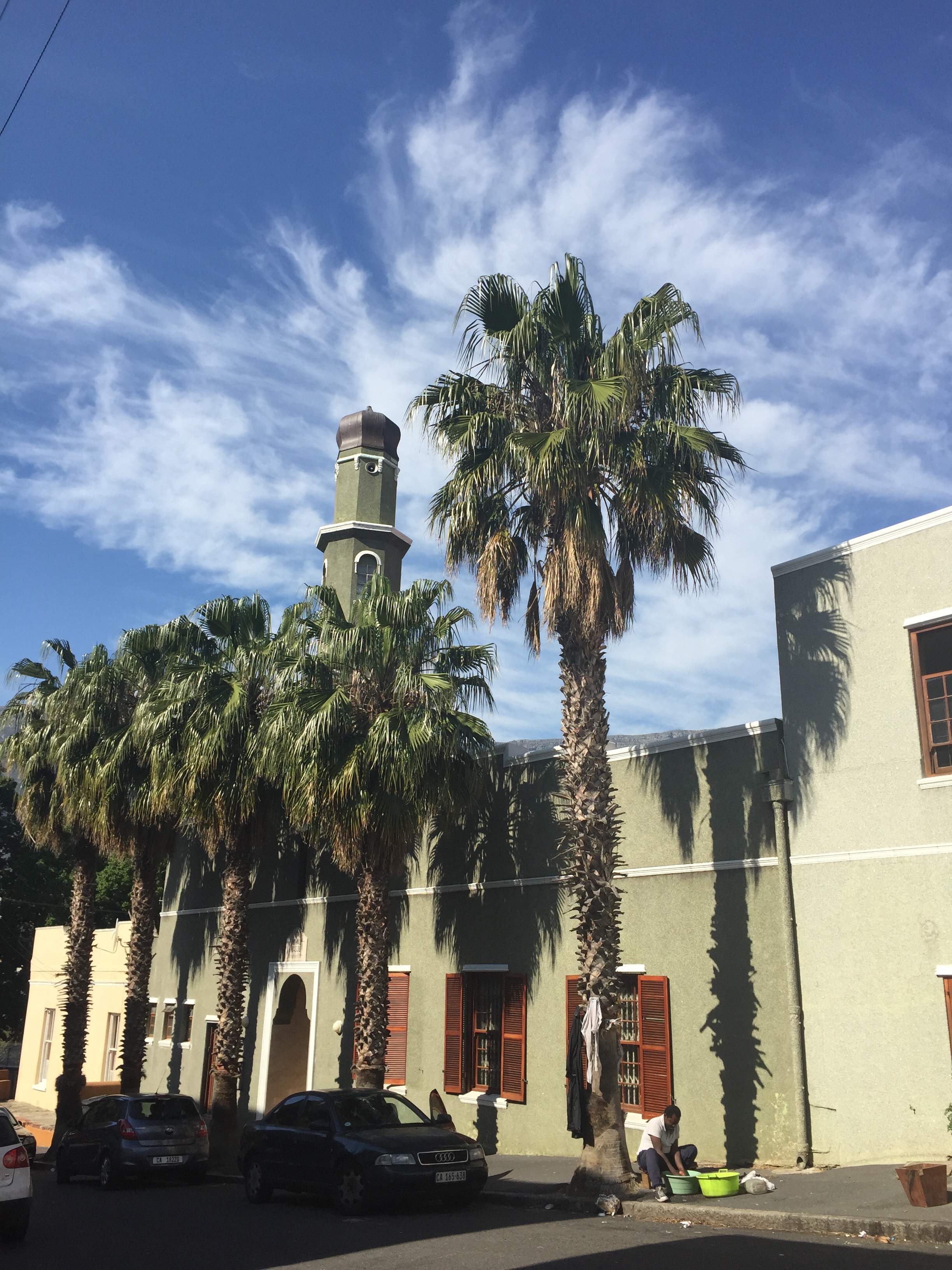
Auwal Mosque
In a prison cell on Robben Island, sometime in the 1780s, a man named Abdussalam sat writing. He had no text to copy from. The religious leader the Cape's Muslim community called Tuan Guru -- "Master Teacher" -- was reconstructing the entire Quran from memory, word by word, verse by verse. When he was finally released in 1793 after thirteen years of imprisonment for resisting Dutch colonial rule, he carried that handwritten Quran with him back to Cape Town. Within a year, he had founded a mosque. It was the first in South Africa, and it still stands in the Bo-Kaap neighborhood, its walls holding three centuries of resilience.
Born on Borrowed Ground
The Auwal Mosque rose in 1794 on land that belonged to Coridon van Ceylon, a Vryezwarten -- a freed Black Muslim who had once been enslaved. After Coridon's death, his daughter Saartjie van de Kaap inherited the property, which had served as a warehouse. She donated it for use as a place of worship. The timing was significant: the first British occupation of the Cape had just begun, and the colonial authorities, perhaps distracted by larger geopolitical concerns, permitted the construction. For the enslaved and freed Muslims of Cape Town, the mosque represented something the colony had long denied them -- the right to worship openly. Tuan Guru became the first imam, and he transformed the building into more than a prayer hall. It became a madrasa where he taught children and adults, a center where Cape Muslim traditions took root and where the Arabic-Afrikaans language was first taught.
A Sacred Text, Reconstructed
Tuan Guru's handwritten Quran remains on display at the Auwal Mosque. Consider what the act of writing it represented: a political prisoner, locked away for opposing colonial power, preserving his faith through the sheer force of memory. He had been a religious leader and prince from Tidore in the Maluku Islands before the Dutch exiled him to the Cape. His crime was resistance. His response was scholarship. The Quran he produced became the spiritual foundation of an entire community -- enslaved people and freed Muslims who had been brought to the Cape from across the Indian Ocean world, from Indonesia, India, Madagascar, and Mozambique. They had been stripped of nearly everything, but they held onto their faith. Tuan Guru gave that faith a home.
A Family's Stewardship
After Tuan Guru's death, the position of imam passed to Achmad of Bengal, husband of Saartjie van de Kaap. The family that had donated the land now led the congregation in prayer. This was not mere coincidence but a reflection of how deeply the mosque was woven into the lives of the people who built it. Achmad's descendants held the position of imam for nearly two centuries, until the last family imam, Gasan Achmat, died in 1980. The continuity speaks volumes: in a city shaped by colonialism, forced removals, and apartheid, one family maintained an unbroken chain of spiritual leadership for almost two hundred years.
A Congregation Divided, a Legacy Multiplied
In 1807, a dispute over succession split the Auwal congregation. A portion of the worshippers broke away and established Cape Town's second mosque, the Palm Tree Mosque on Long Street. The split was painful but also productive -- it spread the roots of Islam deeper into the city. Today the Bo-Kaap neighborhood surrounding the Auwal Mosque is famous for its brightly painted houses climbing the slopes of Signal Hill, but the colors mask a harder history. This was a community built by people who had been enslaved or exiled, who spoke a creole language written in Arabic script, who practiced a faith their colonial masters tried to suppress. The mosque underwent renovations in 1907 and again extensively in 1936, but its purpose has never wavered. It remains what it has been since 1794: a symbol of the recognition of Islam and the freedom of enslaved people to worship.
From the Air
Located at 33.92S, 18.41E in the Bo-Kaap neighborhood on the slopes of Signal Hill, Cape Town. The Bo-Kaap's colorful houses are visible from low altitude. Nearest major airport is Cape Town International (FACT), approximately 18 km southeast. Table Mountain and Lion's Head provide prominent visual landmarks to the south and west. Best viewed at 2,000-3,000 ft AGL for neighborhood context.