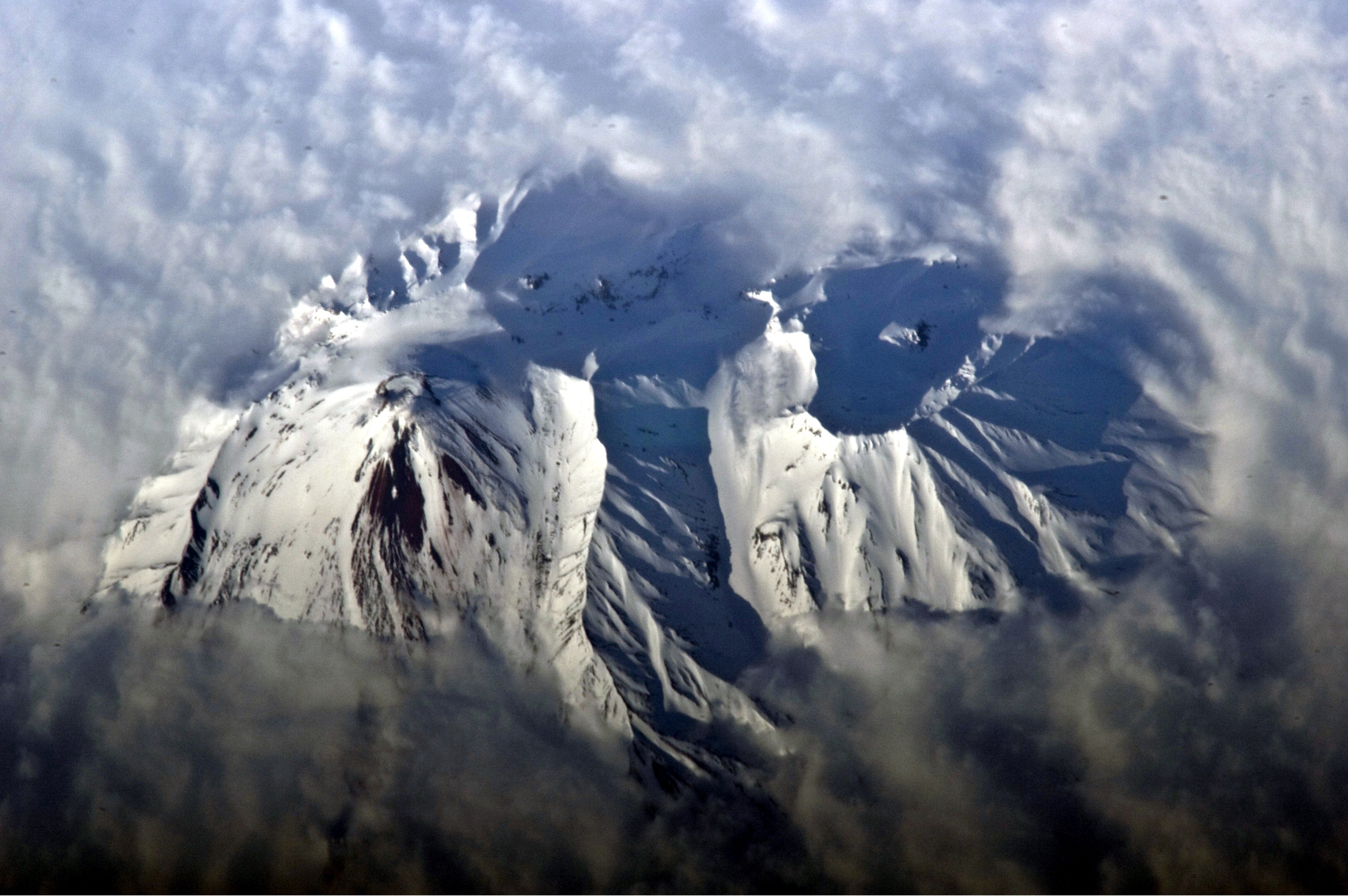
Avachinsky
When Captain Cook's expedition sailed into Avacha Bay in June 1779, the American adventurer John Ledyard recorded a volcano erupting on the horizon. He called it Peter, pairing it with its neighbor Paul, the twin peaks guarding the entrance to Kamchatka's finest harbor. The names did not stick, but the volcano kept erupting. Avachinsky, also known as Avacha, is a stratovolcano that has been active since the Pleistocene and has erupted at least 16 times in recorded history. It stands within direct sight of Petropavlovsk-Kamchatsky, the capital of Kamchatka Krai and home to nearly 200,000 people. That uncomfortable proximity earned it designation as a Decade Volcano in 1996, one of sixteen volcanoes worldwide singled out by the United Nations for their explosive histories and their nearness to populated areas.
Built on a Collapse
Avachinsky sits on the Pacific Ring of Fire at a point where the Pacific Plate slides beneath the Eurasian Plate at roughly 80 millimeters per year. The wedge of mantle material caught between these colliding plates feeds volcanism across the entire Kamchatka Peninsula, and Avachinsky is one of its most restless products. The volcano began erupting in the middle to late Pleistocene, building and destroying itself in cycles of growth and catastrophe. Between 30,000 and 40,000 years ago, a massive landslide collapsed the volcano's southern flank, creating a horseshoe-shaped caldera and burying the area where Petropavlovsk-Kamchatsky now stands under debris. The modern cone grew inside that caldera in two major eruption phases, roughly 18,000 and 7,000 years ago. What you see today is a volcano rebuilt on the ruins of its predecessor, a geological pattern that tends to repeat.
Sixteen Eruptions and Counting
The historical record of Avachinsky's eruptions stretches back to the late 18th century, when Ledyard witnessed it from Cook's ship. Eruptions have generally been explosive, producing pyroclastic flows and lahars, rivers of volcanic mud, that tend to funnel southwest through the breached caldera. The most powerful eruption in modern times came in 1945, a VEI-4 event that ejected a substantial volume of magma. Smaller eruptions followed in 1991 and 2001. Between eruptions, the volcano makes itself felt through frequent earthquakes and a network of fumaroles near the summit that vent gases at extreme temperatures. Avachinsky does not go quiet. It simmers, building pressure in ways that volcanologists monitor closely, knowing that the city below depends on their vigilance.
The Decade Volcano Problem
In 1996, the United Nations designated Avachinsky and its neighbor Koryaksky as Decade Volcanoes under the International Decade for Natural Disaster Reduction. The program identified volcanoes that combined a history of large, destructive eruptions with proximity to densely populated areas. Avachinsky met both criteria with uncomfortable clarity. Petropavlovsk-Kamchatsky lies directly in the path that pyroclastic flows and lahars have historically followed. The 30,000-year-old debris avalanche that created the caldera deposited material across the very ground the city occupies. A repeat of even a moderate historical eruption would pose serious risks. The designation brought increased scientific attention and monitoring, but the fundamental problem remains unsolvable: you cannot move a city of 200,000, and you cannot turn off a volcano. The relationship between Avachinsky and Petropavlovsk is one of proximity and vigilance, a negotiation between human settlement and geological force that has been ongoing since the first Russians built a fort on Avacha Bay.
Twin Sentinels from the Air
From altitude, Avachinsky and Koryaksky form a dramatic paired silhouette northeast of Avacha Bay. Avachinsky is the lower of the two, its horseshoe-shaped caldera clearly visible from the north and east, the newer cone rising inside the older structure's broken rim. Steam often plumes from the summit fumaroles, a reminder that the volcano remains very much alive. Koryaksky, taller and more symmetrical, stands to the northwest. Together they frame the approach to Petropavlovsk-Kamchatsky and its airport at Yelizovo, creating one of the most geologically dramatic approaches to any city on Earth. Snow covers both volcanoes for most of the year, and in winter the cones merge with the surrounding landscape until only the summit fumaroles distinguish Avachinsky's peak from the frozen white ridgelines of the Kamchatka interior.
From the Air
Located at 53.26N, 158.83E, Kamchatka Peninsula. Summit elevation approximately 2,741 m (8,993 ft). Nearest airport is Yelizovo (UHPP), roughly 30 km southwest. Avachinsky and neighboring Koryaksky (3,456 m) form a dramatic twin volcanic profile northeast of Avacha Bay. Active fumaroles at summit frequently emit visible steam. Maintain safe altitude and be aware of volcanic ash hazards and mountain weather conditions. Turbulence common near peaks.