Avebury
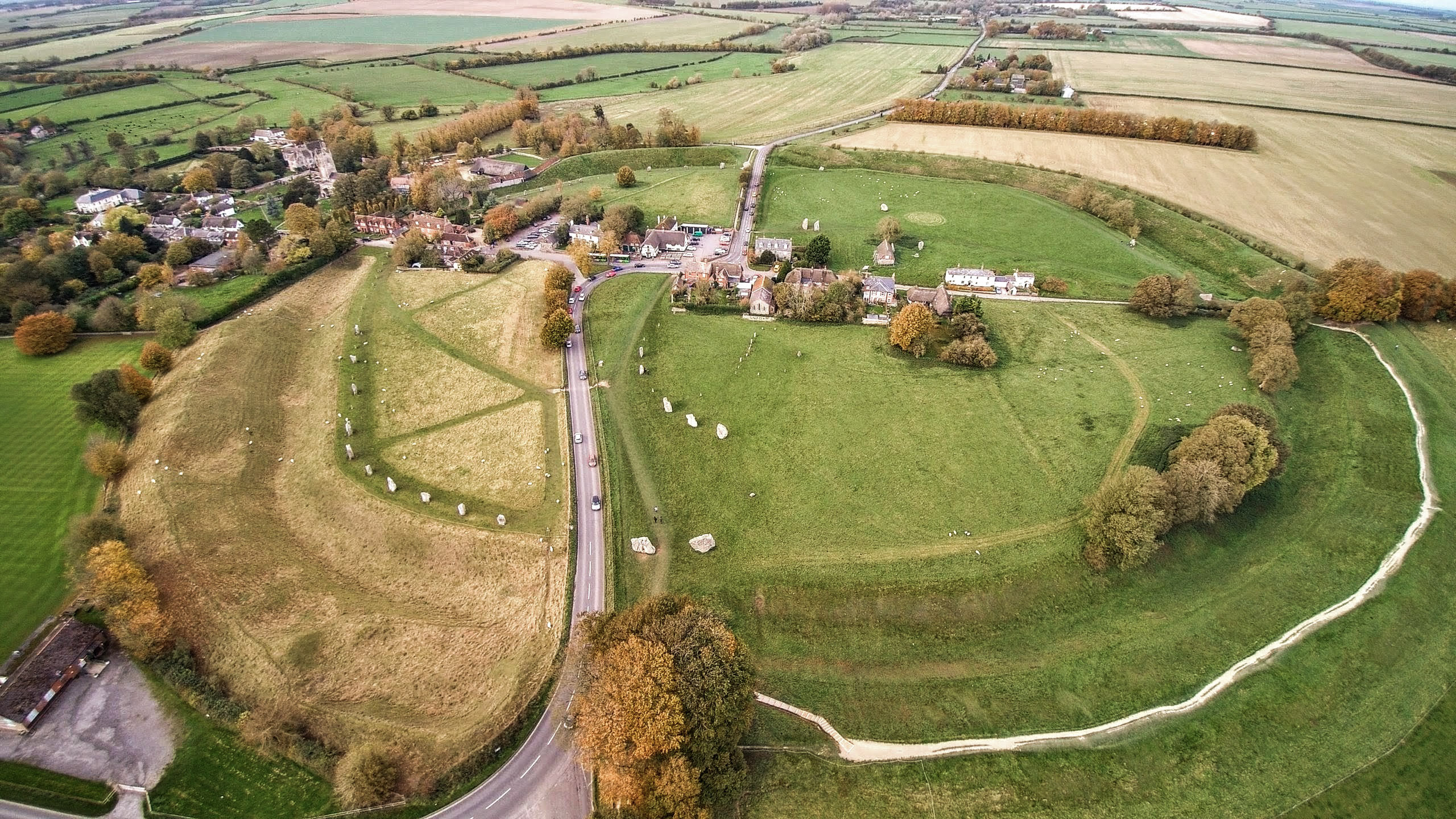
You can touch the stones at Avebury. Unlike Stonehenge, where ropes and fences hold visitors at a respectful distance, Avebury's megaliths stand in fields, along lanes, beside pub gardens, and in people's front yards. The largest stone circle in the world is so enormous that an entire village was built inside it, and that village is still there. Walking through Avebury is walking through a collision of timescales: Neolithic engineering, medieval agriculture, Georgian antiquarianism, and twenty-first-century tourism all occupying the same physical space, separated by millennia but sharing the same chalk ground.
The Monument Nobody Could Miss
Avebury was constructed over several hundred years during the third millennium BC. The monument consists of a massive henge -- a circular bank and ditch -- enclosing a great outer stone circle roughly 330 metres in diameter, with two smaller stone circles set within it. The outer circle originally contained around 98 standing stones, some weighing over 40 tonnes, dragged from the nearby Marlborough Downs. The encircling ditch, cut into solid chalk, was originally nine metres deep. The labour required was staggering. Archaeologists estimate the earthworks alone demanded around 1.5 million man-hours of work with antler picks and ox-shoulder-blade shovels. The purpose remains unknown, though most researchers believe it served some form of ritual or ceremonial function.
Destruction and Discovery
By the Iron Age, Avebury appears to have been abandoned. A village grew up around and within the monument during the early Middle Ages, and from the fourteenth century onward, local people began systematically destroying the standing stones. Some were toppled into pits and buried; others were broken up for building material using a technique of heating them with fires and then dousing them with cold water to crack the stone. In one pit, excavators found the skeleton of a man crushed beneath a falling stone, still carrying his scissors and lancet -- a barber-surgeon who met his end around 1320 while helping to bury the megaliths. The antiquarian John Aubrey rediscovered Avebury for the scholarly world in 1649, and William Stukeley documented the monument extensively in the 1720s, recording stones that were destroyed shortly after his visits.
Keiller's Resurrection
In the 1930s, the wealthy archaeologist and marmalade heir Alexander Keiller purchased much of the site and began an ambitious programme of excavation and restoration. He re-erected fallen stones, marked the positions of destroyed ones with concrete pillars, and excavated portions of the ditch to reveal its original depth. Keiller also established the Alexander Keiller Museum in the village to house his finds. His work transformed Avebury from an obscure curiosity into a recognised archaeological treasure. In 1986, Avebury was inscribed as a UNESCO World Heritage Site alongside Stonehenge and their associated monuments, recognition of a prehistoric landscape whose ambition rivals anything in the ancient world.
A Landscape of Monuments
Avebury does not stand alone. It anchors a constellation of Neolithic and Bronze Age monuments spread across the surrounding downs. West Kennet Long Barrow, one of the largest chambered tombs in Britain, lies a mile and a half to the south. Silbury Hill, the largest prehistoric artificial mound in Europe, rises from the valley floor nearby. The Sanctuary, a concentric arrangement of timber and stone posts on Overton Hill, was connected to Avebury by the West Kennet Avenue, a processional route of paired standing stones stretching over a mile. Windmill Hill, to the north, was a Neolithic causewayed enclosure predating the henge itself. Together, these sites suggest a landscape designed for ceremony on a scale that implies organisation, authority, and a shared belief system stretching across generations of builders. The people who made Avebury are gone, and their reasons are lost. The stones remain.
From the Air
Located at 51.429N, 1.854W on the Wiltshire downs. The circular henge bank is dramatically visible from the air, with the village of Avebury sitting inside it. Silbury Hill is visible 1.5km to the south. Nearest airports: Membury Airfield approximately 15nm east, Lyneham (EGDL) approximately 10nm west. Best viewed from 2,000-4,000ft for the full pattern of henge, village, and surrounding monument landscape.