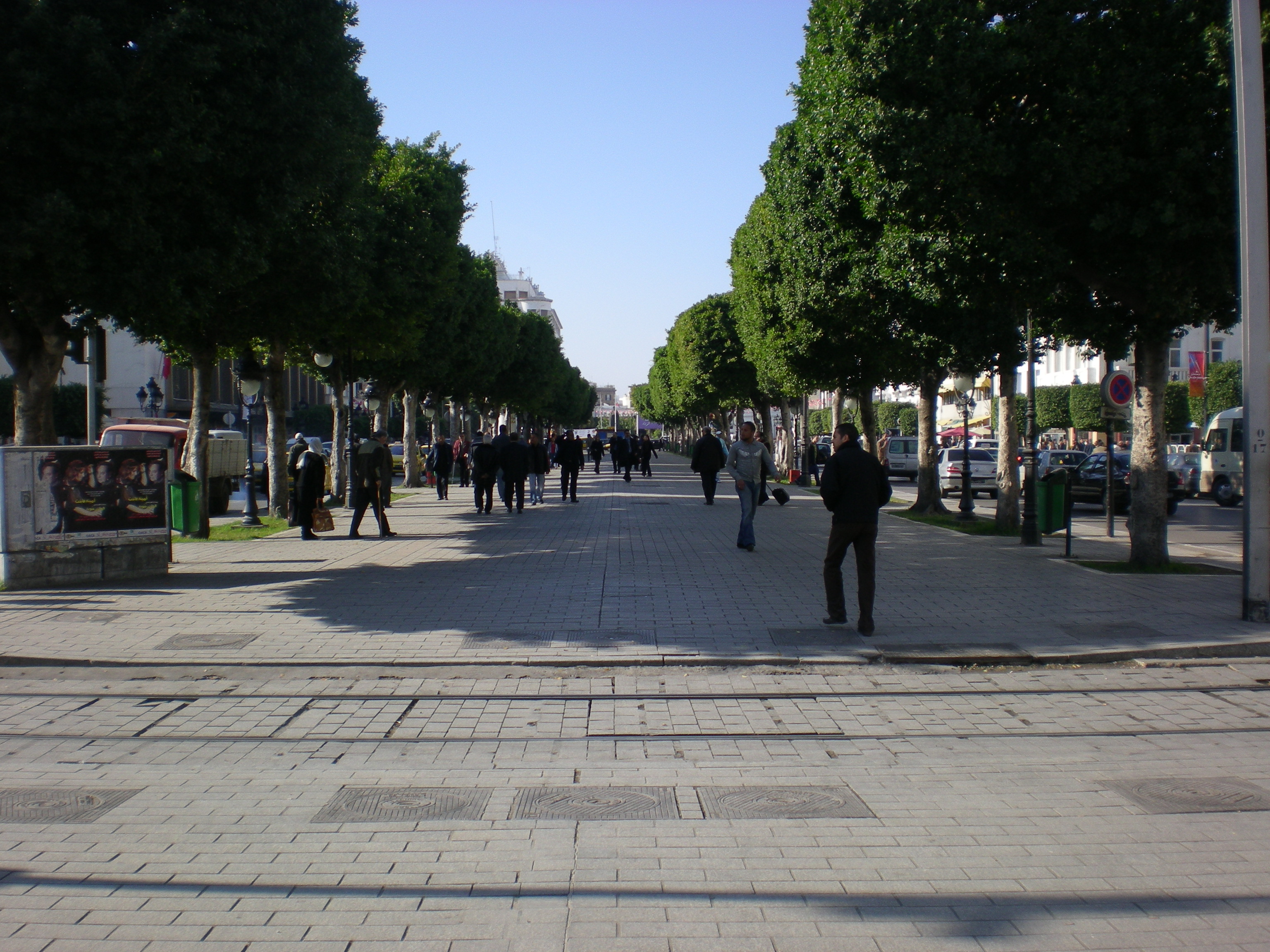
Avenue Habib Bourguiba
Every Tunisian city has an Avenue Habib Bourguiba, but only one is the original. Sixty meters wide, lined with ficus trees, and flanked by cafe terraces where conversation runs as freely as the coffee, Tunis's central boulevard stretches east-west from the gates of the ancient Medina to a causeway crossing the Lake of Tunis. Visitors compare it to the Champs-Elysees. Tunisians know it as something more complicated: a stage where the nation's modern history has unfolded in full public view, from colonial ceremony to revolutionary fury.
The Colonial Boulevard
The avenue emerged in the decades after France established its protectorate over Tunisia. The city expanded eastward from the Medina, and a new European quarter took shape along what became the main thoroughfare. The French consulate, built between 1890 and 1892, became the seat of the French Residence. By the early twentieth century, the street had accumulated the architectural trappings of colonial ambition: the Cathedral of Saint Vincent de Paul, completed in 1897 in a striking mix of Moorish, Gothic, and Neo-Byzantine styles, and the Municipal Theatre, which opened in 1902 as one of the rare Art Nouveau theaters in the world. On the eve of World War I, the avenue was renamed for Jules Ferry, the French statesman who had championed colonial expansion. It was the entertainment center of the city, the playground of the elite -- and a constant reminder of who held power.
Independence and Identity
When Tunisia achieved independence in 1956, the colonial statue on the avenue was toppled and the street received a new name: Avenue Habib Bourguiba, honoring the leader who had negotiated the end of French rule. The renaming was more than symbolic. New private buildings rose from extensive investment -- international hotels, commercial galleries, the Coliseum complex of cafes and cinemas. At the western end, the Bab Bhar, or Porte de France, stood as a free-standing arch marking the boundary between the European city and the Medina beyond. At the eastern end, a causeway stretched across the shallow Lake of Tunis, connecting downtown to the elegant port of La Goulette and the suburbs of Carthage, Sidi Bou Said, and La Marsa. The avenue became the spine of a nation finding its own identity.
Stage for Revolution
In January 2011, Avenue Habib Bourguiba became the focal point of the Tunisian Revolution. Thousands of demonstrators filled the boulevard, demanding the downfall of President Zine El Abidine Ben Ali, who had ruled for 23 years. The protests -- part of what the world would call the Arab Spring -- succeeded. Ben Ali fled the country on January 14. In the weeks that followed, further demonstrations on the avenue called for the dissolution of the national unity government. The revolution left physical marks on the boulevard: damaged storefronts, a toppled clock commemorating Ben Ali's 1987 seizure of power. But the avenue's role as Tunisia's public square -- the place where citizens come to be seen and heard -- was older than any single ruler and survived the upheaval intact.
Walking the Boulevard Today
A major renovation in 2000-2001 reduced the avenue's quadruple row of ficus trees to two, opening up the central median and giving the boulevard a more spacious feel. The Cathedral of Saint Vincent de Paul still faces the French Embassy across the Place de l'Independance. The Municipal Theatre, rebuilt and enlarged in 1911 after a partial demolition, received a total renovation for its centenary in 2001, its Art Nouveau facade preserved as one of the city's architectural signatures. Between these landmarks, the avenue operates as Tunis's living room: a place for morning coffee and evening strolls, for newspaper vendors and shoe-shiners, for political debate and people-watching. The causeway at the eastern end carries road and metro traffic toward the coast, but the boulevard itself moves at a human pace, its width absorbing crowds the way a river absorbs tributaries.
From the Air
Located at 36.80N, 10.19E in central Tunis. The avenue runs east-west and is visible from above as a broad tree-lined boulevard with a central median, stretching from the Medina's Bab Bhar gate eastward toward the Lake of Tunis causeway. Best viewed at 2,000-3,000 feet. The Cathedral of Saint Vincent de Paul and the Municipal Theatre are identifiable landmarks along its length. Nearest airport is Tunis-Carthage International (DTTA), approximately 7 km to the northeast.