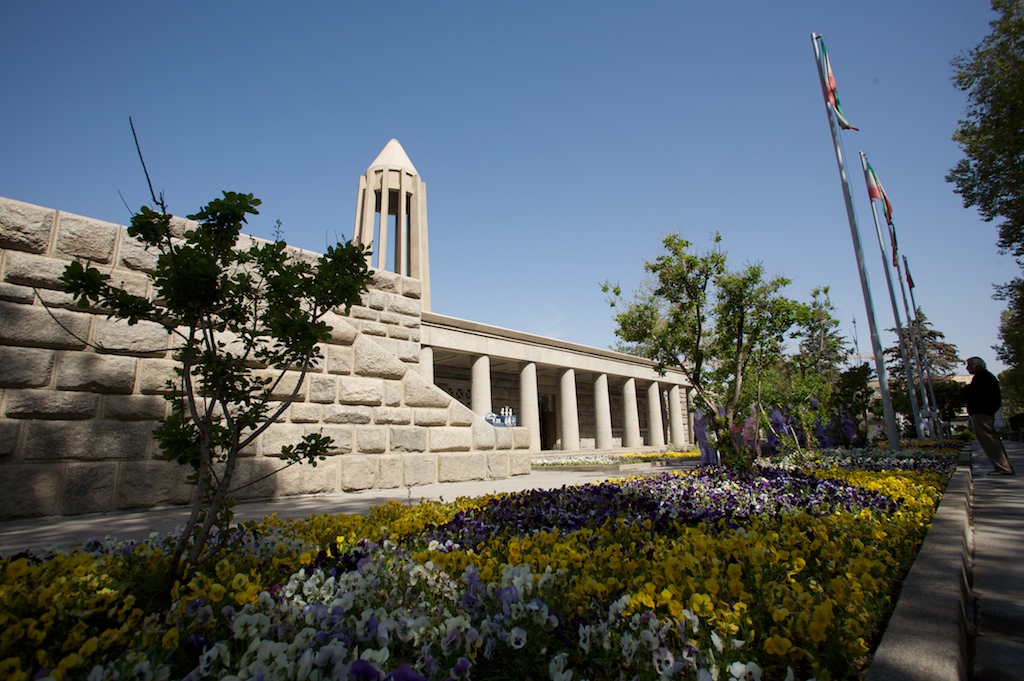
Avicenna Mausoleum
A thousand years after his death, the most influential physician of the medieval world still draws visitors to a small square in Hamadan. The Mausoleum of Avicenna -- known in Persian as the Tomb of Abu Ali Sina -- rises 28 meters in a distinctive spindle shape, its form inspired by the 11th-century Ziyarid-era Kavus Tower. The building is unmistakably modern, yet it honors a man born in 980 CE whose writings shaped medicine, philosophy, and science across civilizations. His Canon of Medicine served as the standard medical textbook in European universities from the 12th century through the 17th. His Book of Healing laid foundations in metaphysics that influenced Thomas Aquinas. The tower in Hamadan is less a tomb than a statement: some contributions outlast every empire that claims them.
The Mind That Mapped Medicine
Ibn Sina -- Latinized as Avicenna -- was born in Afshana, a village near Bukhara in present-day Uzbekistan, and spent his life moving between the courts and cities of the Islamic world. He was a polymath in the fullest sense: physician, philosopher, astronomer, chemist, poet. Of the roughly 450 works he is believed to have written, around 240 survive. His Canon of Medicine, a five-volume encyclopedia, introduced systematic diagnoses and treatments unknown to Greek physicians. He was among the first to describe meningitis, to recognize the contagious nature of tuberculosis, and to argue that diseases could spread through water and soil. He died in Hamadan in 1037, and his grave became a site of reverence almost immediately.
A Mausoleum Built Twice
The original tomb structure dates to the Qajar era, a modest building for an immodest legacy. By 1939, the Pahlavi government had begun planning something grander. The architect Houshang Seyhoun won design competitions for both the Ferdowsi and Avicenna mausoleums before traveling to Paris, where he completed his training at the Ecole des Beaux-Arts in 1948 -- his thesis project was, fittingly, the Avicenna mausoleum itself. The finished building was dedicated in May 1954, timed to mark the millennial anniversary of Avicenna's birth. The avenue in front was renamed in his honor. The complex now houses a library and a small museum alongside the tomb.
Surviving Revolution
When the 1979 Islamic Revolution swept Iran, monuments associated with the Pahlavi dynasty faced a reckoning. Streets were renamed. Statues toppled. Buildings connected to the Shah's legacy became targets for ideological cleansing. The Avicenna Mausoleum, built under Pahlavi patronage, stood in the crosshairs. It survived because Ayatollah Khomeini himself was an admirer of Avicenna's philosophy. The square kept its name. The tower kept its form. This small detail reveals something about Avicenna's reach -- a thinker so deeply woven into Persian identity that even revolutionary fervor could not dislodge him.
Hamadan's Ancient Ground
The city where Avicenna lies has its own deep history. Hamadan is one of the oldest cities in Iran and the ancient world, identified with the Median capital Ecbatana. It sits at the foot of Mount Alvand in western Iran, roughly 340 kilometers west of Tehran. The mausoleum occupies Avicenna Square in the city center, a gathering point for residents and pilgrims alike. The complex was added to the Iran National Heritage List in 1997 and is administered by the Cultural Heritage, Handicrafts and Tourism Organization of Iran. Avicenna's image has appeared on Iranian banknotes -- a 10-rial note in 1954 and a 200-rial note in 1981 -- placing his tomb in the wallets of ordinary Iranians alongside their daily transactions.
A Legacy in Stone and Paper
The spindle-shaped tower is deliberate in its geometry. Its form echoes the Kavus Tower in Gonbad-e Kavus, a Ziyarid monument from the era in which Avicenna lived. The architect's choice links the modern structure to the 11th century without imitating it. Inside, the museum displays manuscripts, instruments, and artifacts from Iran's medical and philosophical traditions. Outside, the tower punctuates Hamadan's skyline like a needle pointing upward. Avicenna wrote that the soul is aware of itself without the need for the body -- his famous Flying Man thought experiment imagined a person suspended in darkness, stripped of all sensation, yet still conscious of existing. The mausoleum inverts that idea. Here the body is gone, but the legacy insists on physical form.
From the Air
Located at 34.79N, 48.51E in Hamadan, western Iran. The distinctive 28-meter spindle-shaped tower is a visible landmark in the city center at Avicenna Square. Hamadan sits at the base of Mount Alvand (3,580 m). Nearest airport is Hamadan Airport (OIHM), approximately 10 km north of the city. Tehran's Imam Khomeini International Airport (OIIE) is roughly 340 km to the east. Best viewed at altitudes of 5,000-8,000 feet to appreciate the tower against the surrounding city grid.