Avila Cathedral
The apse of Avila Cathedral is a turret. Not metaphorically, not in some architect's flight of fancy, but literally: the thick wall of the ambulatory is embedded in the fortified wall that surrounds the city. This is a cathedral designed to serve God and repel invaders with equal conviction. Built in the 12th century when Avila stood on the contested frontier between Christian and Muslim Iberia, it is considered, alongside the Cathedral of Cuenca, one of the first two Gothic cathedrals in Spain - predating Burgos and Leon by decades.
Two Theories, One Foundation
Nobody knows exactly when construction began. One school of thought holds that Alvar Garcia started building in 1091, raising the new cathedral inside the ruins of a previous Romanesque Church of the Saviour that had been devastated by successive Muslim attacks. Alfonso VII of Castile financed the work. Other historians credit the maestro Fruchel, dating the construction to the 12th century and linking it to the repopulation of Castile led by Raymond of Burgundy. What scholars do agree on is the cathedral's French DNA. The design shows clear resemblances to the Abbey Church of St Denis, the building widely considered the first Gothic church in Europe. Fruchel began what would be continued and modified for five hundred years, the style evolving from Gothic through Classicism to Baroque as each generation added its own mark.
A Bell-Ringer's Home in the Sky
The belfry of Avila Cathedral contained a residence for the bell-ringer's family. A pulley and rope system hoisted provisions up and lowered refuse down. The family lived there, above the city, until the 1950s - a domestic arrangement so ordinary and so extraordinary that it captures something essential about this building. The cathedral was not a museum piece or a monument preserved in amber. It was a working structure where people lived, prayed, buried their dead, and rang the hours. The tower stages date from the 13th century, though one tower was never finished. In 1475, Juan Guas built a mechanical clock and moved the western portal to the north side. These were practical decisions made by practical people who happened to work in stone and light.
Altar of Alabaster and Gold
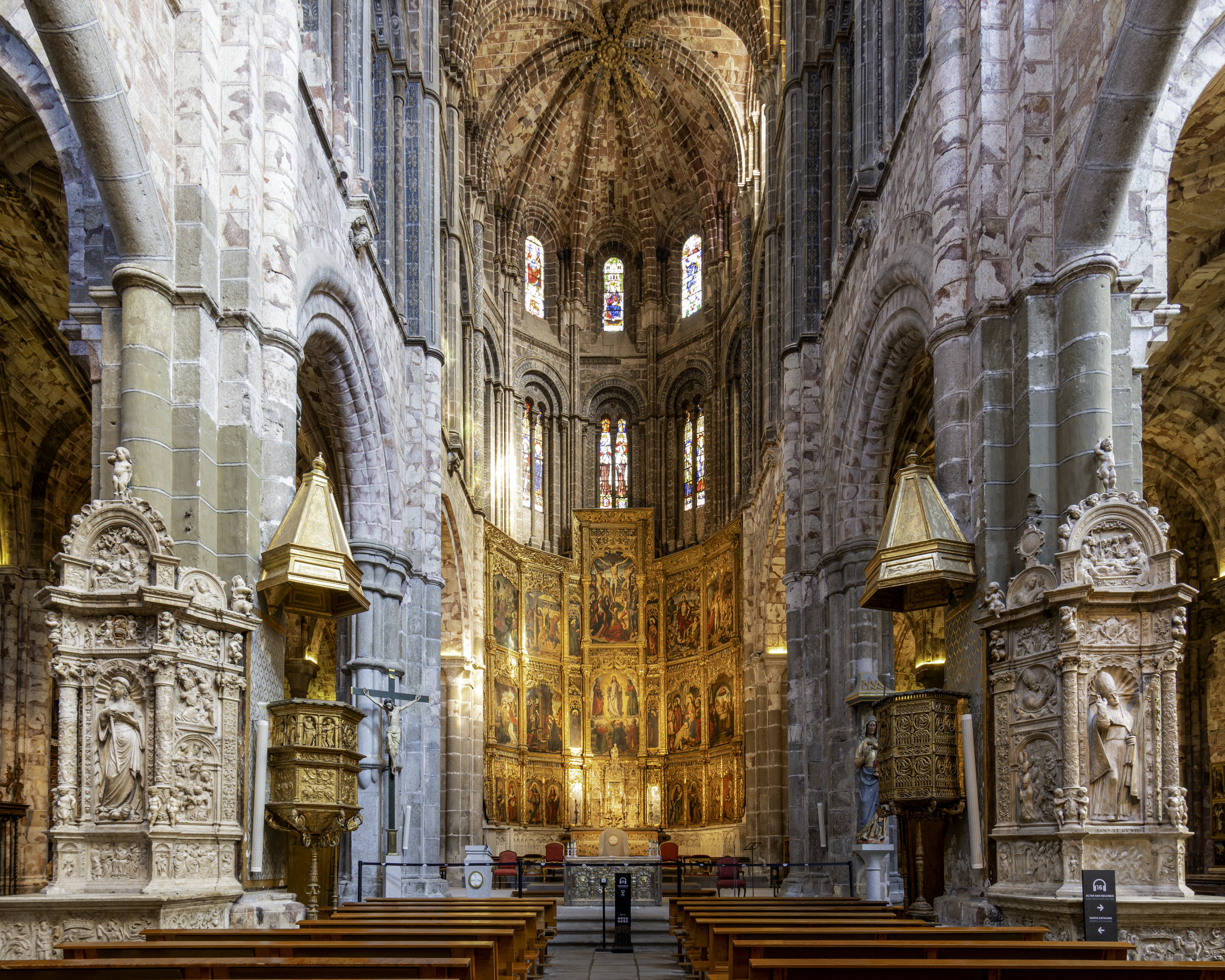
Inside, the cathedral opens into a central nave flanked by two aisles, separated by fine columns and pointed arches that create a sense of lightness unexpected in a fortress church. The vaults use simple quadripartite ribbing. Vasco de la Zarza carved the alabaster baptismal font between 1514 and 1516, and later created the alabaster altars of Saint Secundus, patron saint of Avila, and Saint Catherine in the transept. The plateresque retrochoir bears high-reliefs by Lucas Giraldo showing five scenes from the childhood of Jesus with striking naturalism. The enormous altarpiece was begun by Pedro Berruguete at the turn of the 16th century - eight predellas depicting Evangelists and Doctors of the Church with gold backgrounds - and completed after his death by Bartolome de Santa Cruz and Juan de Borgona. In the ambulatory, the middle panel by Vasco de la Zarza accommodates the tomb of Alonso de Madrigal, the bishop known as El Tostado.
The Goldsmith's Masterwork
The cathedral museum, housed in the sacristies, contains an El Greco portrait and the chalice and paten of Saint Secundus. But its prize is the enormous processional monstrance of 1571, a shrine in six tiers crafted by the goldsmith Juan de Arphe y Villafane. Its central theme is the Sacrifice of Isaac, rendered in precious metal with the kind of obsessive detail that only a master goldsmith could sustain across a work of that scale. The walnut choir stalls, carved by the Flemish sculptor Cornielles de Holanda with help from Lucas Giraldo and others, feature misericords - small shelves hidden beneath hinged seats that allowed monks to rest during long services while appearing to stand. In 2014, the cathedral received a modern burial: former Spanish prime minister Adolfo Suarez and his wife were interred inside, adding a democratic chapter to a medieval story.
From the Air
Located at 40.66N, 4.70W. Avila sits on a high plateau at approximately 1,130 meters elevation in Old Castile. The city's complete medieval walls - among the best preserved in Europe - form a distinctive oval visible from altitude, with the cathedral's apse protruding as part of the eastern wall. Nearest airport is Madrid-Barajas (LEMD), approximately 110 km southeast. Salamanca Airport (LESA) is roughly 100 km to the west. The high plateau terrain and clear air make the walled city a striking visual landmark. Best viewed at 3,000-6,000 feet.