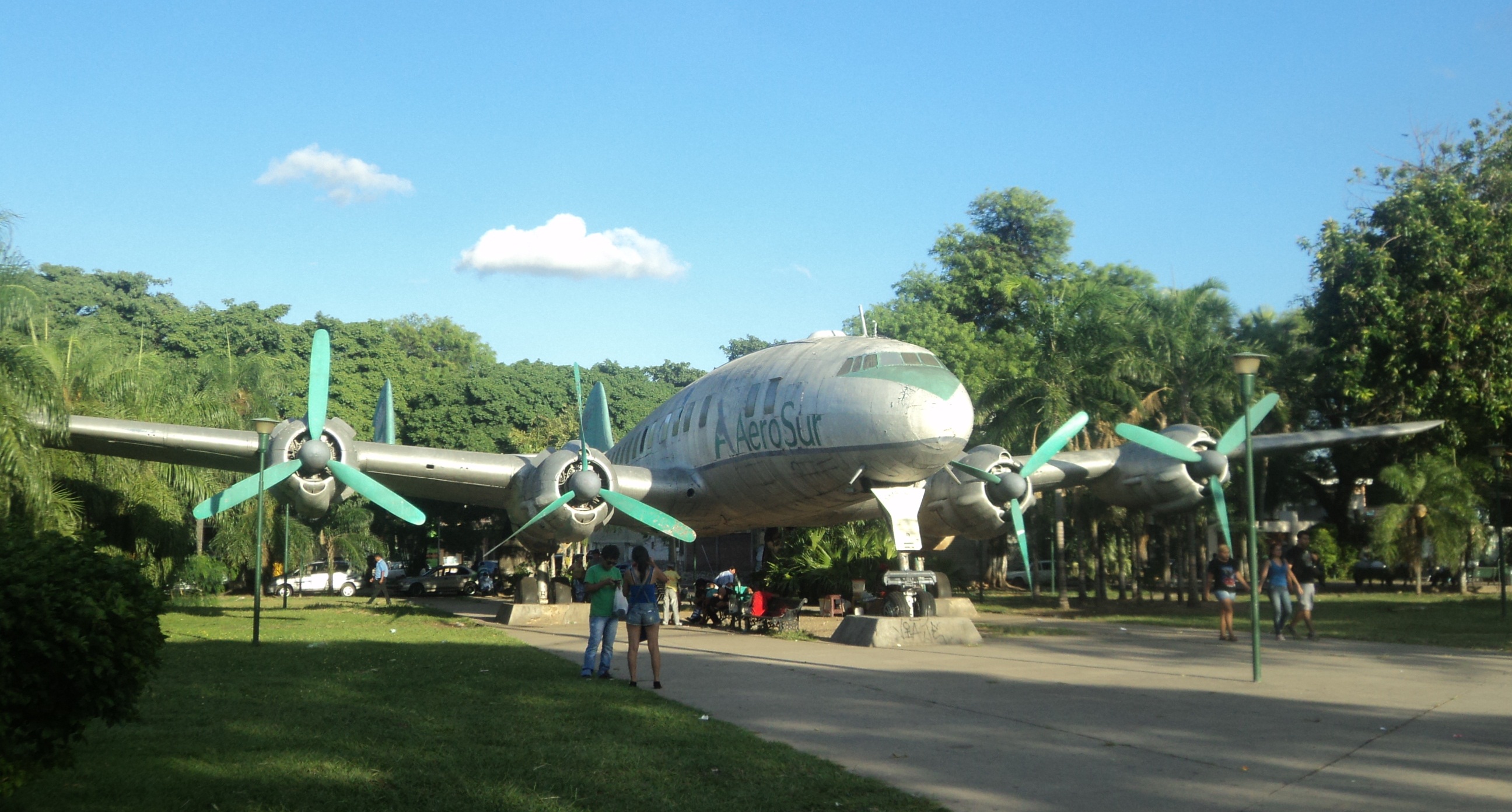
Avion Pirata
On the morning of July 30, 1961, a Lockheed Constellation took off from El Trompillo Airport in Santa Cruz without a flight plan. Within minutes, Bolivian Air Force P-51 Mustangs were in pursuit. The chase ended with gunfire, an emergency landing, a dead fighter pilot, and five arrested foreign crewmen who would later vanish from custody. Bolivians call it the Avion Pirata -- the Pirate Airplane -- and the story has grown into one of the country's most enduring urban legends, a tale of Cold War smuggling, government corruption, and an aircraft that simply refused to disappear.
Night Flights and Contraband
Before the incident that gave it its name, the Constellation had been making nighttime runs into El Trompillo. Locals believed the flights carried cigarettes, textiles, whiskey, television sets, and other contraband between the United States and destinations in Buenos Aires and Arica, Chile. The aircraft, registration N2520B, had lived several lives already. It flew for Braniff International Airways, then Trans American Airlines, before passing through the Empire Supply Company in 1960 and ending up registered to Lloyd Airlines of Miami -- a name that confused many Bolivians, since their own national carrier was Lloyd Aereo Boliviano. On July 29, 1961, the Constellation landed at El Trompillo and sat on the tarmac overnight. When it lifted off the next day heading south, its crew told the control tower they were conducting a practice flight. Nobody believed them.
Mustangs Against a Constellation
El Trompillo's control tower alerted the Fuerza Aerea Boliviana the moment the Constellation departed without clearance. P-51 Mustang fighters scrambled to intercept, ordering the crew to divert to Cochabamba. The Constellation ignored the command. The Mustangs opened fire. Damaged, the Constellation turned back toward El Trompillo for an emergency landing, but during the descent its crew dove sharply in a last attempt to shake the pursuing fighters. Captain Alberto Peredo Cespedes, one of the P-51 pilots, crashed fatally while following the maneuver. The Constellation touched down at El Trompillo, and its crew was arrested on the spot. Military personnel destroyed the aircraft's tires to prevent any further escape, and soldiers were flown in from Cochabamba to secure the airport against feared guerrilla activity.
The Caso Constellation
President Victor Paz Estenssoro ordered an investigation that swept far beyond the five foreigners aboard the plane. Eighty-five soldiers were arrested and 130 more dishonorably discharged, suggesting the smuggling operation had deep roots inside Bolivia's own military. The crew -- American pilots William Roy Robinson and William Friedman, Brazilian co-pilot Salvatore Henrique Romano, flight engineer Bertrand Vinson, and radio operator Gene Hawkins -- faced charges of homicide, piracy, violation of international law, and contraband. They were imprisoned at the Panoptico de La Paz, Bolivia's notorious prison. Three received provisional release, and two were transferred to a hospital under the watch of the American vice-consul. By November 1961, all five had escaped Bolivia. Tried in absentia in 1967, they were each sentenced to ten years. None ever returned. Robinson, the last known survivor among them, died in San Mateo, Florida, in 2010, at the age of 90.
A Pirate's Many Lives
The aircraft itself became a prize nobody quite knew how to claim. A judge awarded it to the Bolivian Air Force as compensation for the lost P-51, but the customs department blocked the transfer, and the Constellation ended up with the military's aviation college instead. In 1979, the Santa Cruz city government took custody and moved the plane to Boris Banzer Prada Park in the El Tao neighborhood, where it has remained ever since. Over the decades, the fuselage has been reinvented repeatedly. It served as a library, then as a branch of the Banco de Credito de Bolivia after a restoration. Pepsi and the now-defunct Bolivian airline Aerosur both used it for advertising. By 2014, television reports showed it falling into disrepair once again. Yet the plane endures, a monument not to aviation but to the kind of story that thrives in the space between fact and folklore -- part Cold War thriller, part smuggling yarn, part cautionary tale about what happens when ambition meets an air force with Mustangs.
From the Air
Located at 17.78S, 63.17W near El Trompillo Airport (SLTR) in Santa Cruz de la Sierra, Bolivia, at an elevation of approximately 416 meters. The aircraft sits in Boris Banzer Prada Park in the El Tao neighborhood. Viru Viru International Airport (SLVR) is the main commercial airport, located about 16 km north of the city. The Constellation's distinctive triple-tail silhouette is not visible from altitude, but the park is identifiable from low approaches. Tropical climate with occasional strong southern winds (surazos) during winter months.