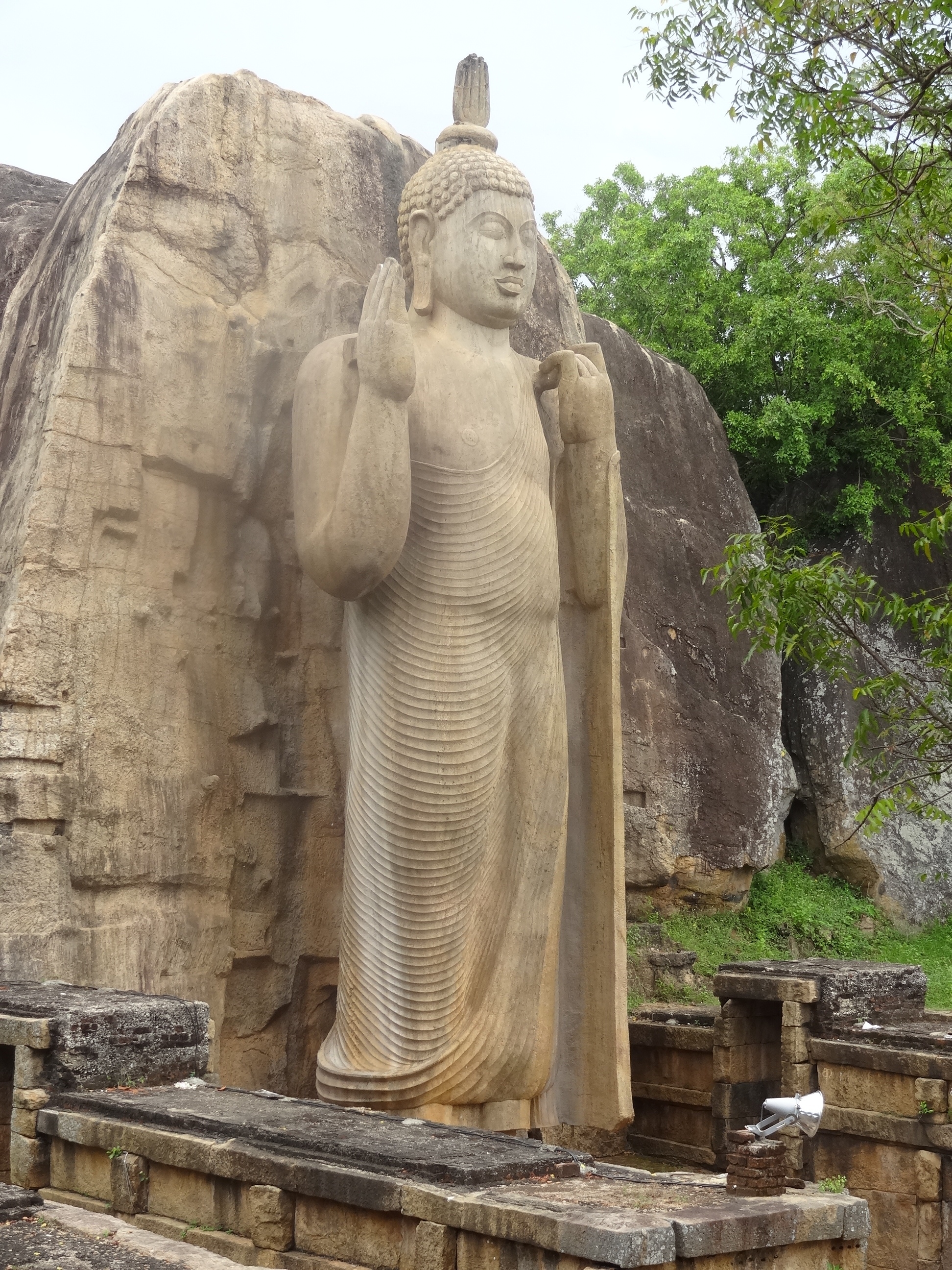
Avukana Buddha Statue
One hand is raised, palm facing outward. Not in greeting, not in warning -- in reassurance. The gesture is called Abhaya mudra, and the Avukana Buddha has held it for fifteen centuries without wavering. Carved from a single granite rock face near the village of Kekirawa in Sri Lanka's North Central Province, this 38-foot standing figure remains partially attached to the cliff behind it by a narrow strip of stone left at the back, as if the mountain were reluctant to let go of what the sculptors pulled from it. The statue faces east, and what it gazes toward matters: the Kala Wewa reservoir, a massive feat of ancient hydraulic engineering. Faith and water, spirit and survival -- at Avukana, they face the same direction.
Granite Made Weightless
The statue stands 38 feet tall on its own, but the lotus pedestal beneath it brings the total to over 46 feet. It is set within a shallow niche in the rock, and the surface behind the figure has been carved to resemble Cyclopean masonry -- massive stone blocks -- creating the illusion of a built wall rather than raw cliff. The effect is deliberate: the Buddha appears to stand before a mountain shrine rather than simply emerging from stone. The image house that once sheltered the statue was 74 feet long and 63 feet wide, with a stone foundation and brick upper walls. Parts of the lower walls remain, but the structure itself is gone, leaving the Buddha exposed to the sky. What survives is enough to understand the scale of devotion the statue inspired -- not just the carving itself, but the architecture built around it. The lotus pedestal is a single piece of stone, its petals rendered with a precision that softens the granite into something almost organic.
The Question of When
Most accounts attribute the Avukana Buddha to the 5th century and the reign of King Dhatusena, the monarch who also built the Kala Wewa reservoir visible from the statue's gaze. That pairing -- the king who tamed water and the king who commissioned stone -- makes for satisfying symmetry. But scholarship resists neatness. Harry Charles Purvis Bell, Ananda Coomaraswamy, and Senarath Paranavithana all weighed in on the dating over the years, and Diran K. Dohanian conducted a comprehensive stylistic analysis comparing the Avukana figure to other Sri Lankan Buddhas and to the Amaravati school of sculpture. His conclusion pushed the date forward to the 8th century. The debate continues, but what is not debated is the statue's quality. Art historians consistently rank Avukana among the finest standing Buddhas produced in ancient Sri Lanka, a judgment that holds regardless of which century the sculptors worked in.
The Guru and the Pupil
A few kilometers away at Sasseruwa stands another standing Buddha, strikingly similar to Avukana but rougher, less refined -- and unfinished. Local legend explains both statues as the result of a competition between a master sculptor and his pupil. The master took Avukana; the pupil, Sasseruwa. Whoever finished first would ring a bell. The master won, and the pupil abandoned his work in defeat. The story accounts for the Sasseruwa statue's incomplete state and for the strong resemblance between the two figures, and for generations the tale was taken at face value. Modern archaeology, however, has complicated things considerably: the Sasseruwa statue appears to predate the Avukana Buddha by roughly four hundred years. The pupil's work came first. Whatever the historical truth, the legend endures because it captures something real about the relationship between these two figures -- the sense that one is the perfected version of an earlier attempt, that mastery required centuries of practice carved in stone.
Facing the Water
The Avukana Buddha does not face the road or the village or any human settlement. It faces east, toward the Kala Wewa, one of the great ancient reservoirs of Sri Lanka's dry zone. This orientation links the statue to the hydraulic civilization that made the Anuradhapura kingdom possible -- a culture that survived not on rainfall alone but on vast engineered networks of tanks and canals that stored and distributed water across the arid landscape. The reservoir and the Buddha share the same story: human ingenuity applied at monumental scale in service of something larger than any single life. Today, pilgrims still arrive from across Sri Lanka to stand before the statue, and the Department of Archaeology has improved the site's facilities. But the essential experience remains unchanged -- the encounter with a figure that has watched over this landscape with one hand raised, promising that there is nothing to fear, since the day someone decided that granite could be made to speak.
From the Air
Avukana Buddha statue (8.023N, 80.520E) is located near Kekirawa in North Central Sri Lanka, at low elevation in the dry zone. The statue faces east toward the Kala Wewa reservoir, which is visible from the air as a large body of water. The site is approximately 50km south of Anuradhapura. Best viewed at lower altitudes in clear conditions. Nearest major airport is Bandaranaike International (VCBI/CMB), approximately 160km southwest. The Anuradhapura area airstrip (no ICAO code currently assigned for commercial use) is closer but limited.