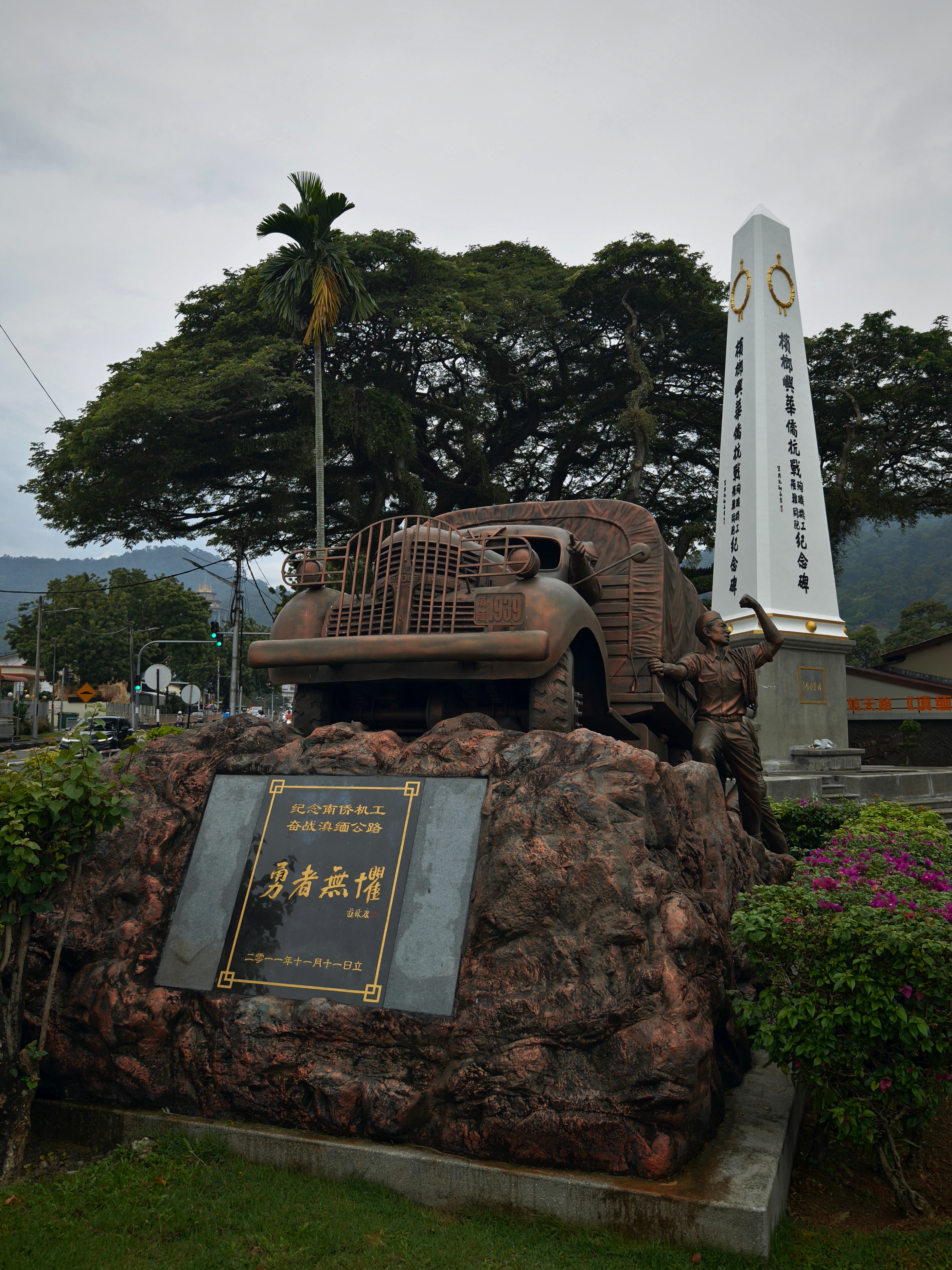
Ayer Itam War Memorial Park
The obelisk is white, and it has seven steps. That number is not architectural whim -- it marks 7 July 1937, the date of the Marco Polo Bridge Incident that ignited the Second Sino-Japanese War. In the Ayer Itam suburb of George Town, Penang, this memorial stands over the exhumed remains of people the Japanese military police killed during the Sook Ching purges. Between 1950 and 1951, workers recovered roughly 800 incomplete skeletons from mass graves scattered across Penang Island -- at Ayer Itam, Gelugor, Tanjong Bungah, and Batu Ferringhi. The memorial unveiled on Armistice Day 1951 was built to ensure those bones, and the people they belonged to, would not be forgotten.
Drivers on the Burma Road
The story of Penang's Chinese wartime resistance begins not in Malaya but in the mountains along the Sino-Burmese border. When Japan blockaded China's maritime trade routes, the Chinese government accelerated construction of the Burma Road -- a lifeline that required some 200,000 laborers to carve through mountainous terrain. In 1939, Singapore-based businessman Tan Kah Kee organized a mobilization of volunteer drivers and mechanics from across British Malaya. More than 3,200 men answered the call, including 358 from Penang. These were not soldiers but civilians -- drivers and mechanics who hauled supplies along switchbacks under continuous Japanese aerial attack. The volunteers from Penang were part of a larger Chinese diaspora effort that kept supplies moving into China when every other route had been severed.
The Relief Fund and the Reckoning
Penang's Chinese community had been politically active since the establishment of the Republic of China and the Kuomintang's unification campaigns in the early 20th century. As tensions between China and Japan escalated, Penang's Chinese imposed a unilateral embargo on Japanese trade and organized civil protests. After the Second Sino-Japanese War erupted in 1937, the community formed the Penang China Relief Fund to send money to war victims. This support did not go unnoticed. When Japan invaded Malaya in December 1941 and captured Penang on the 19th, the Kempeitai -- the Japanese military police -- launched the Sook Ching purges. Ostensibly targeting political opposition and subversives, the campaign was in reality aimed at the Chinese population that had funded China's resistance. The Penang China Relief Fund later documented over 1,600 Chinese victims, many buried in unmarked mass graves across the island.
Bones from Four Towns
Nine years after the war ended, the reckoning with what lay beneath Penang's soil began. Between 1950 and 1951, exhumation teams unearthed approximately 800 incomplete skeletons at sites across Penang Island. The mass graves were found at Ayer Itam, Gelugor, Tanjong Bungah, and Batu Ferringhi -- suburban areas where the killings had been carried out away from the city center. The remains told a grim, fragmentary story. Many skeletons were incomplete, making individual identification impossible. What could be determined was the scale: the documented 1,600 victims represented only the cases the Relief Fund could confirm. The true number remains unknown. On 11 November 1951, Armistice Day, the memorial was officially unveiled at Ayer Itam, giving these remains a permanent resting place and a public marker of what had happened.
Bronze Trucks on a Mountain Road
In 1952, the Penang China Relief Fund was disbanded and the memorial's stewardship passed to the trustees of Kong Min School, which manages a network of Chinese primary schools in the area. The memorial might have quietly faded from public attention, but a major upgrade in 2011, costing RM400,000, ensured it would not. The renovation added a bronze sculpture depicting volunteer transport workers pushing a truck up a steep slope along the Burma Road -- a scene the 358 Penang volunteers would have recognized. A relief wall now displays carvings of trucks and volunteers under attack by Japanese warplanes, connecting the memorial's commemorative purpose to the specific history of Penang's contribution to China's wartime supply chain. The site continues to host annual Remembrance Day ceremonies, drawing community members who gather beneath the seven-stepped obelisk to honor lives that war erased and memory has worked to restore.
From the Air
Located at 5.41N, 100.28E in the Ayer Itam suburb of George Town, Penang, at the base of the hills in the island's interior. The memorial park is surrounded by residential neighborhoods on the western side of Penang Island. Nearby airport: Penang International (WMKP), approximately 10 km to the south. Best viewed at low altitude (2,000-3,000 feet). The Kek Lok Si Temple complex is visible on the hillside nearby, making a useful landmark for orientation.