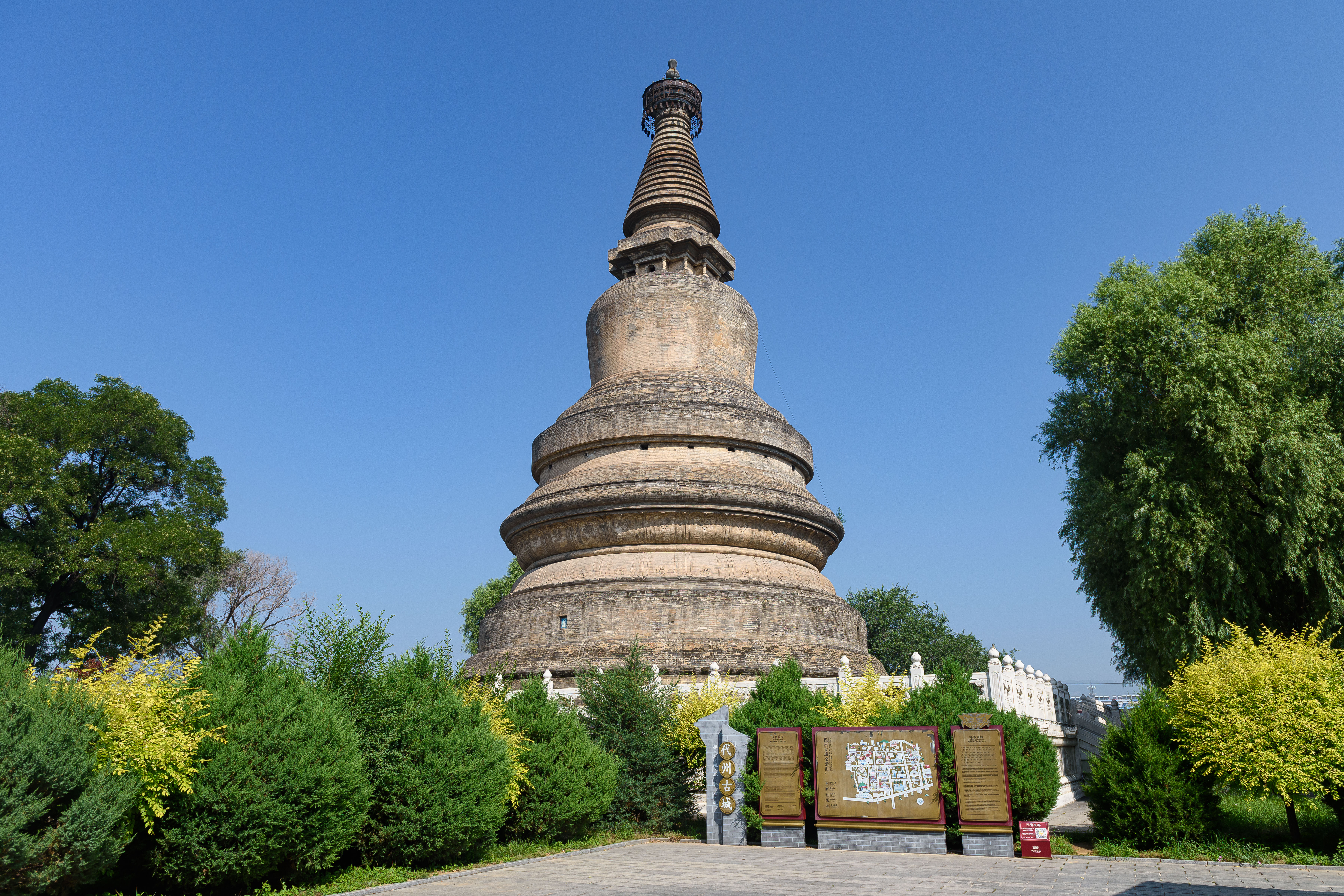
Ayuwang Pagoda
The name reaches across twenty-three centuries and two civilizations. Ayuwang is the Chinese rendering of Ashoka, the Mauryan emperor who unified most of the Indian subcontinent in the third century BC and, after a battlefield conversion, became Buddhism's greatest royal patron. That a pagoda in Dai County, northern Shanxi Province, still carries his name testifies to the extraordinary reach of the religious network Ashoka helped create. First built in 601 AD under the Sui dynasty, the Ayuwang Pagoda has been destroyed and rebuilt three times -- each reconstruction reflecting the Buddhist traditions and political realities of its era.
An Emperor's Legacy in Stone
Ashoka's conversion to Buddhism around 263 BC transformed the religion from a regional Indian movement into a transcontinental force. According to tradition, Ashoka ordered the construction of 84,000 stupas across Asia to house Buddhist relics, a number meant to convey abundance rather than precision. The Chinese pagodas that bear his name -- Ayuwang in Mandarin -- honor this legacy, linking themselves to the founding era of Buddhist architecture even when their actual construction dates fall centuries later. In Dai County, nestled in the northeastern corner of Xinzhou Prefecture, the Ayuwang Pagoda first rose in 601 AD, during the Sui dynasty's brief but energetic reunification of China. The Sui emperors were Buddhist patrons who saw the faith as a unifying force for their newly reassembled empire.
Three Destructions, Three Resurrections
Over the next six centuries, the pagoda was destroyed and rebuilt three times. Each cycle of destruction erased the physical structure while the institutional memory and religious commitment needed to rebuild it survived. The pagoda's current form dates to the Yuan dynasty, when Mongol rulers under Kublai Khan controlled China. The Yuan court favored Tibetan Buddhism, and when they rebuilt the Ayuwang Pagoda, they chose a Tibetan-style dagoba design -- a rounded, whitewashed form fundamentally different from the tiered, multi-story pagodas typical of Chinese Buddhist architecture. The choice was a statement of cultural authority: the Mongols rebuilt this ancient monument in the image of their own preferred tradition, layering Tibetan Buddhist aesthetics onto a site with deep Chinese roots.
Earthquake and Repair
Even the Yuan-era reconstruction did not prove permanent. During the Qing dynasty, an earthquake heavily damaged the dagoba, cracking its structure and threatening its collapse. The subsequent repair preserved the Tibetan-style design while reinforcing the damaged masonry. The pagoda that stands today is therefore a palimpsest: a Sui dynasty foundation concept, rebuilt in Yuan dynasty Tibetan form, repaired under Qing dynasty supervision. Each layer represents a different moment in China's long, complicated relationship with Buddhism -- a religion that arrived from India, was adapted by Chinese culture, was suppressed and revived multiple times, and was periodically reshaped by the preferences of non-Chinese rulers who controlled northern China for much of the last millennium.
The View from Dai County
Dai County sits in a valley flanked by mountains in the northeastern corner of Xinzhou Prefecture, a region better known for the sacred Buddhist mountain of Wutai to the east than for its own scattered temples and pagodas. The Ayuwang Pagoda, with its distinctive Tibetan profile, stands as a reminder that Buddhism in northern Shanxi was not monolithic. Chinese Chan, Tibetan Vajrayana, and various regional traditions coexisted and competed here for centuries, each leaving its mark on the landscape. From the air, the white dagoba is visible against the valley floor, a compact vertical accent in a terrain of terraced fields and low-rise towns. It is a small structure bearing a very large name, connecting a county in Shanxi to an emperor in India through 2,300 years of shared religious history.
From the Air
Located at 39.07N, 112.95E in Dai County, Xinzhou Prefecture, Shanxi Province. The pagoda's white dagoba form is distinctive from the air against the valley floor. Nearest airport is Xinzhou Wutaishan Airport (ZBXZ), approximately 30 km to the east. Mount Wutai, a UNESCO World Heritage Site, is also nearby. Terrain is mountainous valley; approach with standard mountain flying precautions.