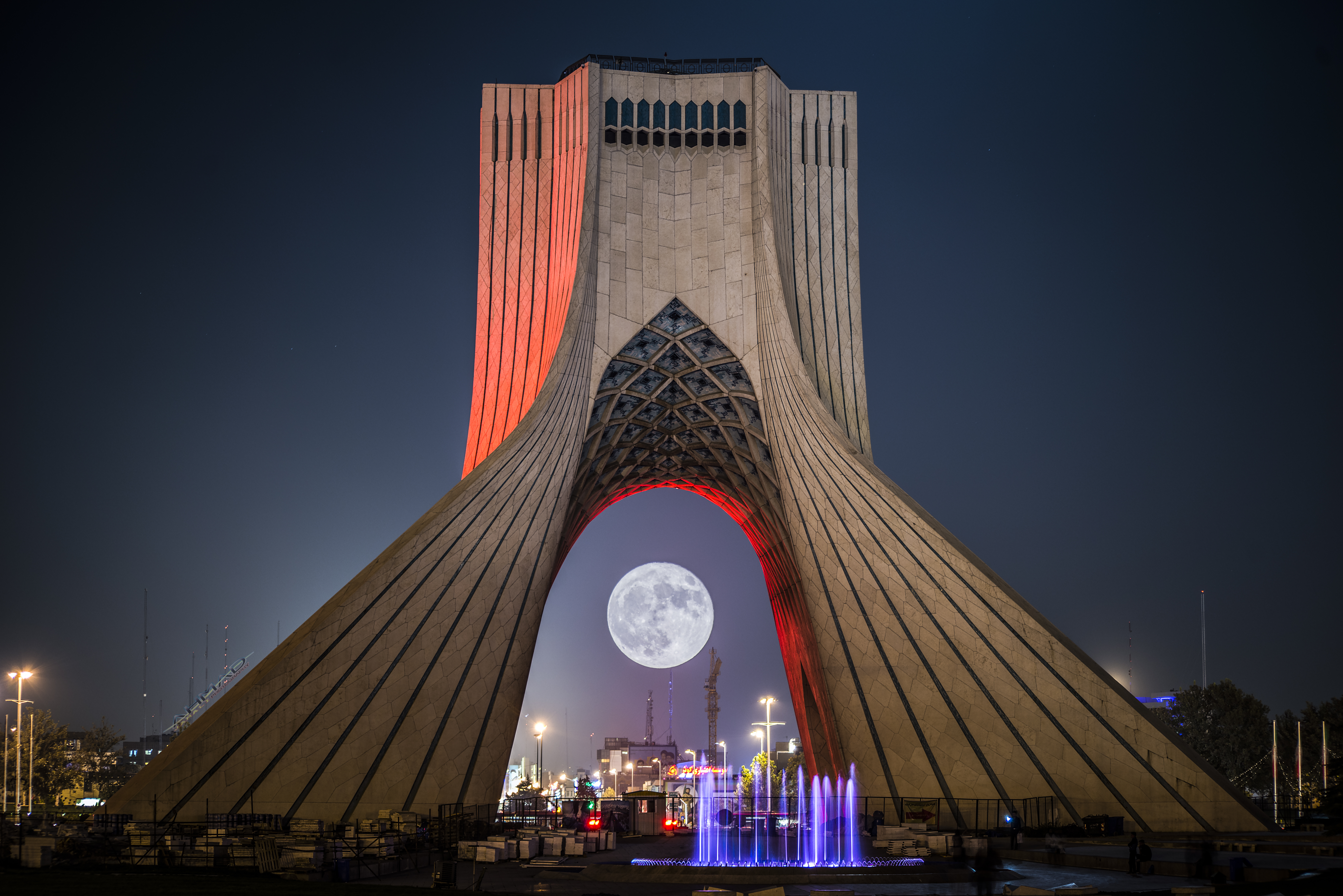
Azadi Tower
Hossein Amanat had just graduated from the University of Tehran when he abandoned his plans to study in the United States. Instead, he set up an architecture studio in his bedroom and entered a competition to design the most important monument in modern Iran. He was twenty-four years old. The structure he conceived -- a 45-meter tower clad in 8,000 blocks of white Isfahan marble, its arches fusing Sasanian classicism with medieval Islamic geometry -- would become Tehran's most recognized landmark. Built in 1971 to celebrate 2,500 years of Persian Empire, it was named Shahyad, the Shah's Memorial. Eight years later, the revolution that toppled the Shah renamed it Azadi: Freedom. The tower outlasted the dynasty that built it and the ideology that rechristened it. It simply stands.
Stone from Isfahan, Ideas from Everywhere
The design is deceptively simple from a distance: a towering inverted Y shape rising from a broad base. Up close, the complexity reveals itself. The main vault is a Sasanian arch, the form that dominated Persian architecture during the classical era. Above it sits a broken arch, the medieval Islamic variation that followed. Connecting the two is a lattice of structural ribs -- Amanat's representation of the continuity between Iran's ancient and post-classical civilizations. Every block of the white marble cladding was cut to a unique shape, the curves and ribs demanding precision that required early computer modeling, a technological novelty in 1960s Iran. Amanat enlisted the British engineering firm Arup -- the same company behind the Sydney Opera House -- to handle the structural calculations. This choice drew opposition from nationalist Iranian engineers, but the Shah himself intervened, sending a letter that left the decision to the architect.
The Sultan of Stone
Sourcing 8,000 marble blocks required a particular kind of expertise. Ghanbar Rahimi, known as the Sultan of Stone of Iran for his encyclopedic knowledge of the country's quarries, located and supplied every piece from Isfahan province. The main contractor, Ghaffar Davarpanah Varnosfaderani, was a master stonemason whose craft would be tested by the tower's mathematically complex surfaces. Five hundred Iranian industrialists funded the project, which cost approximately six million dollars. The inauguration took place on October 16, 1971, during the lavish celebrations marking 2,500 years of the Persian Empire -- festivities that critics would later cite as emblematic of the Shah's extravagance. The tower opened to the public on January 14, 1972, its underground museum displaying a copy of the Cyrus Cylinder, pottery from Gorgan, illuminated Qurans, and miniature paintings tracing Iranian civilization across millennia.
Gateway and Kilometre Zero
The tower marks the western entrance to Tehran, standing at Azadi Square where the highways from Karaj and western Iran converge on the capital. It also serves as Iran's kilometre zero -- the point from which all distances in the country are measured. Before the tower existed, this entrance to Tehran was unremarkable. Amanat described his vision to the BBC: the building starts from the base and moves upward toward the sky, because he felt Iran should be moving toward a higher level. The names the tower accumulated before its completion trace the ambitions attached to it: first the Gate of Cyrus, then the Imperial Gate, finally Shahyad Aryamehr. Each name reached further back into Persian history, anchoring a modern monument to ancient legitimacy.
A Monument Renamed
The 1979 Islamic Revolution swept away the Pahlavi monarchy and with it the tower's name. Shahyad became Azadi -- Freedom -- and the square around it became the site of political demonstrations for decades to come. During the contested 2009 presidential election, massive crowds gathered at Azadi Square in protest, the tower serving as backdrop and symbol for a movement that took its imagery from the very name the revolutionaries had given the structure thirty years earlier. Amanat himself left Iran after the revolution and has watched from abroad as his creation took on meanings he never designed into it. The tower belongs to no single era. Sasanian arches, Islamic geometry, Pahlavi ambition, revolutionary renaming, and democratic protest have all layered themselves onto 8,000 blocks of marble that a twenty-four-year-old once sketched in his bedroom.
From the Air
Located at 35.70°N, 51.34°E at Azadi Square on the western edge of Tehran. The white marble tower is a highly visible landmark from altitude, standing prominently at the convergence of major highways entering the city from the west. Mehrabad International Airport (OIII) is approximately 5 km to the east-southeast, making the tower one of the first recognizable features when approaching Tehran from the west. Imam Khomeini International Airport (OIIE) lies about 45 km to the south. The Alborz Mountains frame the northern horizon. In clear weather, the tower's white marble contrasts sharply with the surrounding urban landscape.