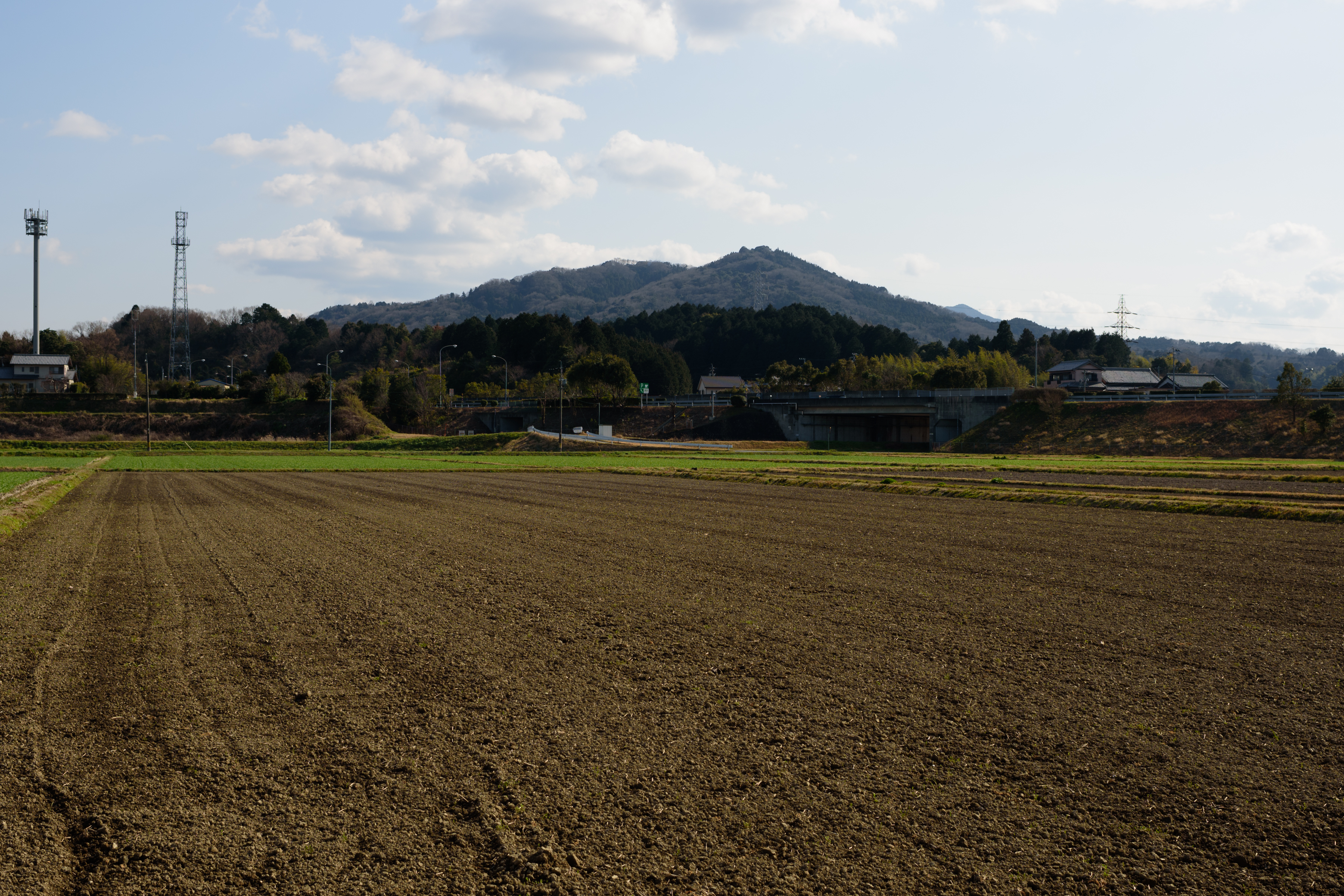
Azaka Castle
Toyotomi Hideyoshi conquered all of Japan. He invaded Korea twice. He commanded armies of hundreds of thousands. And in all those decades of warfare, only one person ever managed to wound him in battle: a castle defender named Omiya Yoshiyuki, who put an arrow through Hideyoshi's thigh at a mountain fortress called Azaka in 1567. The castle itself is gone now -- reduced to earthen ridges and dry ditches on a forested hilltop above the city of Matsusaka in Mie Prefecture. But the story of the arrow endures as one of the more satisfying footnotes in Japanese military history: the most powerful warlord of his age, brought low by a single archer defending a provincial stronghold on a 312-meter peak overlooking Ise Bay.
A Castle That Is Really Two
The name Azaka Castle is a misnomer. What sits on this mountain is actually a pair of fortifications separated by 250 meters of forested ridge, each with its own identity and purpose. The southern portion, known as Shiinogi Castle, is the larger and more complex of the two. Its defenses are built around two narrow plateaus connected by a system of dry moats and earthen walls, with vertical moats cut into the western slope to prevent flanking attacks. The northern section, called Hakumai Castle, occupies higher ground and is visible from Matsusaka below. Its base enclosure forms a 45-by-60-meter trapezoid, while the upper enclosure is a 20-by-35-meter oval with small trapezoid bastions at each corner. Two additional satellite forts -- Taka Castle and Karatachi Castle -- were built by the Omiya clan, vassals of the Kitabatake, to extend the defensive perimeter. Together, the ruins sprawl 180 meters east to west and 330 meters north to south, all within the borders of Ise-Shima National Park.
Built for a Civil War
Azaka Castle was born from the great schism that split medieval Japan into two rival courts. In 1335, Kitabatake Chikafusa entered Ise Province with his three sons -- Akiie, Akinobu, and Akiyoshi -- under orders from Emperor Go-Daigo to seize the province from the Toki clan, who backed the rival Northern Court. The Kitabatake were fierce loyalists of the Southern Court, and Azaka became their mountain stronghold in a conflict that would drag on for decades. Eighty years later, in 1415, the castle proved its worth again when Kitabatake Mitsumasa rallied loyalists from the provinces of Kii, Yamato, and Kawachi to resist the Ashikaga shogunate's opposition to the coronation of Emperor Shoko. An army led by Isshiki Yoshitsura laid siege to Azaka but failed to take it. The mountain held.
The Arrow That Found Its Mark
Azaka Castle disappeared from the historical record for over a century before resurfacing in 1567, during the wars of unification that would reshape Japan. By then, Oda Nobunaga was methodically conquering the provinces around his base in Owari, and Ise was next. He sent his general Takigawa Kazumasu to take Azaka, but the castle's defender, Omiya Yoshiyuki, repelled attack after attack from the mountain's fortified ridges. Nobunaga then dispatched the man who would later become Japan's supreme ruler: Toyotomi Hideyoshi, then still known as Kinoshita Tokichiro. Hideyoshi took the castle through a ruse rather than brute force. But in the fighting, an arrow fired by Omiya Yoshiyuki struck him in the thigh. Hideyoshi would go on to unify Japan, launch two invasions of Korea, and die one of the most powerful men in East Asia. That arrow at Azaka was the only combat wound he ever suffered.
What the Mountain Remembers
Today, very little of Azaka Castle survives above ground. Fragments of earthworks and the outlines of dry moats are all that mark where Kitabatake loyalists once held out against shoguns and warlords. A stone monument stands at the southern end of the castle enclosure, commemorating the site. The ruins were designated a National Historic Site in 1982, recognized alongside the remnants of Taka Castle and Karatachi Castle as a collective testament to the Kitabatake clan's centuries-long grip on northern Ise. Reaching the site requires a one-hour hike from the Iwakuraguchi bus stop, served by Mie Kotsu Bus No. 48 from Matsusaka Station on the JR Kisei Main Line. The climb winds through forest with occasional views of Ise Bay and the distant mountains of what was once Mikawa Province. It is a quiet place now, but the terrain itself -- the steep slopes, the narrow plateaus, the ridgeline that funnels any approach -- explains why the castle stood for so long and cost Hideyoshi his only scar.
From the Air
Located at 34.595N, 136.454E on a 312-meter mountain overlooking Ise Bay, within the borders of Ise-Shima National Park in Mie Prefecture. The twin fortification sites occupy a forested ridgeline that is visible from altitude as a distinct peak above the Matsusaka plain. Ise Bay is clearly visible to the east, with the mountains of the former Mikawa Province beyond. Nearest airports: Chubu Centrair International Airport (RJGG) approximately 70nm northeast, Tsu Airfield (RJAN) approximately 20nm north. The city of Matsusaka spreads below the mountain to the south and east.