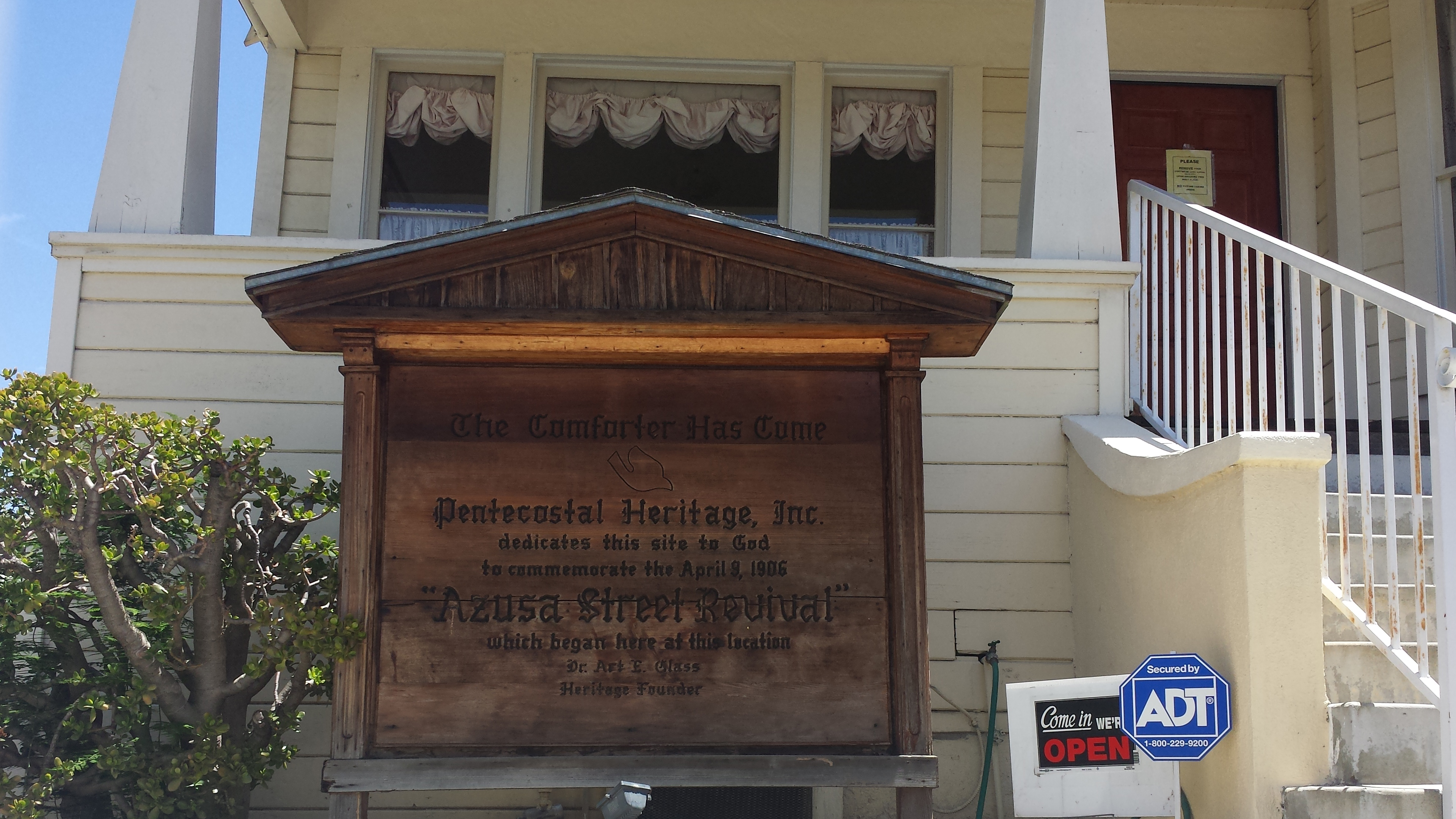
Azusa Street Revival
The building at 312 Azusa Street in Los Angeles was a 60-by-40-foot former livery stable that had most recently served as an African Methodist Episcopal church before being converted to a tenement, then left vacant. The lumber was rough, the plaster flaking, the roof leaking. On April 9, 1906, a 34-year-old minister named William J. Seymour led a prayer meeting there that lasted for years. The Los Angeles Times covered it under the headline 'Weird Babel of Tongues' and described it as a fringe spectacle. Within a generation, it had become the seed of the fastest-growing religious movement in the world.
William Seymour and the Meeting on Bonnie Brae
William Joseph Seymour was born in 1870 in Centerville, Louisiana, the son of formerly enslaved people. He came to Los Angeles in 1906 to preach at a small Holiness church on Santa Fe Street, was locked out of that church after a single service because his theology alarmed the pastor, and continued his meetings in a private home on Bonnie Brae Street. The initial group numbered around 50 to 60 people, a multiracial congregation unusual for the era. When the meetings at the Bonnie Brae house grew too large for the space, the group moved to the vacant building on Azusa Street. Attendance grew rapidly, often exceeding a thousand people at a time, gathered in a space that was never designed for that purpose.
What Happened at Azusa Street
The Azusa Street Revival was characterized by speaking in tongues — what practitioners called glossolalia, the spontaneous utterance of languages unknown to the speaker, understood in Pentecostal theology as a sign of baptism in the Holy Spirit. Services at the mission were highly improvisational: no set order of worship, no paid choir, no professional clergy running the proceedings in any conventional sense. Seymour preached from behind two wooden crates stacked together as a pulpit. The revival continued around the clock for extended periods, drawing participants from across the country who arrived, experienced the services, and then returned to their home communities carrying the theology and the practice with them.
A Theology Without Racial Hierarchy
In 1906 Los Angeles, and across the Jim Crow South, the kind of integrated worship that characterized the Azusa Street Mission was extraordinarily rare. White and Black worshippers prayed side by side, led by a Black minister in a city that maintained its own, less formal versions of racial separation. This interracial character was part of what made the revival notable to observers at the time, and it became significant to later scholars examining the revival's social dimensions. Seymour's theology held that the gifts of the Spirit — speaking in tongues, healing, prophecy — were available to all believers regardless of race or social standing. The practice reflected the belief.
The Global Movement It Launched
Historians of religion generally credit the Azusa Street Revival as the primary catalyst for global Pentecostalism, now the fastest-growing branch of Christianity in the world. Participants who attended the Los Angeles meetings carried Pentecostal practice to every continent within a few years. Missionaries went to Africa, Latin America, and Asia; denominations formed that would become, by the 21st century, some of the largest Christian bodies in the world. The Assemblies of God, Church of God in Christ, and dozens of other Pentecostal and charismatic denominations trace their origins, directly or indirectly, to what began in that leaking building on Azusa Street. Seymour continued to lead the mission until approximately 1915, when the revival gradually wound down.
From the Air
The site of the Azusa Street Mission is at 34.0484°N, 118.2411°W in downtown Los Angeles, a few blocks northeast of the Los Angeles Convention Center and near the 101 freeway. The building no longer exists; the site is now in the commercial district near Little Tokyo. From the air, the dense urban core of downtown Los Angeles surrounds the location. Nearest airports: Burbank Bob Hope (KBUR) 11 miles northeast, Hawthorne (KHHR) 9 miles southwest, Los Angeles International (KLAX) 12 miles southwest.