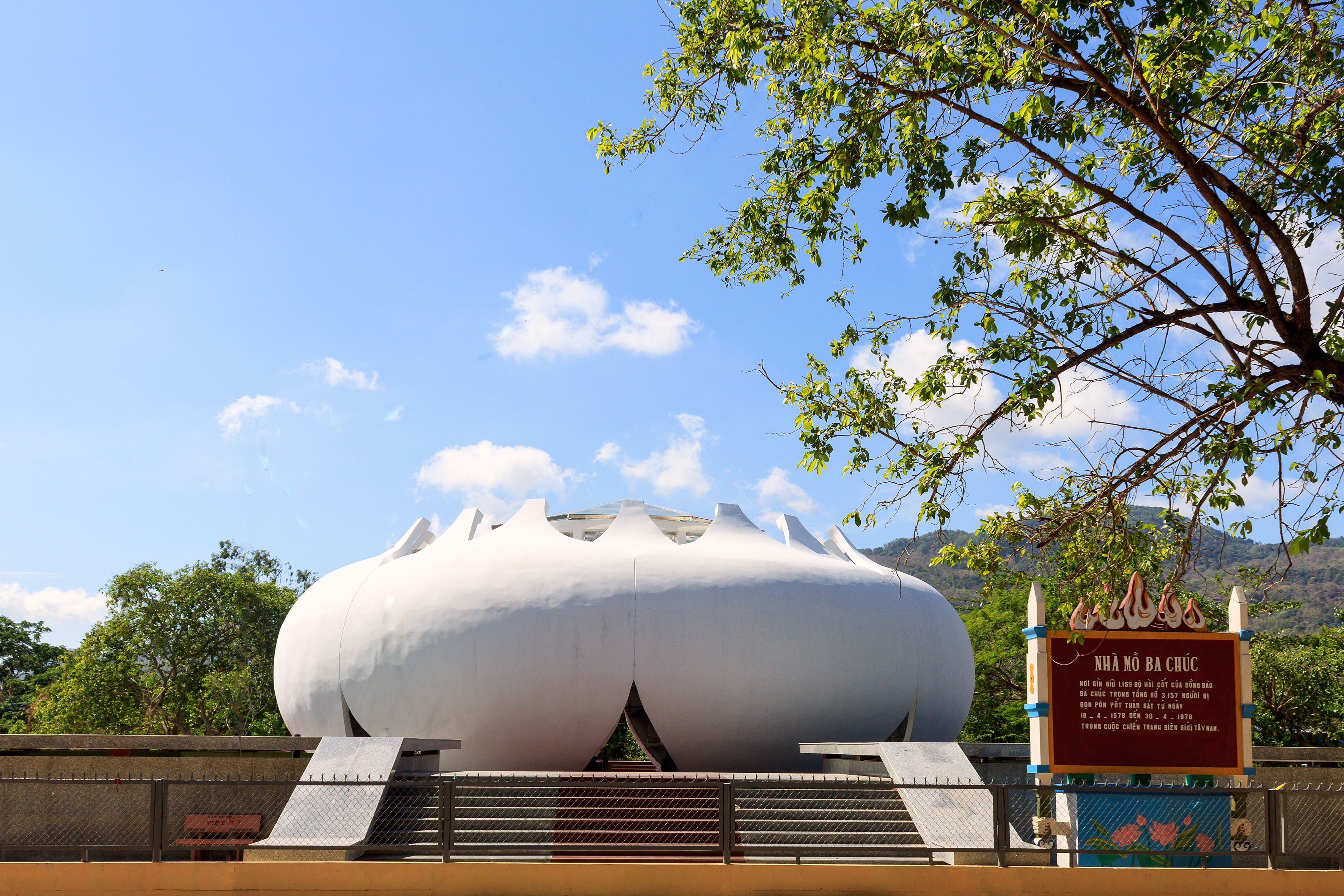
Ba Chuc Massacre
Nguyen Van Kinh woke beneath a pile of corpses. His wife, four children, and six grandchildren lay dead around him. In the darkness, he crawled free and hid in a cave on Elephant Mountain, listening to the screams of the mutilated echoing through the Mekong Delta night. It was late April 1978, and the Khmer Rouge had spent twelve days turning the small Vietnamese town of Ba Chuc into a killing field just 6.4 kilometers from the Cambodian border.
A Border That Bled
The violence at Ba Chuc did not erupt without warning. For years, the Khmer Rouge had been probing Vietnam's southwestern frontier, their cross-border raids growing bolder and more lethal with each incursion. In March 1977, they struck Kien Giang Province. Days later, they hit An Giang. On the Mid-Autumn Festival in September 1977, Khmer Rouge forces pushed ten kilometers deep into Tay Ninh Province, killing 592 residents in a single assault. The Central Khmer Rouge shelled Chau Doc, the provincial capital of An Giang, and a May 1977 attack killed 222 civilians in one day. These were not skirmishes between armies. They were systematic attacks on villages, on families, on anyone the Pol Pot regime considered an enemy -- and to the Khmer Rouge, every Vietnamese person qualified.
Twelve Days in April
On April 18, 1978, the Kampuchea Revolutionary Army crossed the border, surrounded Ba Chuc, and cut every road into town. What followed was methodical. Soldiers went house to house, looting valuables and slaughtering livestock before setting the buildings ablaze. They herded villagers into the town's temples and schools -- places of learning and worship turned into execution chambers. The killing methods were personal: victims were shot, stabbed, or beheaded. Those who fled toward the Bảy Núi mountains were hunted down and slaughtered in the surrounding countryside. By the time the Khmer Rouge withdrew on April 30, they left behind land mines that killed or injured another 200 people. The final count stood at 3,157 civilians dead -- nearly the entire population of the town.
The War That Followed
Ba Chuc became a turning point. At the end of 1978, Pol Pot mobilized ten divisions for a full-scale invasion of Vietnam, but the Vietnamese struck first. On December 7, 1978, the Political Bureau of the Communist Party of Vietnam authorized military action to overthrow the Khmer Rouge. The Kampuchean Revolutionary Army, overestimating its own strength, chose to fight the Vietnamese head-on rather than retreat into guerrilla warfare. It was a catastrophic miscalculation. The far more experienced Vietnamese military crushed the Khmer Rouge within two weeks. On January 7, 1979, Phnom Penh fell, and the Khmer Rouge fled across the Thai border, ending the Cambodian genocide that had consumed an estimated two million lives.
What Remains at Ba Chuc
In 1979, the An Giang provincial government built a cemetery for the dead. The two temples where the massacres took place are now designated national historical sites, and every year on the 15th and 16th of March by the lunar calendar, collective ceremonies honor the victims. In 2011, the province allocated 30 billion Vietnamese dong to rebuild the memorial complex, which now spans 50,000 square meters. At its center sits a burial chamber containing the remains of 1,159 victims whose bodies were never claimed -- including 1,017 skulls, catalogued by age and gender. The memorial hall displays photographs and artifacts from the massacre, bearing witness in a manner that deliberately echoes the Tuol Sleng Genocide Museum across the border in Phnom Penh. Ba Chuc insists on remembering. The skulls stare out from behind glass, each one a person with a name, a family, a life interrupted by ideology turned murderous.
From the Air
Located at 10.50N, 104.90E in An Giang Province, southwestern Vietnam, approximately 6.4 km from the Cambodian border. The memorial site is visible as a large complex amid the flat Mekong Delta landscape. Nearest airports include Can Tho International Airport (VVCT) approximately 90 km southeast. The Bay Nui (Seven Mountains) area rises from the surrounding delta flatlands, providing a visual reference point. Best viewed at 3,000-5,000 feet for context of the border proximity.