Baan Dam Museum
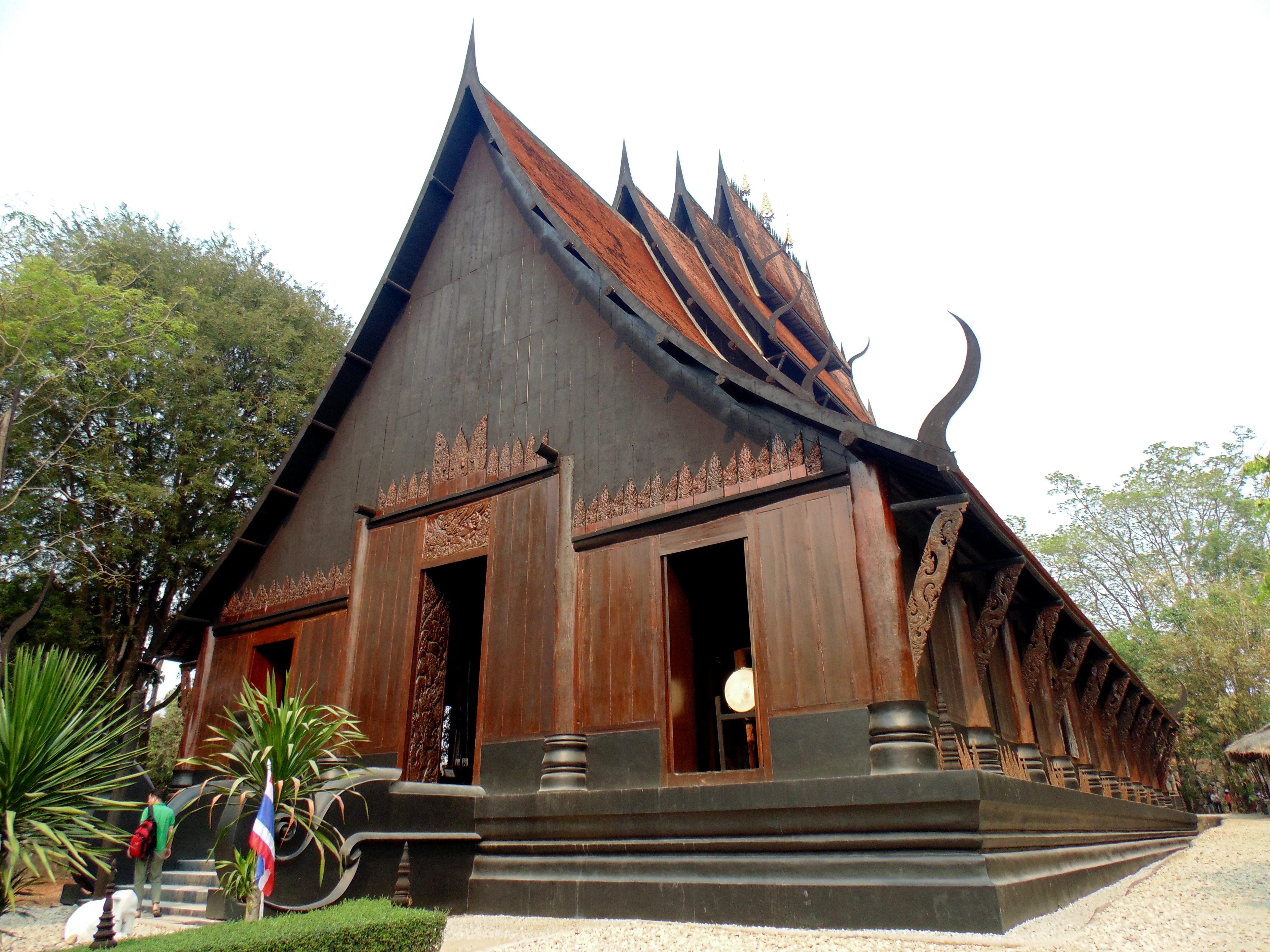
Most museums are built to house art. Baan Dam -- the Black House -- is a museum that is the art. Spread across 160,000 square meters of land north of Chiang Rai, this compound of more than 40 buildings was the life's work of Thawan Duchanee, one of Thailand's most celebrated and provocative contemporary artists. Starting in 1975 and continuing until his death in 2014, Thawan designed each structure as a fusion of traditional Lanna architecture and his own darkly surreal aesthetic. Animal skulls hang from rafters. Crocodile skins drape over furniture carved from massive tropical hardwoods. The buildings themselves -- raised on stilts, crowned with steeply pitched multi-tiered roofs, finished in black -- feel like temples dedicated to something older and wilder than any single religion. Visitors expecting a conventional gallery find instead a landscape-scale artwork where architecture, sculpture, and the natural world merge into a single unsettling, magnificent vision.
The Artist Who Built a World
Thawan Duchanee was born in Chiang Rai in 1939 and trained at Silpakorn University in Bangkok before studying in Amsterdam. He returned to northern Thailand not to retreat from the international art world but to construct an alternative to it. Where Bangkok's galleries offered white walls and fluorescent lighting, Thawan wanted his work experienced in spaces he controlled completely -- from the angle of the roof beams to the quality of the shadows on the floor. Baan Dam began as a single building in 1975, the Tri Phum or Triangle House, a triangular wooden structure laid along an east-west axis. It was destroyed by storms three times and rebuilt each time, taking seven years in total. The stubbornness required to rebuild a building three times tells you something about the man: Baan Dam was not a project with a completion date. It was a practice, renewed daily for four decades.
Darkness as a Design Language
The compound's Thai name, Baan Dam, translates literally as "Black House," and the color pervades everything. Dark-stained teak, blackened roof tiles, and deep shadows beneath raised floors create an atmosphere closer to a sacred forest than an art museum. Each of the more than 40 structures has its own name and purpose. The Cathedral, the largest building, took seven years to construct between 1999 and 2009. Its 44 massive wooden pillars support a steeply pitched four-tiered roof in the Lanna style, decorated with traditional swan-tail finials and balalee ornaments. At 20.3 meters wide, 44 meters long, and 44 meters high, it dominates the compound. Inside, Thawan's paintings and sculptures fill a space that feels less like a gallery than a reliquary -- a place where art objects carry the weight of spiritual artifacts.
Where Lanna Meets the Uncanny
What makes Baan Dam extraordinary is the tension between its traditional architecture and its deeply unconventional contents. The Small Temple, built in 1992, combines Lanna Thai woodcarving with Shan Yai influences and Burmese-style arches, sheltering a carved wooden Buddha in a space barely five meters long. The East Pavilion, completed in 1994, replaces walls with glass beneath a mansard Lanna roof, creating a transparent structure that displays indigenous art and hill tribe instruments on a single large wooden table. Throughout the grounds, animal bones, hides, and horns appear alongside carved wood and Buddhist imagery. Thawan drew no line between the sacred and the visceral, between the refined traditions of Lanna court art and the raw materials of the natural world. The result is a kind of architecture that exists nowhere else -- buildings that function simultaneously as traditional Thai structures and as expressions of one artist's uncompromising imagination.
A Legacy in Teak and Shadow
Thawan Duchanee died in 2014, but Baan Dam continues to grow in reputation. Many art institutes in Thailand and abroad have offered research scholarships to scholars studying the compound, and the site is open to the public seven days a week. The museum sits in striking contrast to Chiang Rai's other famous art destination, the White Temple (Wat Rong Khun), built by Thawan's former student Chalermchai Kositpipat. Where the White Temple dazzles with mirror-bright surfaces and intricate white plasterwork, Baan Dam absorbs light and invites contemplation. Together they represent two poles of contemporary Thai art: one reaching toward heavenly brilliance, the other rooted in the fertile darkness of earth, wood, and bone. For visitors willing to spend time wandering the scattered buildings and letting the compound's strange atmosphere accumulate, Baan Dam offers something no conventional museum can -- the experience of walking through a single artistic mind made physical.
From the Air
Located at 19.99N, 99.86E, approximately 13 kilometers north of Chiang Rai city center along the highway toward Mae Sai. The nearest airport is Chiang Rai International Airport (VTCT/CEI), roughly 10 kilometers to the east. From the air, the compound is identifiable by its cluster of dark-roofed traditional buildings spread across a large landscaped area, contrasting with the surrounding agricultural land and small settlements. The terrain is relatively flat with gentle hills, at approximately 400 meters elevation. Best viewed at 2,000-4,000 feet to appreciate the scale of the 160,000-square-meter compound. The Kok River valley stretches to the south toward Chiang Rai, with mountains rising to the north toward the Myanmar border.