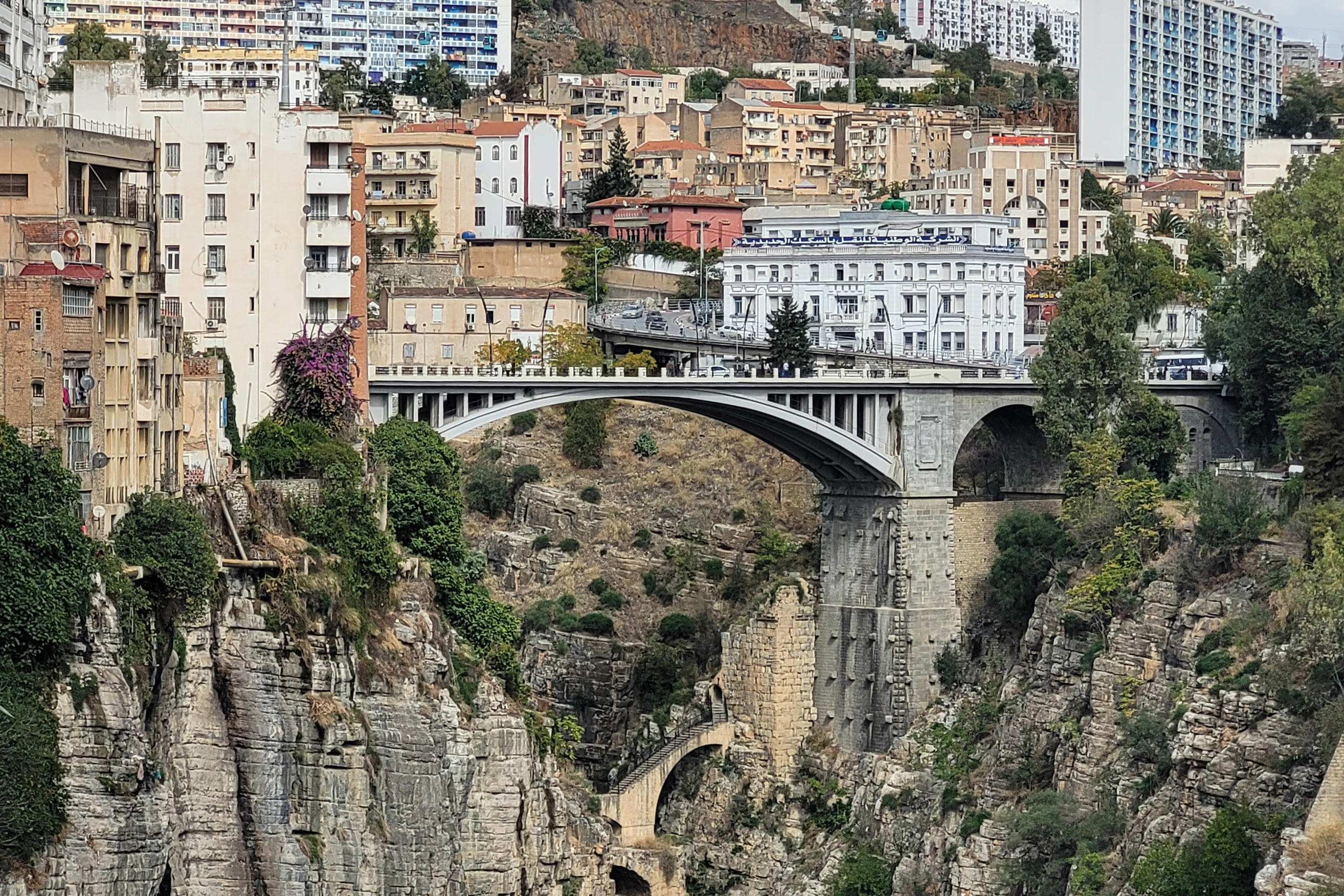
Bab El Kantra Bridge
Every empire that has ruled Constantine has had to solve the same problem: how to cross the Rhumel River gorge. The Bab El Kantra Bridge is the oldest answer, though the structure standing today is not the same one the Romans built, nor the one the Ottomans rebuilt, nor even the French iron arch that replaced it. This crossing has been destroyed and reconstructed so many times that it functions less as a single bridge than as a continuous argument between the city and the chasm that defines it.
Bridge Upon Bridge
The name itself carries the history. Kantra derives from the Latin for centuriation, adapted through Algerian Derja to simply mean bridge. In 1185, all of Constantine's Roman bridges were destroyed; only El Kantara was rebuilt. It fell again in 1304. Between 1771 and 1792, Salah Bey, one of the most celebrated rulers of Constantine, entrusted the reconstruction to a Balearic builder named Bartolomeo. Starting from the foundations of the ancient Roman structure, Bartolomeo completed the bridge using stone quarried from the ruins of the city's Roman amphitheater. The result roughly reproduced the Roman configuration while reducing the number of arches and reinforcing the remaining ones. Crucially, the reconstruction also restored the siphon system that channeled water from Djebel Ouahch into the city.
Assaults at the Gate
The bridge's name, Bab El Kantra, means the bridge door, and that door was literal. The span was closed by heavy gates that defended the main access route into the city. In 1836, during the first French attack on Constantine, General Trezel's troops attempted to blow up the door. The assault was repulsed, and soldiers who failed to retreat were hurled into the gorge below. The bridge survived that attack but not the second occupation. On March 18, 1857, the structure collapsed after a French infantry detachment crossed it. The collapse also destroyed the aqueduct, cutting the city's main water supply. It was a catastrophe that captured the bridge's essential paradox: it was both the city's lifeline and its most vulnerable point.
Iron, Then Concrete
The French rebuilt the bridge in 1863 as an iron arch, a structure that served for nearly a century before problems emerged. In 1951, part of the cast iron cladding collapsed, prompting the municipality to undertake a major reconstruction that widened both the walkways and the roadway. The current concrete arch bridge was inaugurated in 1952. Beneath it, almost directly below the span, a natural stone bridge blocks much of the river from view, a geological feature that predates every human structure on the site. Partial remains of the earlier stone bridges can still be seen resting atop this natural formation, a layering of human and geological engineering that exists nowhere else quite like this.
One of Eight
Bab El Kantra is one of eight high-level bridges that cross the Rhumel gorge, earning Constantine its nickname as the City of Bridges. The Sidi M'Cid suspension bridge towers above it. The Sidi Rached Viaduct stretches below with its massive stone arches. The modern Salah Bey Viaduct carries traffic on cables. But the Kantra remains the crossing with the deepest roots, the one where Roman foundations support Ottoman stonework beneath French iron beneath Algerian concrete, where every layer records a different empire's attempt to master the same 200-meter drop. The monumental gate that once defended the entrance is gone, but its stone arches are stored along the road to the Corniche, waiting for a future that may or may not find a use for them.
From the Air
Located at 36.37N, 6.62E spanning the Rhumel River gorge in Constantine, Algeria. The bridge is one of eight dramatic spans visible crossing the deep gorge that bisects the city. Best viewed at 1,500-3,000 feet AGL for the full gorge perspective. Nearest airport: Mohamed Boudiaf International Airport (DABC) approximately 10 km south. The gorge itself is a striking terrain feature visible from considerable altitude. City elevation approximately 640 meters.