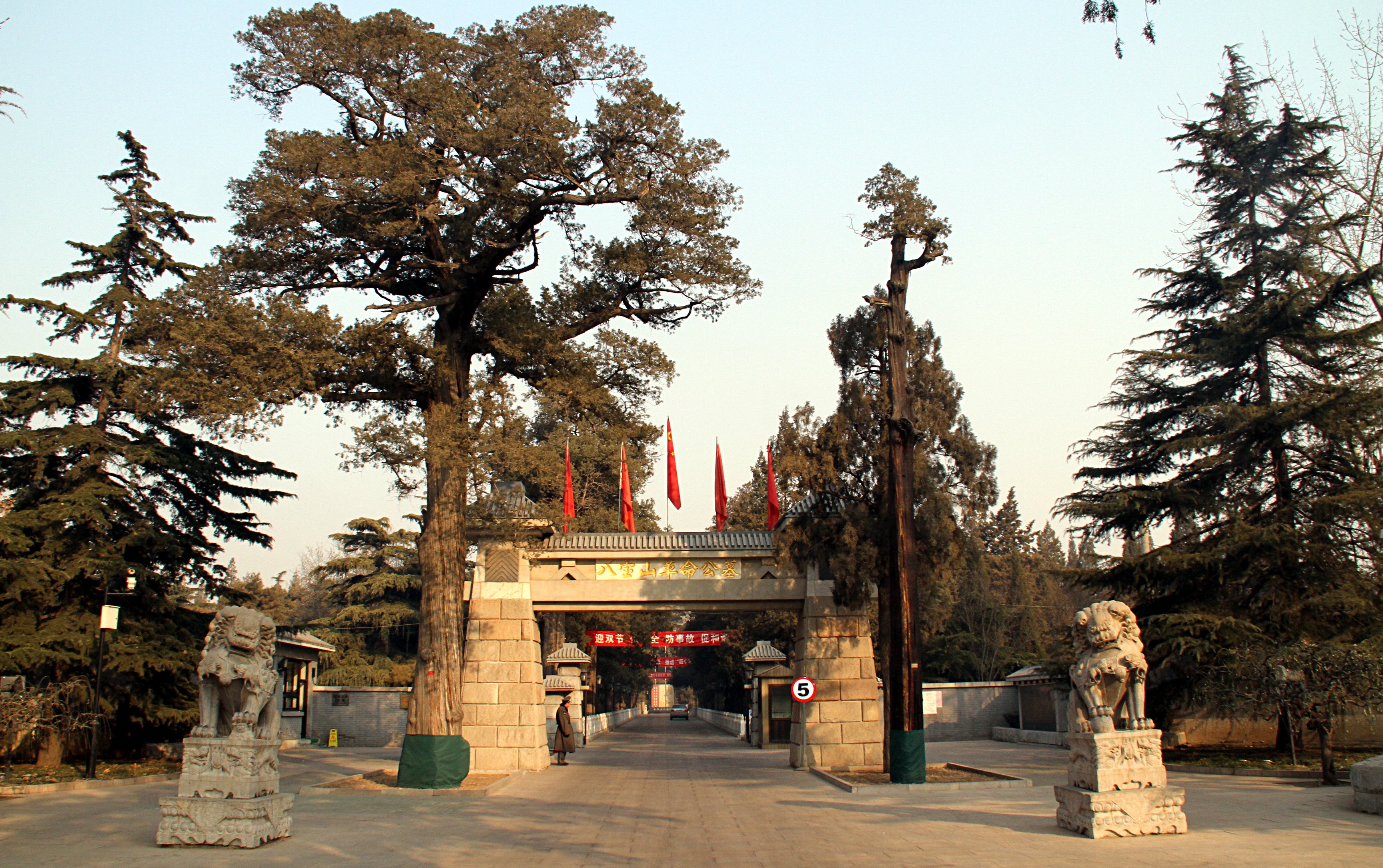
Babaoshan Revolutionary Cemetery
The man who negotiated the deal had castrated himself at nineteen. Xin Xiuming, the last abbot of a Taoist temple on the western edge of Beijing, had served as a eunuch for the last emperor, Puyi. After the fall of the Qing dynasty, he retreated to this temple -- a retirement home for eunuchs -- and built it into a prosperous agricultural estate. When the communists arrived in the 1950s and decided his temple would become a cemetery for revolutionary martyrs, Abbot Xin did not resist. He negotiated.
The Eunuch's Temple
The site's origins are unexpected for a communist shrine. The Babaoshan temple was first built to honor General Gang Bing, a Ming dynasty soldier who castrated himself as an act of obedience to the Yongle Emperor. The emperor designated the surrounding area as a final resting place for concubines and eunuchs, and over the centuries the Taoist temple evolved into a care home for retired palace servants. By the time Abbot Xin Xiuming took charge, the temple owned substantial agricultural land: 52 Chinese acres farmed by the eunuchs themselves, 157 acres worked jointly with tenant farmers, and 269 acres rented out entirely. It was a self-sustaining community, small but economically viable.
A Shrewd Negotiation
When the new government decided to convert the temple into a cemetery, Xin Xiuming faced the kind of problem that has no good solution -- only less bad ones. He negotiated with Wu Han, the deputy mayor of Beijing, and secured terms that were remarkably favorable: the government would pay full price for all temple assets and provide each remaining eunuch a monthly pension until death. Xin even convinced the government to arrange vehicles for the relocation, sending the older eunuchs to a eunuch temple at Colored Glazed River and the younger ones to another at Westward Tilted Street. It was the end of an institution that had existed for centuries, but it was an end managed with care rather than imposed by force.
Where Power Goes to Rest
The cemetery that replaced the temple became Beijing's most politically significant burial ground. Spanning 0.10 square kilometers on the western edge of the city's urban sprawl, it holds the remains of China's highest-ranking revolutionary figures, military leaders, and individuals deemed to have made extraordinary contributions to society. Marshal Zhu De is buried here, alongside Peng Dehuai, Nie Rongzhen, and Qian Xuesen -- the father of China's missile and space programs. The ashes of Puyi, the last emperor whom Abbot Xin once served, were interred here in 1967 before being moved to the Hualong Imperial Cemetery near the Western Qing tombs in 1995. His brother Prince Pujie remains at Babaoshan.
The Living Politics of the Dead
Burial at Babaoshan is not merely an honor -- it is a political statement. Who is admitted, and who is denied, reflects the current leadership's reading of history. In 2005, Israel Epstein, a Polish-born journalist who had spent decades in China, was cremated here. In January 2010, eight Chinese citizens killed in the Haiti earthquake were interred as martyrs. In December 2022, former General Secretary Jiang Zemin was cremated at Babaoshan's crematorium before his state funeral. The cemetery remains an active tool of state narrative-building, each new burial affirming who the Party considers worthy of remembrance. From a temple for society's most marginalized members to a cemetery for its most powerful -- the transformation of Babaoshan mirrors the transformation of China itself.
From the Air
Located at 39.908N, 116.236E in Shijingshan District, western Beijing. The cemetery is set on low hills (Babaoshan means 'Eight Treasure Mountains') on the western frontier of Beijing's urban area. From altitude, look for green space and orderly memorial grounds amid the surrounding development, west of the 5th Ring Road. Nearest airports: Beijing Daxing International (ZBAD) to the south, Beijing Capital International (ZBAA) to the northeast. Best viewed at 3,000-5,000 ft AGL.