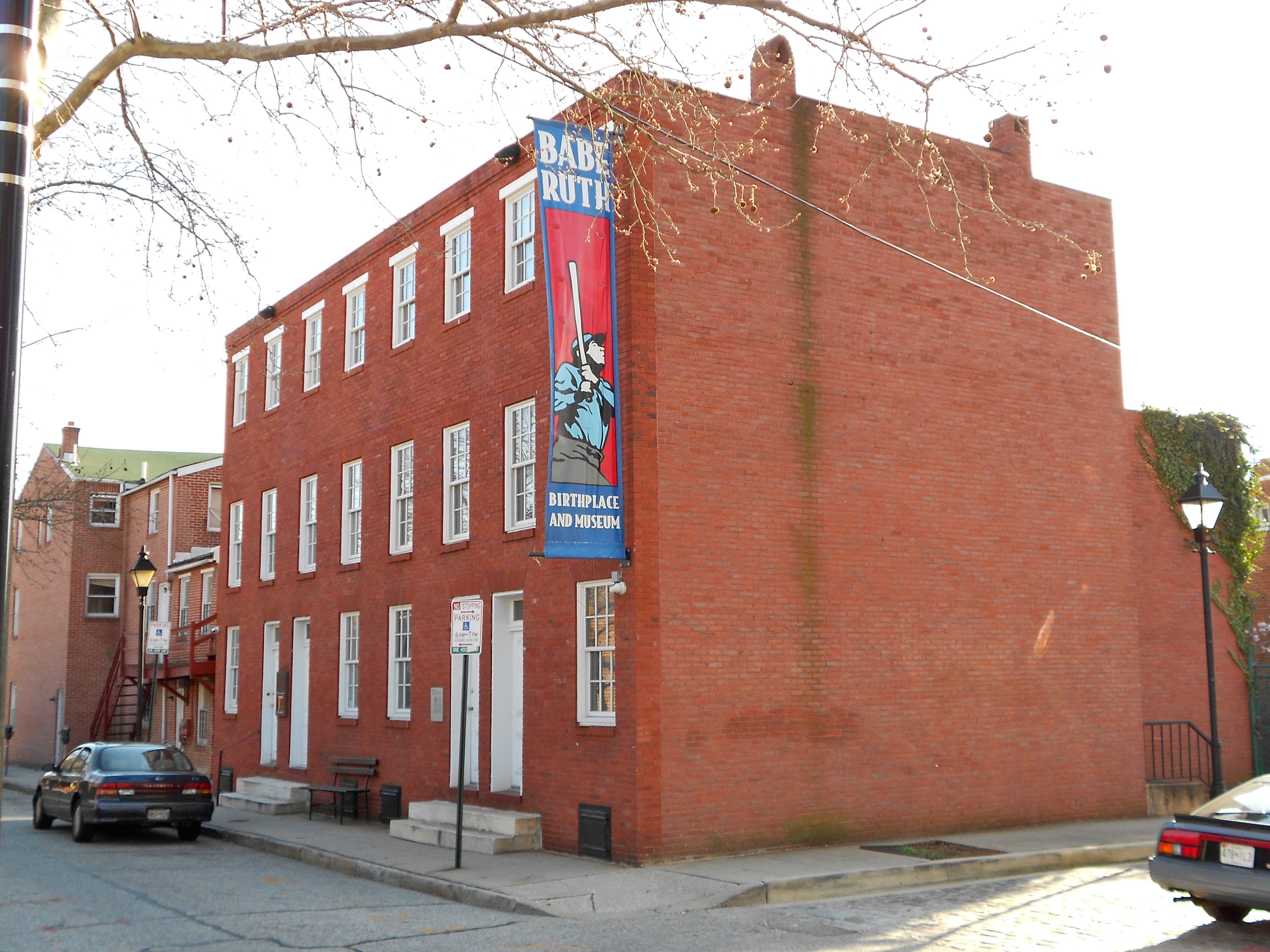
Babe Ruth Birthplace and Museum
The house at 216 Emory Street is three stories tall and barely wide enough for two people to pass in its hallway. On February 6, 1895, in an upstairs bedroom of this Baltimore row house, Katherine Schamberger Ruth gave birth to a boy named George Herman Ruth Jr. The neighborhood of Ridgely's Delight was working-class German-American then, the house leased by Ruth's maternal grandfather Pius Schamberger, an upholsterer by trade. The baby born there would become the most famous baseball player who ever lived. Today, the house stands in the shadow of Oriole Park at Camden Yards, close enough that a strong batter could theoretically put one through its window. That proximity is no accident -- it is the kind of poetic geography that sports cities live for.
A Rough Start on Camden Street
The Ruth family did not stay long at 216 Emory Street. They moved first to Goodyear Street, then above George Sr.'s saloon on West Camden Street, where young George grew up in the rough world of a waterfront bar. Baltimore in the 1890s and early 1900s was a city of saloons, factories, and docks, and the boy ran wild. At seven years old, his parents sent him to St. Mary's Industrial School for Boys, a reformatory and orphanage run by Xaverian Brothers on Wilkens Avenue at the southwestern edge of the city. It was there, on those institutional grounds, that Brother Matthias Boutlier taught George Ruth to play baseball. The reformatory shaped the legend. Ruth spent most of his youth at St. Mary's, learning the game that would take him from Baltimore to the major leagues, first with the Boston Red Sox in 1914 and then to his immortal years with the New York Yankees.
Saved from the Wrecking Ball
By the late 1960s, the Emory Street row house had fallen into disrepair. The owner received a court order in 1967 to either repair or demolish the building, and demolition was scheduled for December 10. Local residents intervened. Hirsh Goldberg, press secretary for Baltimore Mayor Theodore McKeldin, led a campaign to save the house, and McKeldin himself halted the demolition, declaring the building "an important part of our past." The city purchased the property in 1968 for $1,850. The Babe Ruth Birthplace Foundation, a nonprofit, restored the house and the three adjoining row structures, and in July 1974 the museum opened to the public as a national shrine. Ruth's widow Claire, his two daughters Dorothy and Julia, and his sister Mamie -- who was also born at 216 Emory Street -- helped install the original exhibits.
More Than the Sultan of Swat
The museum's collection goes well beyond Babe Ruth memorabilia, though that remains the heart of the place. Visitors can see rare baseball cards, the earliest known signature of Ruth, and artifacts from his extraordinary career -- 714 home runs, a .342 lifetime batting average, seven World Series championships. In 1983, the museum became the official museum of the Baltimore Orioles. Two years later, it was designated the official archives of the Baltimore Colts football team, and the Super Bowl V trophy won by the Colts in January 1971 is displayed there. When the Sports Legends Museum at Camden Yards closed in 2015, its extensive archives were absorbed into the Babe Ruth Museum's collection, significantly expanding the holdings of Maryland sports history stored in the climate-controlled basement -- including Johnny Unitas's first contract, signed for $7,000 in 1956.
A New Chapter at Camden Yards
A major renovation in 2015 reimagined the galleries, repaired aging woodwork, improved accessibility, and added a new entrance on Dover Street. The museum reopened during a week when both the New York Yankees and the Boston Red Sox -- Ruth's two most famous teams -- were visiting Camden Yards to play the Orioles, a scheduling coincidence that felt like fate. In 2024, Emory Street was renamed Babe Ruth Way. The museum draws about 25,000 visitors annually, and its leadership has expressed hopes that the $1.2 billion state-funded stadium redevelopment around Camden Yards might support an expansion. For now, the narrow row house does what it has done since 1974: it puts visitors in the room where a legend began, in a neighborhood that still feels like the Baltimore that shaped him.
From the Air
Located at 39.29°N, 76.63°W in the Ridgely's Delight neighborhood of downtown Baltimore, just south of Oriole Park at Camden Yards. The museum is a small row house, not individually visible from altitude, but Camden Yards and its surrounding complex are a prominent landmark. Baltimore/Washington International (KBWI) is approximately 9nm south. Martin State Airport (KMTN) is roughly 12nm northeast. Baltimore's Inner Harbor and the distinctive shape of Camden Yards provide easy visual reference. Best appreciated in the context of Baltimore's dense downtown urban fabric at 1,500-2,500 feet AGL.