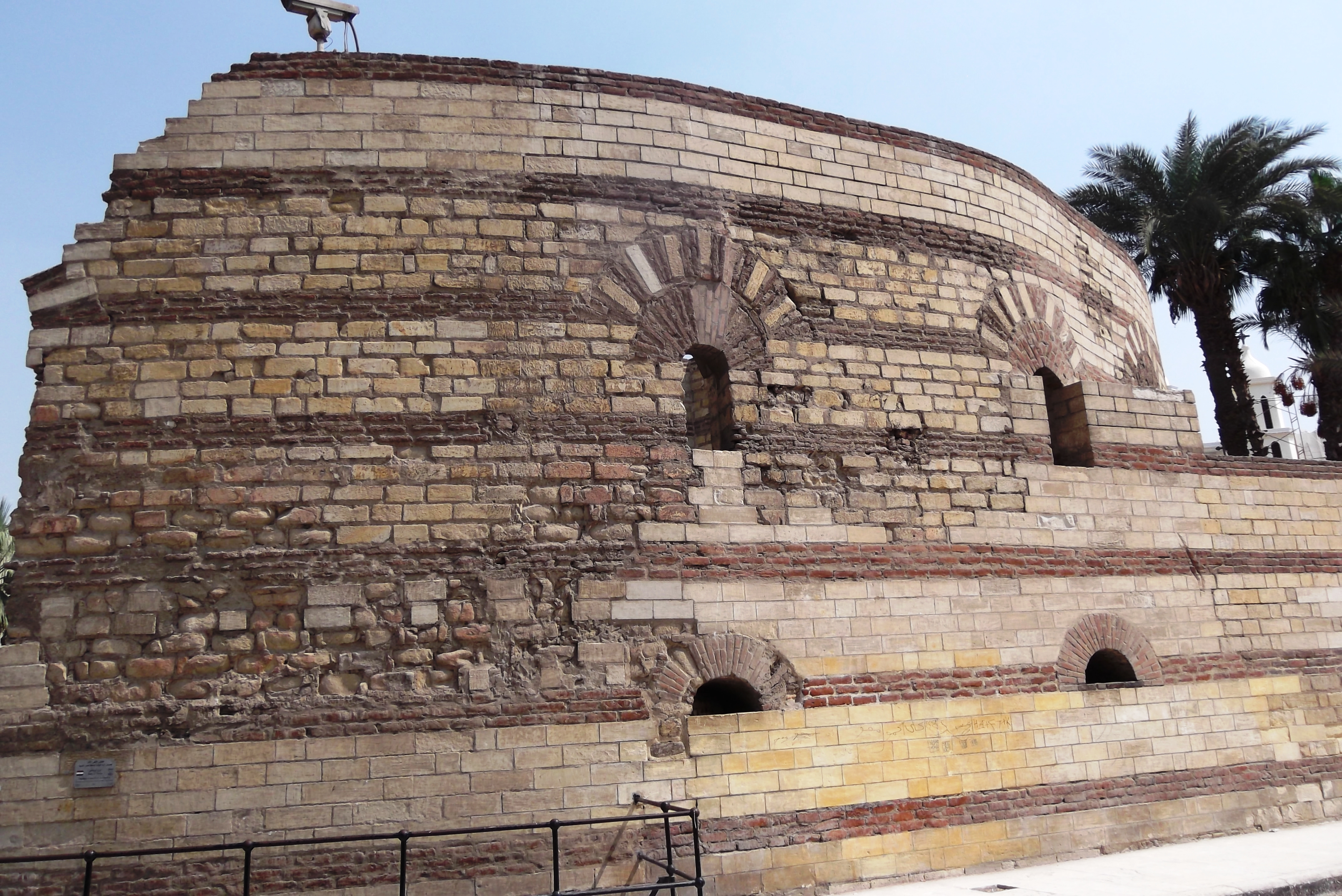
Babylon Fortress
There is a place in Cairo called Babylon, and it has nothing to do with Iraq -- or rather, everything to do with it by way of a twenty-five-century game of telephone. According to the seventh-century writer John of Nikiu, Nebuchadnezzar II campaigned in this part of Egypt around 568 BC and named the settlement after his capital on the Euphrates. Egyptologists suggest the name actually derives from Perhabinon, an older Egyptian toponym, filtered through centuries of linguistic drift. Whatever the etymology, Babylon Fortress stands today in Old Cairo as a Roman fortification wrapped around some of the most sacred sites in Coptic Christianity.
Where the Nile Met the Red Sea
Babylon occupied a strategic position that few sites in Egypt could rival. It sat at the boundary between Lower and Middle Egypt, where river craft paid tolls ascending or descending the Nile. More critically, it guarded the entrance to the Canal of the Pharaohs, an ancient waterway linking the Nile to the Red Sea. The canal had been re-dug by the Persian king Darius around 500 BC and later reconstructed by the Roman emperor Trajan, who moved its mouth southward to the site of present-day Old Cairo and built a fortified harbor. Control of Babylon meant control of the junction between Mediterranean and Indian Ocean trade -- a chokepoint that empires from the Achaemenids to the Byzantines refused to leave unguarded.
Diocletian's Massive Walls
The fortress visible today dates primarily to around 300 AD, when Emperor Diocletian expanded the fortifications after the Crisis of the Third Century had exposed the fragility of Rome's eastern defenses. The new fortress was enormous, anchored by two massive round towers that flanked the canal's entrance. Water flowed directly through the middle of the fortification -- a practical arrangement that allowed ships to pass while remaining under military watch. In later centuries, a wall was built between the towers to block the canal entirely. The construction used the heavy stone and brick techniques characteristic of late Roman military architecture, built to endure in a way that Diocletian's administrative reforms, which divided the empire, could not.
From Bishops to Byzantines
Babylon became the seat of a Christian bishopric, a suffragan of Leontopolis in the Roman province of Augustamnica Secunda. After the Council of Chalcedon in 451 split Christianity over the nature of Christ, most of Babylon's bishops rejected the council's conclusions -- an early expression of the Coptic theological identity that would define Egyptian Christianity. During the Eastern Roman period, the city revolted against Emperor Phocas, demonstrating that even within the empire, Babylon's population maintained a fierce sense of independence. The fortress's Christian character deepened over the centuries, as churches, a convent, and eventually the Coptic Museum took root within its walls.
Seven Months Against the Arab Conquest
In 640 CE, the Arab general Amr ibn al-As arrived at Babylon's walls with an army intent on conquering Egypt. The Byzantine garrison held out for approximately seven months -- one of the longest sieges of the entire Arab conquest -- before the fortress fell in December 640. John of Nikiu chronicled the conquest and the subsequent Arab rule over what was still a predominantly Coptic Christian city. His account, surviving only in Ethiopic manuscripts, remains one of the most important sources for this pivotal moment when Egypt shifted from Byzantine to Islamic control. The fall of Babylon effectively opened the road to Alexandria and the rest of Egypt.
Sacred Ground Within Ancient Walls
Today, the fortress's former enclosure holds the Coptic Museum, several churches including the Hanging Church -- which sits atop one of the Roman gate towers -- and the Church of St. George. The round towers themselves, visible from street level, are among the most tangible Roman remains in Cairo. Walking through the narrow lanes of Coptic Cairo, past churches that predate the Islamic city by centuries, you descend -- literally, as the ground level has risen around the fortress over time -- into a layer of Cairo that most visitors never suspect exists. The fortress that Nebuchadnezzar may have named, that Trajan fortified, that Diocletian rebuilt, and that Amr ibn al-As besieged now shelters the living heritage of Egyptian Christianity.
From the Air
Babylon Fortress is located at 30.006N, 31.230E in Old Cairo (Coptic Cairo), on the eastern bank of the Nile. The site is identifiable from the air by the cluster of churches and the Coptic Museum within a compact area south of central Cairo. Cairo International Airport (HECA) lies approximately 22 km to the northeast. Best viewed at 2,000-4,000 feet. The Nile immediately to the west and the distinct break between the dense modern city and the older Coptic quarter provide orientation.