The Bacardi Buildings: Miami's Modernist Jewel Box
From a plane descending into Miami International Airport, you can spot a massive Bacardi bat logo painted on a plaza along Biscayne Boulevard. That logo sits atop an underground parking garage connecting two of Miami's most striking buildings - a 1963 tower covered in vivid blue azulejo murals and a 1973 annex wrapped entirely in hammered-glass mosaics so colorful it earned the nickname "The Jewel Box." Together, the Bacardi Buildings are a declaration: when the Bacardi family fled Castro's Cuba, they brought their taste for bold, unapologetic architecture with them.
The Blue Tile Tower
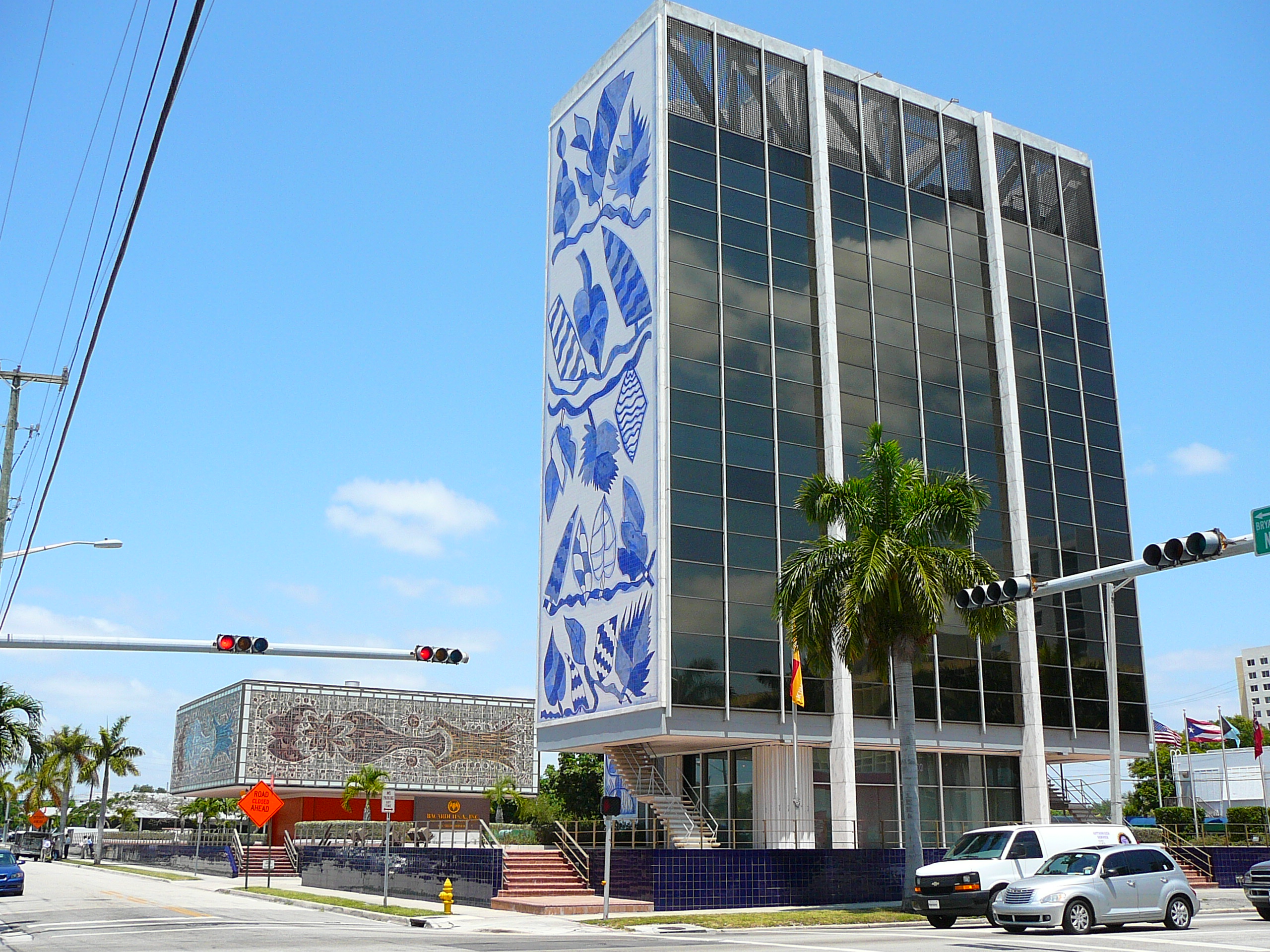
The Bacardi Imports Tower rose at 2100 Biscayne Boulevard in 1963, commissioned by former Bacardi president Jose "Pepin" Bosch and designed by Cuban architect Enrique Gutierrez. Two of the building's exterior walls are covered in azulejo murals - the traditional painted tile work of Portugal and Spain, here executed by Brazilian artist and ceramist Francisco Brennand. The murals transform what could have been an ordinary mid-century office block into something vivid and distinctly tropical. The blues shift in the Miami sunlight, earning the building its informal name: "the blue tile building." Gutierrez brought a Cuban sensibility to American Modernism, creating a structure that felt at home in the subtropics while standing apart from the glass-and-steel boxes rising elsewhere in American cities.
The Jewel Box
Ten years after the tower, Bacardi added an administration annex designed by Ignacio Carrera-Justiz of Coral Gables. Where Gutierrez had chosen painted tile, Carrera-Justiz wrapped all four sides of his building in a colorful hammered-glass mosaic designed by German artist Johannes M. Dietz. The mosaic draws on Mesoamerican themes - geometric patterns that catch and fragment Miami's abundant light. The effect is startling: a building that seems to glow from within, its surfaces alive with color. "The Jewel Box" became the annex's inevitable nickname, and it is one of those rare corporate buildings that people cross the street to admire.
Exile Architecture
The Bacardi Buildings are inseparable from the story of Cuban exile in Miami. When Fidel Castro nationalized Bacardi's Cuban operations, the company relocated its U.S. headquarters to Midtown Miami. The buildings that Bosch commissioned were not defensive or modest - they were a statement of permanence, of cultural confidence, of a company and a community putting down roots in a new city. University of Miami architecture professor Allan Shulman captured their significance: "Miami's brand is its identity as a tropical city. The Bacardi buildings are exactly the sort that resonate with our consciousness of what Miami is about." Architect Chad Oppenheim called them "elegant, with a Modernist look combined with a local flavour." These buildings helped define what Miami architecture could be - not imported Northern Modernism, but something warm, textured, and tropical.
Preservation and New Life
By 2009, as Miami's development boom threatened older structures, citizens launched a campaign to protect the Bacardi Buildings. On April 18, 2012, the American Institute of Architects' Florida chapter placed them on its list of Florida Architecture: 100 Years. 100 Places. In 2018, both buildings were added to the National Register of Historic Places. Today the complex is occupied not by a rum company but by the National YoungArts Foundation, which has used the space since 2012 to nurture emerging artists. The shift feels fitting - buildings conceived as corporate headquarters for an exile company have become a home for young creative talent, the Bacardi bat logo on the plaza now presiding over a different kind of ambition.
From the Air
Located at 25.80°N, 80.19°W along Biscayne Boulevard in Midtown Miami, directly in the approach path for Miami International Airport (KMIA). The large Bacardi bat logo painted on the plaza between the buildings is visible from aircraft arriving at and departing from MIA. The tower's blue tile facade and the annex's colorful glass mosaics are distinctive at lower altitudes. Nearby airports include Miami International (KMIA), Opa-locka Executive (KOPF), and Miami-Homestead General Aviation (X51). The buildings sit in the dense urban corridor of Biscayne Boulevard, about 3 miles north of downtown Miami's skyline.