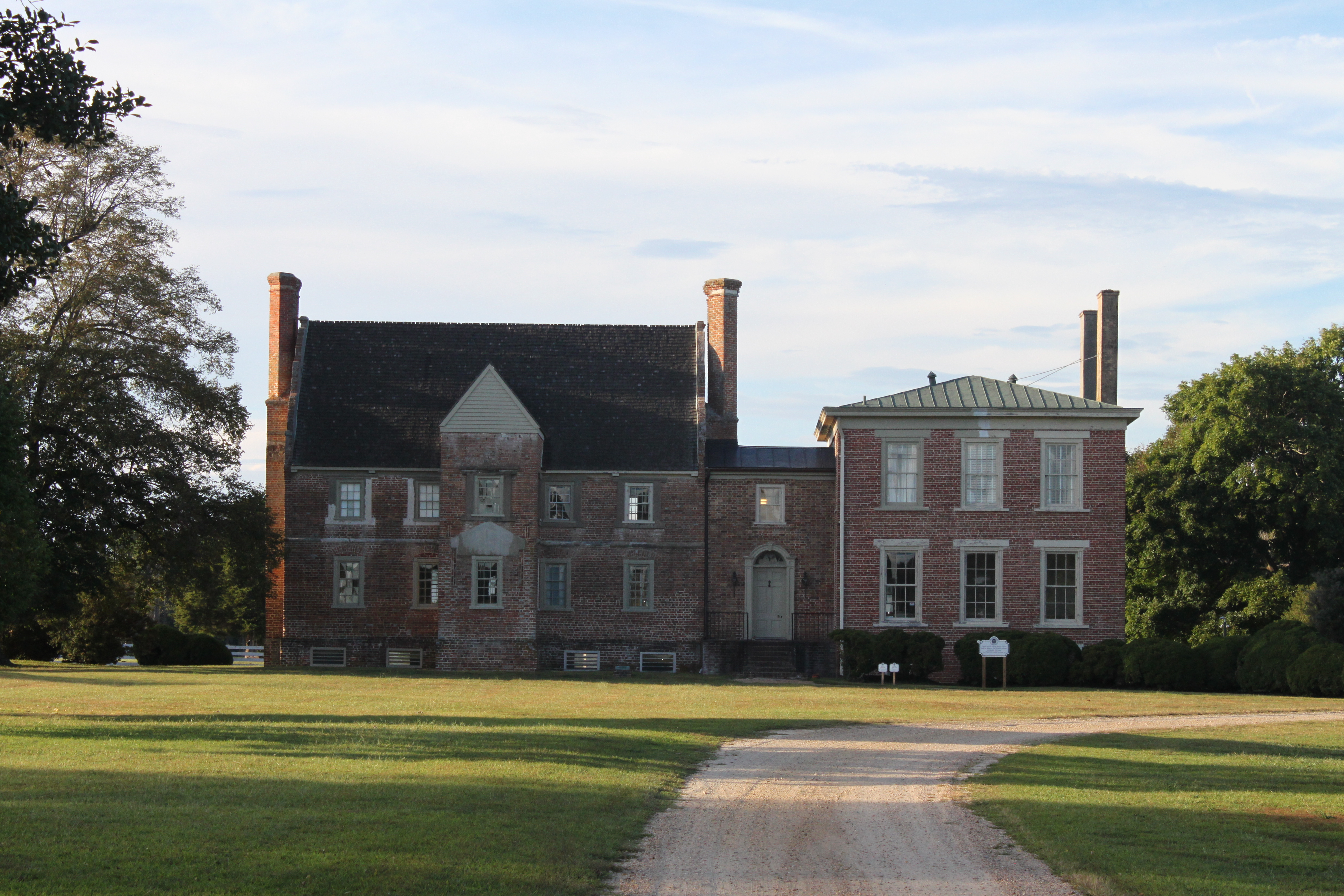
Bacon's Castle
Nathaniel Bacon never lived here. He never even visited. Yet this brick house in Surry County, Virginia, has carried his name for more than three centuries, a testament to how rebellion writes its own history on the landscape. Built in 1665 by wealthy merchant Arthur Allen, the house is the oldest documented brick dwelling still standing in what became the United States. Its shaped Flemish gables, triple-stacked chimneys, and carved compass roses mark it as one of only three surviving Carolean great houses in the Western Hemisphere -- the other two stand in Barbados. When Bacon's followers seized it in September 1676 and fortified it as their stronghold, Allen's elegant manor became a rebel castle, and the name stuck long after the rebellion collapsed and Bacon himself died of dysentery.
A Merchant's Ambition in Brick
Arthur Allen was a man who built to impress. A wealthy merchant and Justice of the Peace in Surry County, he constructed his house in 1665 near the James River in a style that had no business existing in the Virginia wilderness. Carolean architecture -- the ornate English fashion of the era of Charles II -- was meant for the estates of London-connected gentry, not colonial outposts. Yet Allen raised Flemish gables, stacked his chimneys three high, and had compass roses carved into the cross beams of his public rooms. The house announced that Virginia was no longer a desperate experiment. It was becoming a place where Englishmen intended to stay and live well. Allen died in 1669, just four years after completing his masterpiece, but his son, Major Arthur Allen II, inherited the property and continued the family's prominence as a member of the House of Burgesses.
The Siege That Named a Castle
In September 1676, the Virginia frontier was ablaze with Bacon's Rebellion, a violent uprising of colonists against Governor William Berkeley's administration. Bacon's followers -- angry frontiersmen demanding harsher action against Virginia's Indigenous peoples and frustrated with Berkeley's perceived favoritism -- needed strongholds. Major Allen's imposing brick house, solidly built and defensible, was too tempting to pass up. Rebels under the command of William Rookings seized it and fortified it as a garrison. For more than three months, a rotating cast of commanders -- Rookings, Arthur Long, Joseph Rogers, and John Clements -- held the house while their cause crumbled around them. Bacon himself died of dysentery in October. His successor, Joseph Ingram, proved an inept leader who scattered the remaining forces into small, undisciplined garrisons that descended into looting. Yet the name endured. The Allens got their house back; history gave it to the rebels.
Duels, Debts, and a Poet's Elegy
Bacon's Castle passed through generations and wars. By the Civil War era, it belonged to the Hankins family. James DeWitt Hankins, a law student at the University of Virginia, left school to fight for the Confederacy, eventually commanding the Surry Light Artillery through the war's bitter end at Appomattox. Peace brought no safety: on October 18, 1866, Captain Hankins was killed in a duel at the Isle of Wight Courthouse, shot dead over insults exchanged while drinking in a tavern. His opponent, William Underwood, was acquitted of murder despite the fact that dueling had been outlawed in Virginia since 1810. The killing ignited a feud between the Hankins and Underwood families that smoldered for years across the Tidewater. Hankins' sister Virginia, heartbroken, asked the poet Sidney Lanier -- her brother's friend -- to write an elegy. Lanier obliged with 'In Memoriam.' Virginia Hankins, burdened by debt after her father mortgaged the estate, sold the 1,200-acre property in 1872. She moved to Richmond, became a schoolteacher fluent in Latin, French, and German, wrote poetry and an unpublished novel, and never married. She died on Christmas Eve, 1888.
Three Centuries in Brick and Mortar
The architecture of Bacon's Castle tells its own story. It remains the only surviving 'high-style' house from seventeenth-century America. Its Flemish gables -- curved and stepped, a hallmark of the Carolean period -- are unique on the continent. Between the mid and late nineteenth century, the house was modified: a Greek Revival wing replaced the original one-story service wing, the entrance was relocated, and diamond-pane casement windows gave way to double-hung sash windows. The scar where the original pedimented doorway once stood is still visible in the brickwork. The house was listed on the National Register of Historic Places and designated a National Historic Landmark in 1960. Today it operates as a historic house museum under Preservation Virginia, open to visitors who can walk through rooms where compass roses still decorate the beams and the ghosts of rebellion, ambition, and loss inhabit every corner.
From the Air
Located at 37.109°N, 76.722°W in rural Surry County, Virginia, south of the James River. From the air, look for the distinctive triple-stacked chimneys and Flemish gable roofline set among farmland. The nearest significant airport is Williamsburg-Jamestown Airport (KJGG) approximately 15 nm to the northeast. Newport News/Williamsburg International (KPHF) is about 25 nm east. Best viewed at low altitude (1,500-2,500 ft AGL) in clear conditions to appreciate the architectural details against the flat Tidewater landscape.