Bactria-Margiana Archaeological Complex
Soviet archaeologist Viktor Sarianidi was surveying the deserts of southern Turkmenistan in the 1970s when he found something that should not have been there: the remains of a sophisticated Bronze Age civilization, complete with monumental architecture, irrigation systems, and artifacts that connected it to distant cultures across Asia. Scholars had long believed this region was empty steppe during the Bronze Age. Sarianidi proved them wrong. What he uncovered -- now called the Bactria-Margiana Archaeological Complex, or the Oxus Civilization -- rewrote the map of the ancient world, adding a major urban culture to a landscape most archaeologists had simply overlooked.
Cities in the Sand
The BMAC flourished roughly from 2300 to 1700 BC across what is now Turkmenistan, northern Afghanistan, southern Uzbekistan, and western Tajikistan. Its urban phase, dated by archaeologist Sandro Salvatori to approximately 2250 to 1950 BC, produced fortified settlements with massive mudbrick walls, internal corridors, and planned layouts. The largest sites -- Gonur Depe, Togolok, and Dashly -- were not villages. They were towns with monumental temples, craft workshops, and irrigation canals drawing water from the Murghab River delta. Recent excavations have expanded the known range of BMAC culture into northeastern Iran, including sites like Tepe Chalow and Shahrak-e Firouzeh. The civilization was broader than its name suggests.
Gonur Depe and the Palace of Rituals
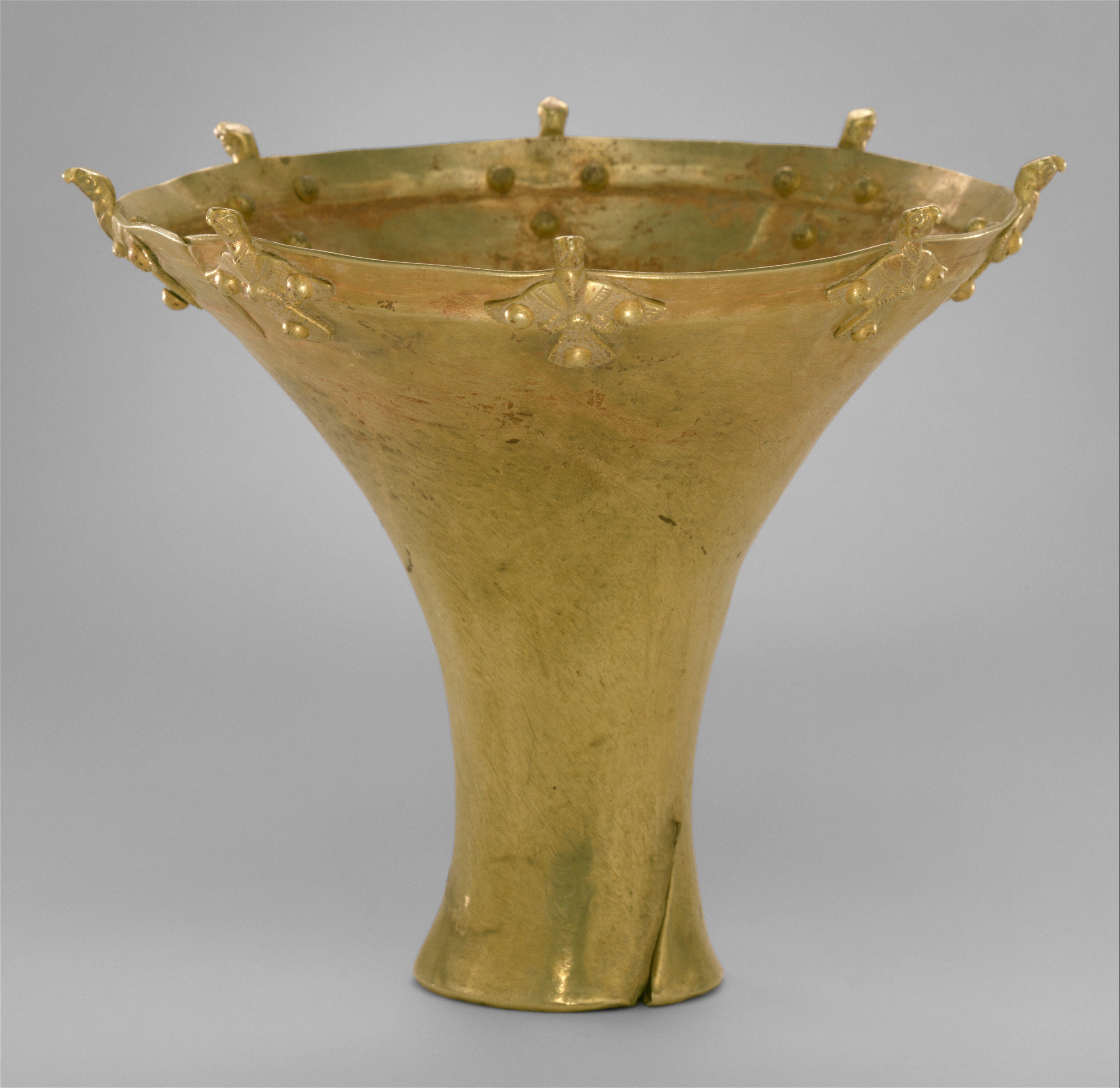
Gonur Depe, discovered by Sarianidi in the Murghab delta, is the largest known BMAC site. Its main complex covers roughly 28 hectares and includes a fortified palace, a temple with fire altars, and extensive storage facilities. The site's grave goods -- gold and silver vessels, stone seals, ceramic figures -- reveal a wealthy society with complex religious practices. Sarianidi identified what he believed were ritual preparations involving ephedra and cannabis, suggesting ceremonial use of psychoactive plants. Some scholars connect these findings to the soma or haoma rituals described in early Indo-Iranian texts. Whatever the interpretation, the material culture at Gonur Depe points to a society that invested heavily in both spiritual and civic life.
Traders Across Three Worlds
BMAC artifacts have appeared in contexts that span enormous distances. Distinctive compartmented stone seals and carved stone vessels from the Oxus Civilization have been found at sites in Mesopotamia, the Iranian Plateau, and the Indus Valley. Indus-style seals and etched carnelian beads have turned up at BMAC sites, evidence of contact or trade with the Harappan civilization more than a thousand kilometers to the southeast. Lapis lazuli from the mines of Badakhshan in Afghanistan passed through BMAC territory on its way to workshops in Sumer. The civilization sat at a crossroads, linking the great Bronze Age cultures of the ancient world. It was not isolated. It was connected.
The Question of the Indo-Iranians
The BMAC occupies a central -- and contentious -- place in debates about Indo-Iranian migrations. Some scholars have proposed that the Oxus Civilization was created by early Indo-Iranian peoples moving south from the Central Asian steppe. Others argue that the BMAC was an indigenous development, and that Indo-Iranian speakers arrived later, possibly absorbing or displacing the existing population. The appearance of steppe-derived Andronovo cultural elements at late BMAC sites has been interpreted both ways. What is clear is that by the time the civilization declined around 1700 BC, the cultural landscape was shifting. The Yaz culture that followed shows different settlement patterns and material traditions, suggesting a significant transition in the region's population and lifeways.
Buried and Found
The Oxus Civilization vanished from both the landscape and from memory. No ancient text names it. No later tradition preserves its stories. When Sarianidi began publishing his findings in the 1970s and 1980s, he faced skepticism from scholars who doubted that a major urban civilization could have gone entirely unrecorded. But the evidence accumulated. Excavations at Gonur Depe, Togolok, Namazga, and dozens of smaller sites produced a consistent picture: planned towns, monumental buildings, standardized pottery, widespread trade connections, and sophisticated metallurgy. Today, the BMAC is recognized as one of the major civilizations of the Bronze Age, alongside Mesopotamia, Egypt, the Indus Valley, and China. From the air, the ruins are barely distinguishable from the surrounding desert -- mounds and outlines that only reveal their meaning to those who know what to look for.
From the Air
Located at approximately 38.23N, 61.45E in southeastern Turkmenistan, in the Murghab River delta region. The archaeological sites are scattered across the Karakum Desert, with Gonur Depe as the primary site. Nearest airport is Mary Airport (UTAM). The ruins appear as low mounds in flat desert terrain, difficult to spot from altitude without knowing their locations. Clear skies prevail most of the year.