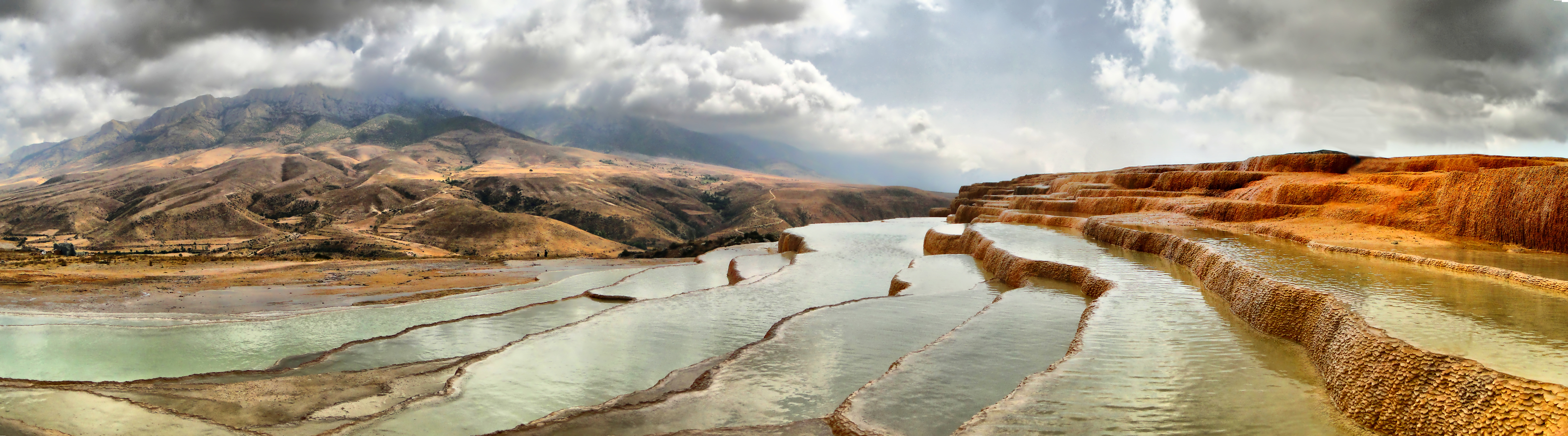
Badab-e Surt
Two springs emerge from the same mountainside, but they could not be more different. One produces salty water that locals believe cures rheumatism and skin conditions. The other runs sour and orange, stained by heavy iron oxide deposits at its outlet. Where their mineral-laden waters have flowed downhill and cooled over thousands of years, they have built something astonishing: a natural staircase of travertine pools in shades of orange, red, and yellow, terraced across the mountainside at 1,840 meters above sea level. This is Badab-e Surt, hidden in northern Iran's Mazandaran province, 95 kilometers southeast of the city of Sari.
What the Name Tells You
The Persian name encodes the geology. 'Badab' is a compound of 'bad' meaning gas and 'ab' meaning water -- 'gassed water,' a reference to the carbonated mineral springs that create the terraces. 'Surt' is an old name for the nearby village of Orost, derived from a Persian word meaning intensity. The name amounts to a description: intensely carbonated water. The two springs that feed the terraces sit at the top of the formation, each contributing different minerals to the water that sculpts the landscape below. The first spring collects in a small natural pool of extremely salty water. The second, more visually dramatic, produces the orange-stained flow that gives the terraces their most striking coloration.
Chemistry Written in Stone
The terraces are made of travertine, a sedimentary rock that forms when mineral-saturated water reaches the surface and releases dissolved carbon dioxide into the air. As the gas escapes, calcium carbonate and iron carbonate can no longer remain dissolved. They precipitate out of the water as soft, jelly-like deposits that slowly harden into solid stone. The process has been building these terraces since the Pleistocene and Pliocene geological periods -- millions of years of mineral deposition, layer upon layer, each pool slightly different in color depending on the ratio of iron to calcium in the water that formed it. The iron carbonate produces the warm oranges and reds. The calcium carbonate creates lighter, cream-colored terraces. Together they produce a palette that shifts across the mountainside like a geological watercolor.
A Staircase of Colored Pools
The visual effect is of a naturally formed staircase descending the mountainside, each step holding a shallow pool of mineral water in a different shade. From above, the terraces resemble the contour lines of a topographic map rendered in warm earth tones. The surrounding landscape provides sharp contrast: pine forests to the north, scrubby short trees and shrubs to the east, and exposed rock quarries to the west. The formation sits seven kilometers east of Orost village, accessible only by roads that wind through the mountains of northern Iran. Badab-e Surt draws comparisons to Mammoth Hot Springs in Yellowstone National Park, Pamukkale in Turkey, and the Huanglong terraces in China -- all sites where similar geological processes have created similar stepped formations, though each in its own distinct palette and scale.
Fragile Beauty at Altitude
Despite its visual drama, Badab-e Surt is a fragile formation. The travertine terraces are actively growing, but the rate of mineral deposition is slow measured against the pace of human visitation. Foot traffic on the terraces can damage the soft, newly deposited mineral surfaces before they have hardened into stone. The site's relative remoteness in the mountains of Mazandaran province has provided some natural protection, but increasing tourism has raised concerns about preservation. The springs themselves continue their ancient work, adding imperceptible layers of mineral deposit with each day's flow. The terraces represent a geological process caught in the act -- not a relic of the past but a living formation, still growing, still coloring itself with the chemistry of the earth beneath it.
From the Air
Located at 36.35N, 53.86E at approximately 1,840 meters elevation in the mountains of Mazandaran province, northern Iran. The travertine terraces may be visible from low altitude as distinctive orange-red formations on a mountainside. The nearest major city is Sari, approximately 95 km to the northwest. The nearest airports include Sari Dasht-e Naz International Airport (OINR). Terrain is mountainous with pine forests to the north and rocky terrain surrounding the formation.