Badagry
The main god of Haiti's official Vodun religion is called Ogun-Badagri. The name carries an ocean of history in it. From this lagoon town on the Gulf of Guinea, an unknowable number of enslaved people were shipped to the Caribbean and the Americas, and the spiritual practices they carried with them took root in new soil thousands of miles away. Badagry exists at the intersection of profound sorrow and stubborn vitality: a place that served as a departure point for one of humanity's greatest crimes, and then became the gateway through which Christianity, Western education, and colonial administration entered Nigeria.
Refugees, Traders, and the Lagoon
Badagry was founded in the early fifteenth century by Popo refugees fleeing wars with the Fon people of Dahomey. They settled on the north bank of the Porto-Novo runlet, an inland waterway connecting what are now the capitals of Nigeria and Benin. The lagoon's protected harbor proved both blessing and curse. It attracted trade, which brought prosperity, and it attracted European slavers, who brought devastation. By the late 1720s, Badagry had been drawn into the transatlantic slave trade, its harbor becoming a major embarkation point. Enslaved people were funneled through the town, held in barracoons like the one built by Brazilian slave merchants in 1840 -- the Seriki Abass Slave Baracoon, which still stands -- before being loaded onto ships bound for Salvador da Bahia in Brazil, for Saint-Domingue, and for plantations across the Americas.
The First Sermon, the First School
In 1842, Reverend Thomas Birch Freeman preached what is recorded as the first Christian sermon in Nigeria at Badagry. The site where he stood is now marked by the Agiya Tree Monument beside the Badagry Town Hall. A year later, in 1843, the Wesleyan mission established the country's first primary school, the Nursery of Infant Church, which evolved into St. Thomas' Anglican Nursery and Primary School under Rev. Golmer of the Church Missionary Society in 1845. That same year saw the construction of the first storey building in Nigeria, an Anglican missionary house. Badagry was accumulating firsts at a remarkable pace: first church, first school, first European-style building. The town that had been a doorway to enslavement was becoming, in the eyes of colonial missionaries, a doorway to what they called civilization.
Destruction and Decline
Badagry's prominence did not last. In 1851, the army of Lagos attacked the town, and fire consumed much of it. The constant military threat from the Fon kingdom to the west, combined with poor sandy soils that limited agriculture, triggered an exodus of traders, missionaries, and farmers. The town that had hummed with commerce and missionary activity emptied out. In 1863, the British annexed Badagry and incorporated it into the Lagos colony, and in 1901 it became part of Nigeria. From the 1840s onward, as the slave trade was suppressed, Badagry's commercial significance faded. It settled into a quieter existence, its population sustained by fishing and coconut cultivation, its role in national history largely commemorative.
Eight Quarters and a Kingdom
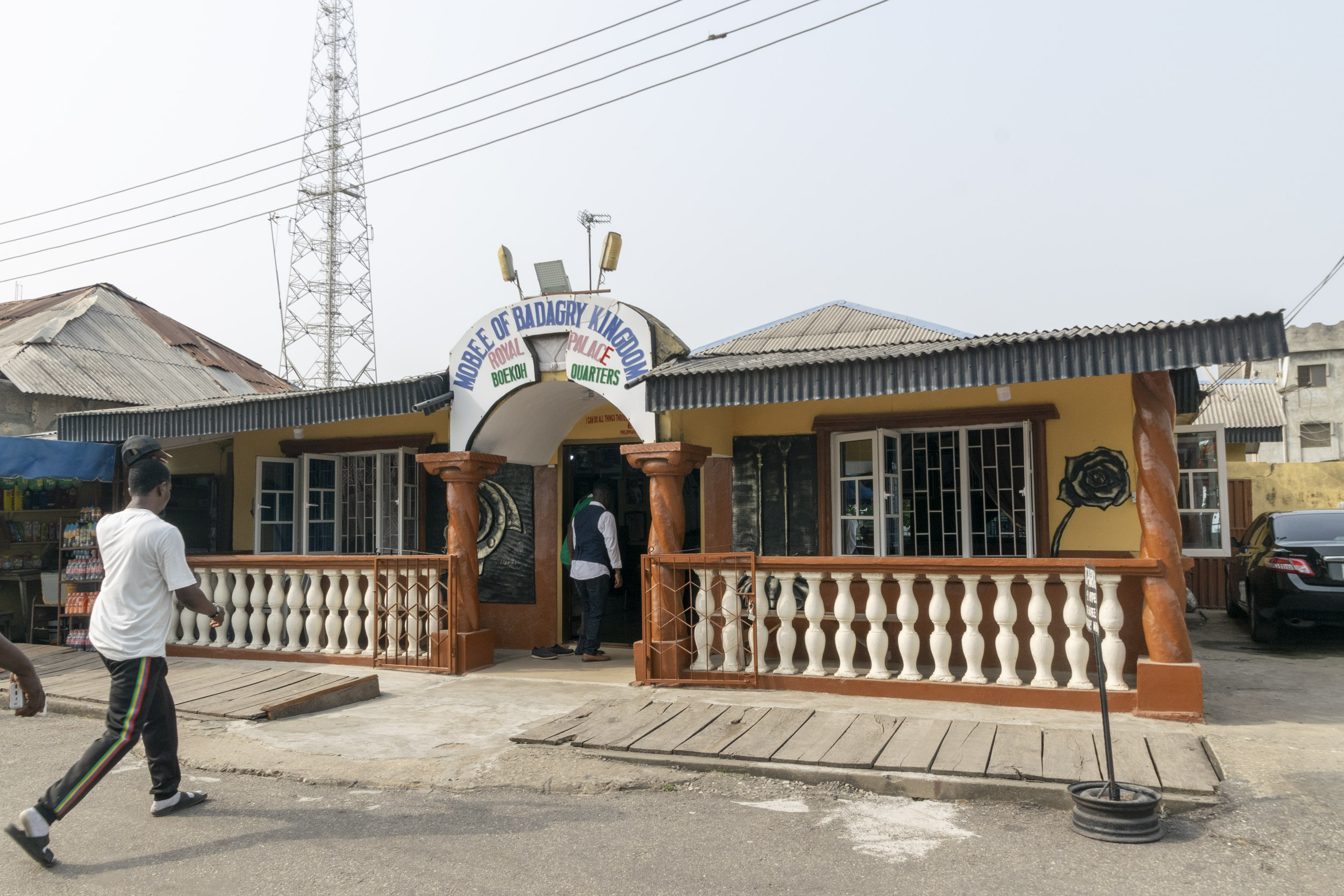
Badagry is governed by a traditional monarchy headed by the Akran of Badagry and his seven white-cap high chiefs. The institution of divine kingship, known as De Wheno Aholu, traces its roots to the town's migration from the Ketu kingdom in the fifteenth century. Seventeen Akrans have held the stool. The chiefs administer eight quarters -- Ahovikoh, Boekoh, Jegba, Posukoh, Awhanjigo, Asago, Whalako, and Ganho -- and the families that ruled these quarters once played direct roles in brokering the slave trade with Europeans and Brazilians. The title of Oba Akran carries such weight that one of the longest commercial avenues in Ikeja, Lagos, is named after it. Today, traditional worship of the Supreme Being through deities like Ogun and Hevioso coexists with Christianity and Islam in a town where the Egun, Yoruba, and Ogu peoples share a distinctive culture.
Coconuts and Memory
Modern Badagry, with a population of roughly 241,000, straddles the road between Lagos and the Benin border. Coconut plantations established in the 1880s still shape the landscape and the economy: the town exports coconuts, copra, coir, fish, and cassava to Lagos, 55 kilometers to the east. The Agbalata International Market buzzes with cross-border trade, its stalls selling everything from groundnut oil to smuggled goods. But tourism, powered by history, is increasingly important. The Badagry Heritage Museum occupies the building of the first Christian mission and displays the manacles and chains that once bound human beings for export. The Seriki Abass Slave Baracoon stands as a tangible remnant of the trade. Visitors walk through these spaces and confront a history that shaped not just this town but the entire Atlantic world.
From the Air
Badagry is located at 6.417°N, 2.883°E, on the coast of Lagos State in southwestern Nigeria, roughly 55 km west of Lagos along the lagoon. The town sits on the north bank of the Porto-Novo inlet, which is visible as a narrow waterway paralleling the coast. From the air, the lagoon system and coconut plantations distinguish the landscape. The nearest major airport is Murtala Muhammed International Airport (DNMM) in Lagos. The Benin border at Seme is approximately 20 km to the west. Coastal weather is tropical and humid, with sea breezes moderating temperatures year-round.