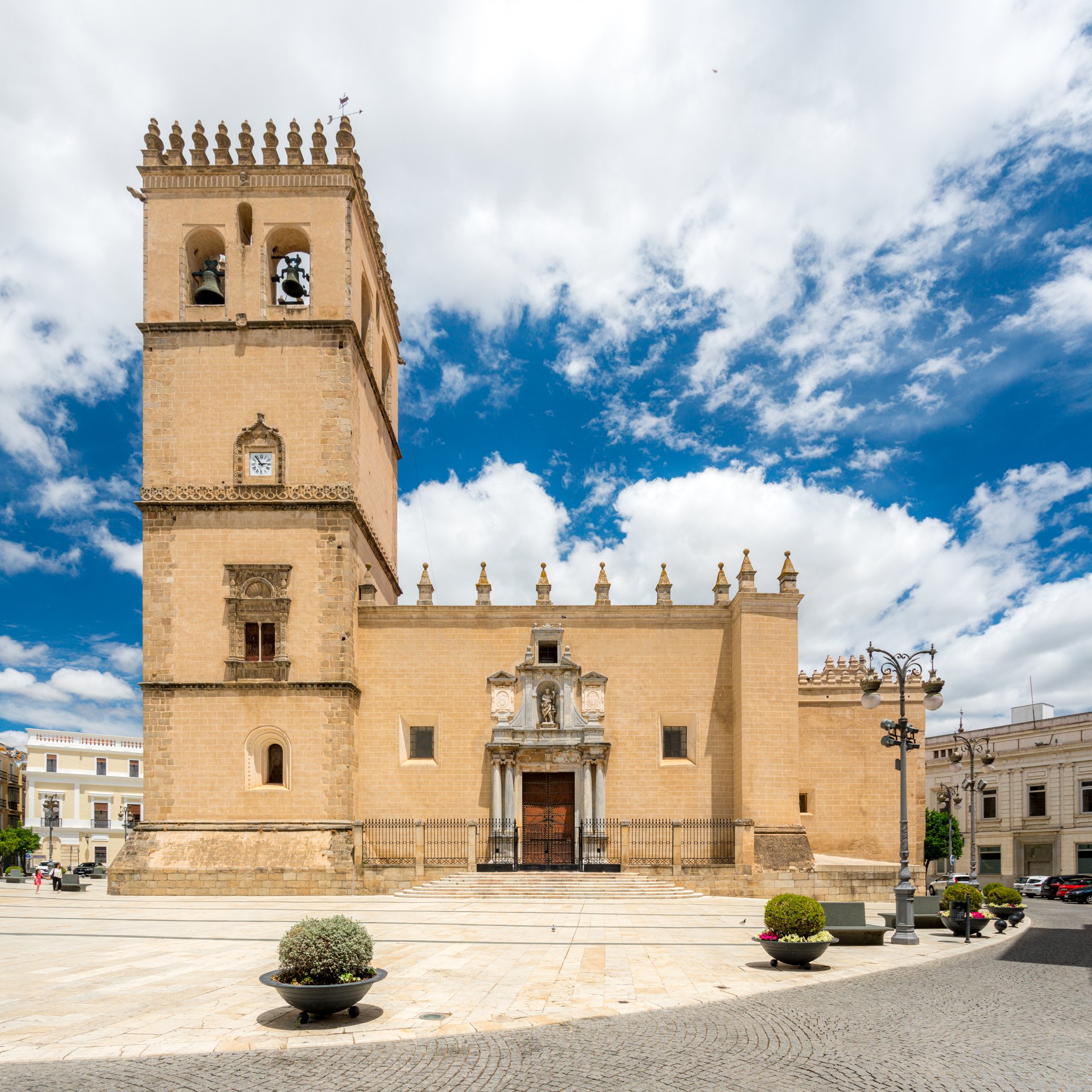
Badajoz Cathedral
Most cathedrals aspire upward. Badajoz Cathedral hunkers down. With its thick walls, sturdy bastions, and Gothic merlons crowning every surface, the Metropolitan Cathedral of Saint John the Baptist looks less like a house of worship than a stronghold prepared for siege -- which, given Badajoz's position on one of the most fought-over borders in European history, was entirely the point. Situated outside the city's Moorish citadel in the Campo de San Juan, this church was built to serve God and, if necessary, to withstand armies.
Rising From the Reconquista
When King Alfonso IX of Leon reconquered Badajoz from the Moors in 1230, the new bishop Pedro Perez did what conquerors often do: he repurposed. The former mosque inside the Alcazaba was hastily adapted as a cathedral. But this was always a temporary arrangement. By the mid-13th century, work had begun on a proper cathedral, and the site chosen carried its own layers of history -- a spot where Visigothic and Mozarabic Christians had worshipped before the Moorish conquest erased their church. In 1270, though construction was far from finished, the cathedral was consecrated and dedicated to Saint John the Baptist. Work continued for another two centuries, with modifications and renovations stretching into the 17th century, each generation adding its own mark to the evolving structure.
A Church in Armor
The cathedral's fortress character is no accident of style. Badajoz changed hands repeatedly between Christian and Muslim forces, then became a flashpoint in wars between Spain and Portugal. The church's position outside the citadel walls left it exposed, so its architects gave it the means to defend itself. The square tower -- 11 meters on each side and 14 meters tall, divided into four sections with bells in the topmost -- was designed as much for observation as for summoning worshippers. The original plan called for two such towers, though only one was completed. Gothic merlons line every wall and the tower itself, transforming the roofline into a crenellated battlement. From a distance, it is easy to mistake the building for a military installation.
Beneath the Merlons
Step inside, however, and the martial exterior gives way to devotional grandeur. The interior follows the late Gothic plan of a nave flanked by two aisles, with side chapels branching off at intervals. The high altar features a richly decorated Baroque retablo, its gilded surfaces catching whatever light filters through the stone. The choir stalls are carved in the Plateresque style -- that uniquely Spanish fusion of Gothic structure and Italian Renaissance ornament -- while a Baroque organ fills the space above. The main marble portal, added in 1619, frames two Ionic columns supporting a niche where a statue of Saint John the Baptist greets visitors. On the southern side, the Portal of Saint Blaise may be the oldest surviving entrance, its pilasters flanking a small image of the saint. The cloister, unexpectedly, follows the Portuguese Manueline style, a reminder that the border between these two nations has always been more porous than maps suggest.
Seat of Two Cities
In 1931, the cathedral was declared a national historical monument, protecting it from the upheavals that would soon engulf Spain. It survived the Civil War and continued serving the diocese of Badajoz through decades of dictatorship and transition to democracy. Then, on July 28, 1994, Pope John Paul II reshaped the region's ecclesiastical geography by establishing the Archdiocese of Merida-Badajoz, elevating this border-town church to the status of metropolitan cathedral. It now shares its archdiocese with the Co-cathedral of Saint Mary Major in Merida, linking two cities whose histories have been intertwined since Roman times. Nearly eight centuries after its consecration, the fortress-cathedral still stands where it always has -- outside the walls, exposed, unyielding.
From the Air
Located at 38.88N, 6.97W in Badajoz, western Spain, near the Portuguese border. The cathedral's sturdy tower and fortress-like silhouette are visible near the Alcazaba citadel. Badajoz airport (LEBZ) is approximately 14 km east. The flat Guadiana River valley offers good visibility, though summer haze can reduce clarity.