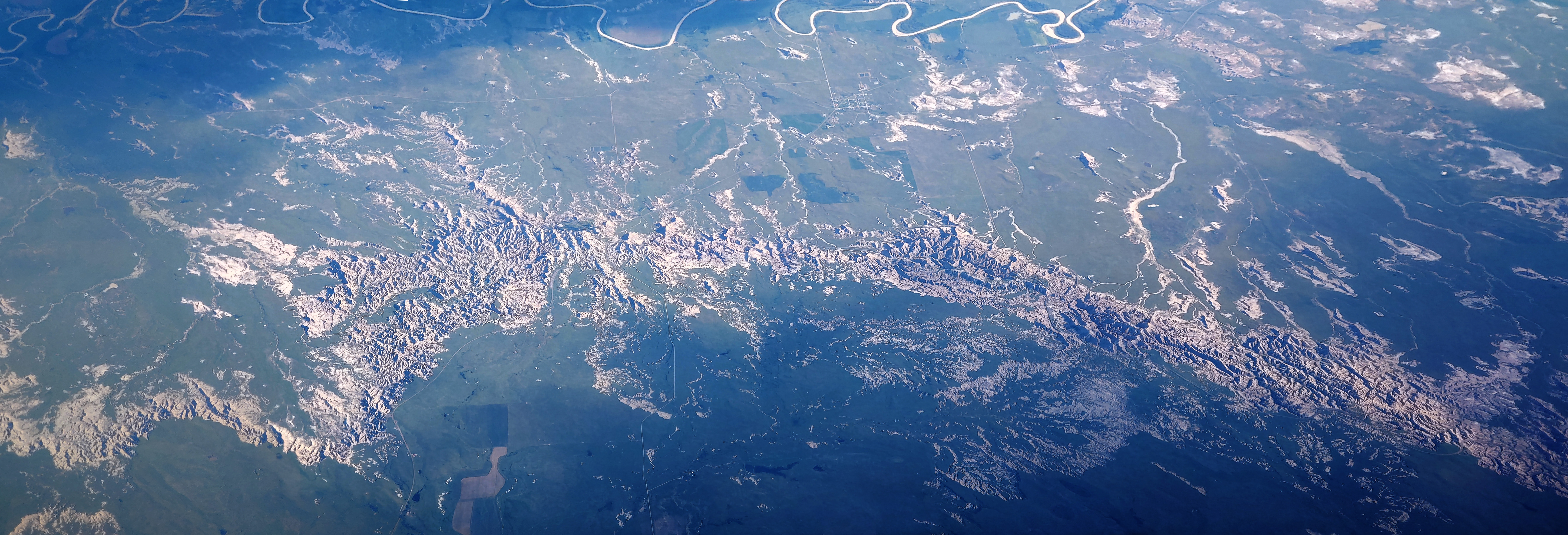
Badlands National Park
The Lakota called it mako sica, bad land, and French trappers agreed, cursing it as les mauvaises terres pour traverser. The name stuck because it's accurate: water is undrinkable, temperatures swing wildly, and the terrain will break an ankle without warning. Yet people keep coming, drawn by walls of striped sediment in colors that seem borrowed from another planet, domes and twisted canyons rising from grassland so abruptly they appear painted onto the prairie.
When the Rockies Were Young
Sixty million years ago, streams carried pulverized mountains eastward from the rising Rockies, dumping their sediments across vast lowlands that would become the Great Plains. Dense vegetation grew, fell into swamps, and was buried by new layers, eventually becoming lignite coal and petrified wood that now pokes through eroding hillsides. The layered deposits sat undisturbed until five million years ago, when the land uplifted and water and wind began carving the mesas, buttes, pinnacles, and spires visible today. The park loses about an inch of elevation each year. What you see is temporary on a geological scale, a snapshot of ongoing destruction that has exposed some of the richest fossil beds from the Oligocene epoch, 20 to 35 million years old.
The Living Prairie
The barren appearance deceives. Badlands National Park protects the largest undisturbed mixed-grass prairie in the United States, where grasses of varying heights transition between the tall-grass east and short-grass west. Nearly two hundred bird species visit. Bison roam again after being reintroduced. Prairie dogs build underground cities. Pronghorn sprint across the flats. Bighorn sheep navigate the crumbling cliffs. And in the Sage Creek Wilderness Area, the black-footed ferret, once the most endangered land mammal in North America, has been brought back from near extinction. Rattlesnakes hunt in the grass, and prickly pear cacti hide beneath the vegetation, their thorns waiting for careless hikers who fail to watch their step.
Ghosts in the Stronghold
The park's South Unit, the Stronghold District, belongs to a different history. The Oglala Sioux Tribe co-manages this largely roadless backcountry on the Pine Ridge Reservation. Here, on Stronghold Table, some of the last Ghost Dances were performed in 1890, ceremonies calling on ancestors to restore the buffalo and sweep away the colonizers. That same year, the movement ended at Wounded Knee, just south of the park. During World War II, the Air Force used the area as a gunnery range, forcibly relocating 125 families. Unexploded ordnance still litters the ground. Pilots flying from Ellsworth Air Force Base near Rapid City sometimes missed the boundaries; in the town of Interior, shells punched through the roofs of a church and the post office.
Into the Badlands
Unlike most national parks, Badlands encourages off-trail exploration. The Open Hike Policy lets you wander anywhere you can safely reach, including the informal trails leading up to dramatic formations. The erosion rate means your footprints will wash away with the next rainstorm. But the policy also means there are no fences at cliff edges. Summer temperatures exceed 100 degrees Fahrenheit; winter plunges below zero. March can swing fifty degrees in a single day. The only drinkable water comes from visitor centers, and no amount of filtering will make the local water safe. The Badlands Loop Road offers a 30-mile scenic drive through the North Unit, connecting overlooks and trailheads. For those seeking isolation, the Sage Creek Rim Road leads west into emptier country.
From the Air
Badlands National Park sits at 43.75N, 102.50W in southwestern South Dakota, about 50nm southeast of Rapid City Regional Airport (KRAP). From the air, the park appears as a dramatic wall of eroded formations cutting across the prairie, the pale striped buttes contrasting sharply with surrounding green grasslands. The Badlands Wall runs roughly east-west. State Route 240 (Badlands Loop Road) is visible threading through the North Unit. The South Unit on Pine Ridge Reservation shows less development. Best viewing at 2,000-4,000 feet AGL for appreciation of the terrain's surreal quality.