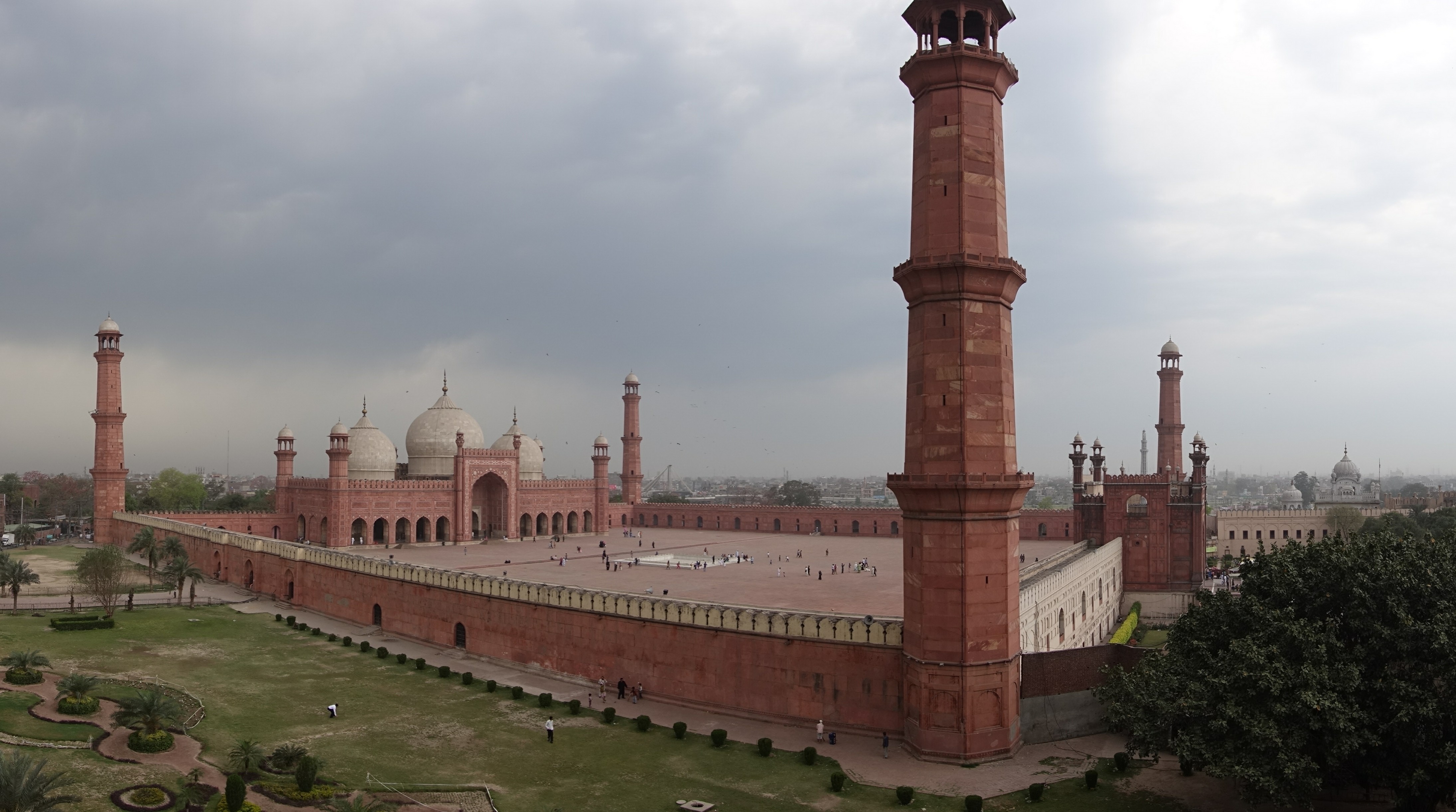
Badshahi Mosque
Only two years. That is how long it took to raise one of the largest mosques the Mughal Empire ever built. In 1671, Emperor Aurangzeb ordered its construction in Lahore to commemorate his military campaigns in southern India, particularly against the Maratha ruler Shivaji. By 1673, the Badshahi Mosque stood complete: carved red sandstone inlaid with white marble, a vast courtyard that could hold tens of thousands, and four minarets that would, in the centuries ahead, serve purposes their architect never imagined.
A Monument to Conquest
Aurangzeb was not, by temperament, a builder. Unlike his forebears, who poured imperial wealth into gardens and palaces, the sixth Mughal emperor spent most of his reign on military conquest. The Badshahi Mosque is the grand exception, a monument where martial ambition meets architectural splendour. Its gateway faces east toward the Alamgiri Gate of the neighbouring Lahore Fort, also commissioned by Aurangzeb, creating a choreography of approach: 22 steps ascend to the mosque's main entrance, lifting worshippers from the city into a courtyard enclosed by single-aisled arcades. The red sandstone exterior, decorated with white marble inlay, marks a deliberate departure from Lahore's older tradition of intricate tile work, or kashi kari, seen in mosques like the Wazir Khan. Where those earlier buildings dazzle with colour, the Badshahi Mosque imposes through scale and restraint.
Horses in the Courtyard
Empires rise and fall, and the Badshahi Mosque measured the distance between them. After the Mughals weakened, Maharaja Ranjit Singh captured Lahore and turned the mosque's vast courtyard into a stable for his cavalry. The 80 hujras, small study rooms ringing the courtyard, became soldiers' quarters and ammunition stores. In 1818, Singh built a marble pavilion in the facing Hazuri Bagh to serve as his royal court, reportedly using marble plundered from other Lahore monuments. During a Sikh civil conflict in 1841, his son Sher Singh positioned light cannons called zamburahs atop the mosque's minarets to bombard rivals sheltering in the Lahore Fort, destroying the fort's Diwan-e-Aam in the process. A French cavalry officer in Sher Singh's employ, Henri de La Rouche, even stored gunpowder in a tunnel connecting the mosque to the fort. A building designed for prayer had become an instrument of war.
Garrison, Then Sanctuary Again
When the British seized Lahore in 1849, they continued the military occupation. After the Indian Rebellion of 1857, they demolished the 80 hujras entirely, fearing they could shelter anti-British conspirators, and replaced them with open arcades called dalans. Muslim resentment at the mosque's continued use as a garrison grew steadily. With the advocacy of Khan Bahadur Nawab Barkat Ali Khan, the British established the Badshahi Mosque Authority in 1852 to oversee restoration and return the building to religious use. Viceroy John Lawrence eventually handed it back to the Muslim community. In April 1919, the mosque briefly became a site of political unity when an estimated 25,000 to 35,000 Sikhs, Hindus, and Muslims gathered in its courtyard to protest the Amritsar Massacre. A speech by Gandhi was read aloud by Khalifa Shuja-ud-Din, who would later become Speaker of the Provincial Assembly of the Punjab.
Sandstone from the Source
Major restoration began in 1939 under Punjab Premier Sikandar Hayat Khan, supervised by architect Nawab Alam Yar Jung Bahadur. Khan's contribution was so significant that he was buried in the adjacent Hazuri Bagh upon his death. The work continued past Pakistan's independence in 1947, finally completing in 1960 at a cost of 4.8 million rupees. In 2000, workers repaired the marble inlay in the main prayer hall. The most striking restoration came in 2008, when the red sandstone tiles of the courtyard were replaced using stone imported from the mosque's original Mughal quarry source near Jaipur, Rajasthan, in India. Centuries after partition, the materials that built this monument still had to cross the border to maintain it.
The Poet at the Gate
Near the mosque's entrance lie two tombs that tell the story of the building's survival. One belongs to Sir Sikandar Hayat Khan, the premier whose fundraising and political will saved the mosque from further decay. The other holds Muhammad Iqbal, the poet and philosopher widely revered as the intellectual father of the Pakistan Movement, which led to the creation of Pakistan as a homeland for South Asia's Muslims. Iqbal's burial here is no accident: the Badshahi Mosque is not merely a place of worship but a symbol of Lahore's identity, where Mughal grandeur, Sikh pragmatism, British colonialism, and Pakistani nationhood layer over one another like the successive floors archaeologists have found beneath the neighbouring Lahore Fort. Today the mosque is the second largest in Pakistan, a UNESCO World Heritage tentative list site, and a living congregation. From above, its symmetrical red courtyard and three white domes remain among the most recognizable shapes in Lahore.
From the Air
Located at 31.59°N, 74.31°E, adjacent to the Lahore Fort in the northwest corner of the Walled City. The mosque's large red sandstone courtyard and three white marble domes are clearly visible from altitude, sitting immediately west of the Lahore Fort complex. Nearest major airport is Allama Iqbal International Airport (OPLA), approximately 12 km to the southeast. The Ravi River lies to the north. The Badshahi Mosque, Lahore Fort, and Hazuri Bagh form a distinctive cluster of Mughal-era landmarks.