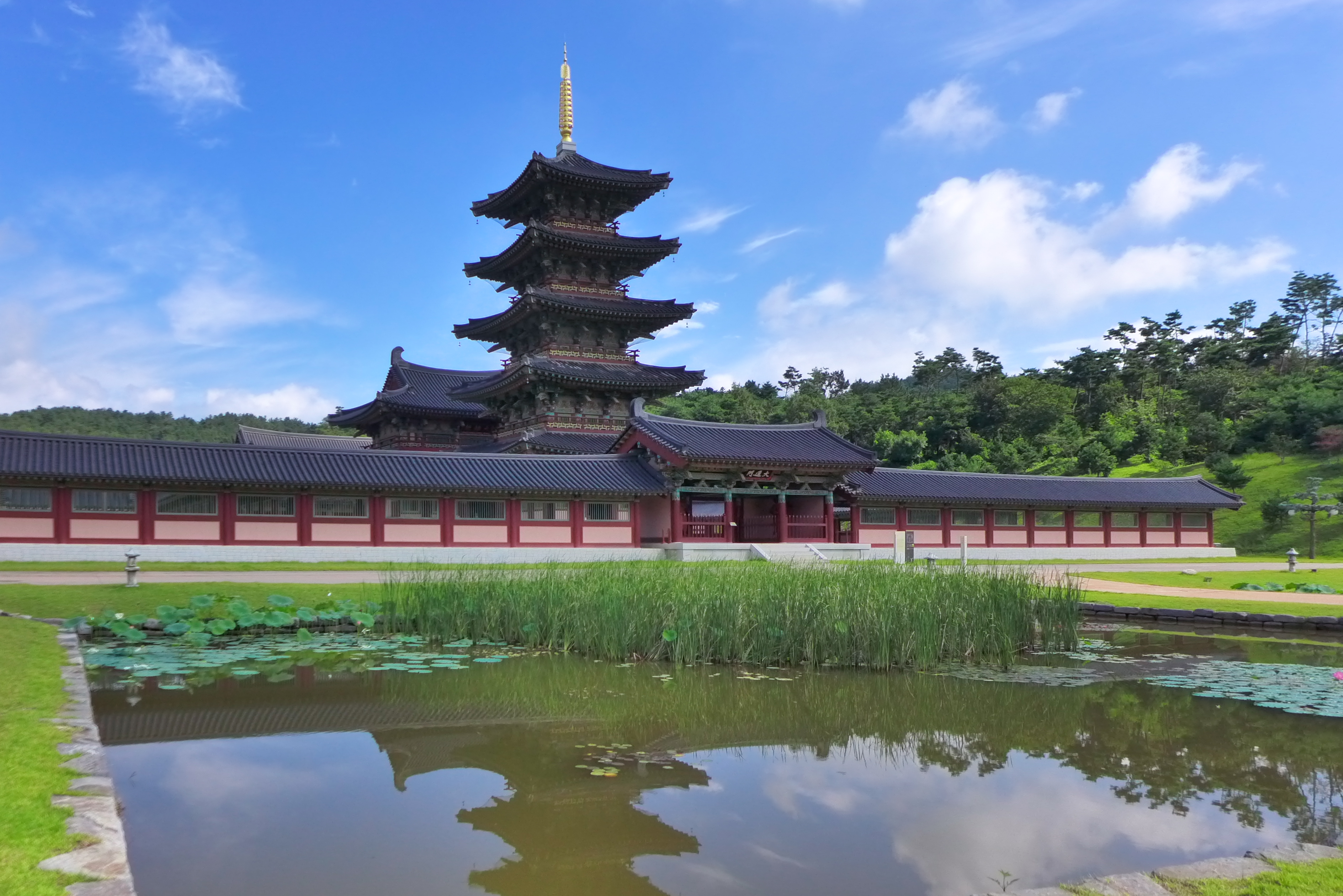
Baekje Historic Areas
When archaeologists opened the tomb of King Muryeong in 1971, they found it exactly as it had been sealed fifteen centuries earlier. More than 4,600 artifacts lay undisturbed inside a brick-vaulted chamber on a hillside above the Geumgang River. The 25th king of Baekje and his queen had waited in perfect stillness since the 6th century, surrounded by treasures that told the story of a kingdom most of the modern world has never heard of. The Baekje Historic Areas, inscribed as a UNESCO World Heritage Site in 2015, span eight monuments across three South Korean cities, preserving the final two centuries of a kingdom that thrived for 678 years and helped shape the religious and architectural character of East Asia.
Three Capitals, One Kingdom
Baekje was founded in 18 BC on the banks of the Han River, in what is now Seoul. For nearly five centuries, the kingdom grew alongside its rivals, Goguryeo to the north and Silla to the east, in the three-way power struggle that defined early Korean history. When Goguryeo conquered the capital in 475 AD, Baekje did not collapse. It relocated to Ungjin, where the Gongsanseong Fortress rose atop Gongsan Mountain, its stone and earthen walls stretching 2,666 meters across ridgelines and valleys. Sixty-three years later, in 538 AD, King Seong moved the capital again, this time to Sabi in present-day Buyeo, to gain better access to trade routes. A third city, Iksan, served as a secondary administrative capital. Each relocation brought new construction, new cultural absorption, and new monuments that survive today.
Buddhism Carved in Stone
Buddhism arrived in Baekje from China in the late 4th century and transformed the kingdom from the inside out. In the 6th century, a Baekje monk named Gyeomik traveled all the way to India to study Buddhist scriptures firsthand, returning with texts that were translated into the local language. The religion spread through every level of society, and rulers came to see themselves as instruments of the Buddha's authority. This devotion produced the monuments that anchor the World Heritage listing: the five-story stone pagoda at the Jeongnimsa Temple Site, standing 8 meters high in the classic pagoda-prayer hall-lecture hall arrangement that became standard across Korea; and the Mireuksaji Seoktap, the largest stone temple site not only in Korea but in all of East Asia. Baekje transmitted this architectural and religious knowledge to Japan during the 5th through 7th centuries, making the kingdom a crucial link in Buddhism's eastward journey.
The Rock of Falling Flowers
Not every monument here celebrates triumph. At the Busosanseong Fortress in Buyeo, a rock ledge called Nakhwaam overlooks the Geumgang River. Its name means "Rock of Falling Flowers," and the legend it carries is one of the most tragic in Korean history. When the allied forces of Silla and Tang China finally conquered Baekje in 660 AD, three thousand royal court ladies are said to have leaped from this cliff rather than face capture. The fortress itself, perched on Busosan Mountain at 106 meters elevation, had served as the royal palace's backyard garden and emergency escape route. Its rammed-earth walls stretch nearly 2,500 meters, and archaeological evidence suggests the site was in continuous military use for more than a thousand years after Baekje's fall.
Unearthed and Unbroken
What makes the Baekje Historic Areas remarkable is not just their age but their condition. The Royal Tombs at Neungsan-ri, excavated between 1915 and 1917, revealed seven burial chambers arranged in rows, their ceilings shifting from vaulted to flat designs as architectural fashions changed. The Naseong City Wall, 6.3 kilometers of rammed earth and stone built to defend Sabi's northern and eastern flanks, still shows the innovative construction techniques that set Baekje apart from its neighbors. A gilt-bronze waist belt found at the temple site on Busosan Mountain's southwestern slope hints at the wealth of whoever worshipped there. These sites were buried for centuries, and that burial preserved them. South Korea's Cultural Heritage Protection Act of 1962 began the formal process of recognition, and the Baekje Historic Areas Conservation Foundation now coordinates protection efforts across central, provincial, and local governments.
From the Air
The Baekje Historic Areas are centered around Gongju and Buyeo in South Chungcheong Province, at approximately 36.46N, 127.13E. The sites are spread across three cities: Gongju, Buyeo, and Iksan. The nearest major airport is Cheongju International Airport (RKTU), roughly 80 km to the northeast. Seoul Gimpo (RKSS) lies about 130 km north. The Geumgang River provides a useful visual landmark for navigation. Recommended viewing altitude is 5,000-8,000 feet AGL.