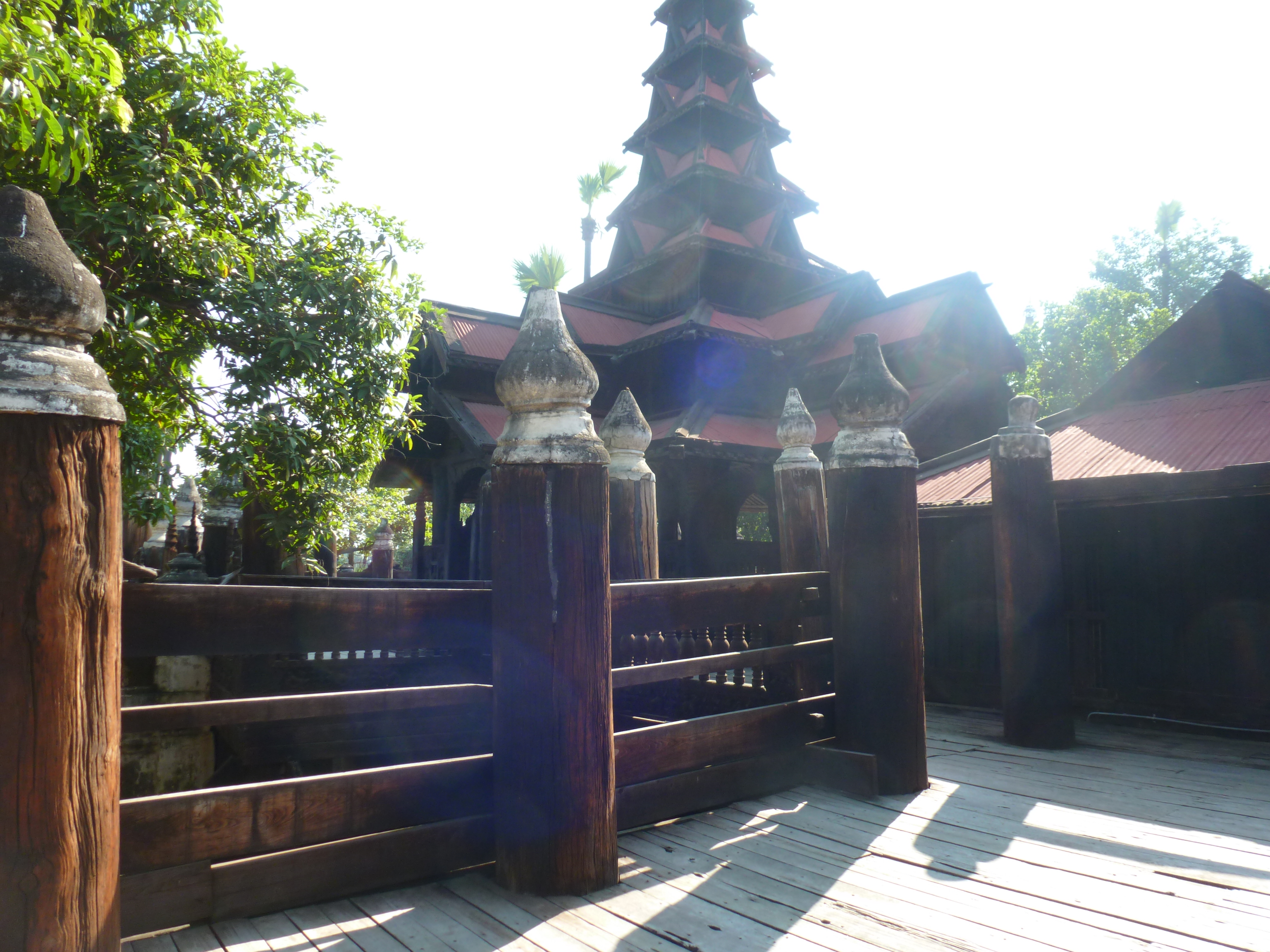
Bagaya Monastery
The teak darkens with age. Over centuries, it turns from honey gold to the deep brown-black of old iron, and the carvings cut into its surface seem to sharpen rather than erode -- floral arabesques, curving figurines, birds and animals rendered in relief that catches the shifting light of the Mandalay plain. The Bagaya Monastery stands in the middle of wide paddy fields in Inwa, Myanmar's ancient royal capital, surrounded by palms, banana trees, and thorny green bushes that cluster around its shady base. Known formally as Maha Waiyan Bontha Bagaya Monastery, it has occupied this site in one form or another since the late 16th century, surviving fire, war, and the slow dissolution of the kingdom it was built to serve.
Teak, Fire, and Reinvention
The original Bagaya Monastery was constructed from teak in 1593, approximately 11 miles from present-day Mandalay. Its name derives from a Burmese transliteration of a Mon word, a linguistic trace of the older civilization that once dominated lower Burma. During King Hsinbyushin's reign from 1763 to 1776, the town officer of Magwe -- a man named Maha Thiri Zeya Thinkhaya -- built a new structure within the Bagaya monastic establishment and dedicated it to the monk Shin Dhammabhinanda. But it was fire, not time, that would prove the monastery's greatest adversary. On April 15, 1821, during the reign of King Bagyidaw, a devastating blaze swept through Inwa and destroyed many important buildings, the Bagaya Monastery among them. The wooden structure that visitors see today is a reconstruction, but one built to follow the proportions and design of its predecessor.
The Art of Inwa
What makes the Bagaya Monastery remarkable is not its size or its age but the quality of its ornamentation. Every surface carries evidence of the Inwa era's artistic ambitions. The exterior walls display intricately carved wooden panels -- floral arabesques intertwined with relief sculptures of birds and animals. Small decorative pillars line the walls, and curved figurines emerge from the woodwork in poses that blend the devotional with the playful. Burmese teak carving reached a high point during the Inwa period, and the Bagaya Monastery is one of its finest surviving examples. The monastery was reconstructed in 1992 with a new brick building added to house Buddha images and Pitaka scriptures, but the teak structures that remain demonstrate a craftsmanship that modern materials cannot replicate. Walking through its dim interior, you can trace the chisel marks left by artisans whose names have been forgotten but whose skill has not.
Words Pressed into Palm Leaves
For centuries, the monastery accumulated a large collection of palm-leaf manuscripts -- texts inscribed on dried leaves of the talipot palm, the traditional medium for Buddhist scripture in Southeast Asia. These fragile documents survived fire, humidity, and insects through the care of successive generations of monks. In 2016, the abbot made a decision that balanced preservation against tradition: he requested that the collection be transferred to the National Library of Myanmar, where the manuscripts could be properly conserved. Two years later, in 2018, the National Library partnered with the Pali Text Society to digitize the collection, making texts that had been accessible only to monks in a remote monastery available to scholars worldwide. It was a quiet act of cultural stewardship -- recognizing that the best way to protect these documents was to let them leave the place that had sheltered them for so long.
Inwa's Long Twilight
The monastery's setting tells its own story. Inwa -- known to the British as Ava -- served as the capital of several Burmese kingdoms over a span of nearly four centuries. At its height, the city hummed with court life, monastic scholarship, and the commerce of empire. Today, the ruins of Inwa's palace and fortifications are scattered across flat agricultural land south of Mandalay, slowly being absorbed by the paddy fields and vegetation. The Bagaya Monastery is one of the most intact structures remaining from this long era, and visitors typically reach it by horse cart along unpaved roads that wind through the old capital's footprint. From the air, Inwa appears as a green patchwork of fields and tree canopies punctuated by the occasional spire or ruined wall -- a landscape in which the monastery's dark teak roof is one of the few signs that a royal city once stood here.
From the Air
Located at 21.848N, 95.968E in the Mandalay Region of central Myanmar, on the flat alluvial plain south of Mandalay. Inwa (Ava) sits at the confluence of the Irrawaddy and Myitnge rivers, which are clearly visible from altitude. The monastery is surrounded by paddy fields and scattered ruins of the former royal capital. Nearest major airfield is Mandalay International Airport (VYMD), approximately 35 km to the south. The flat terrain and river confluence make Inwa easy to identify from the air. Visibility is generally good in the dry season (November to March) but can be reduced by haze during the hot season and monsoon.