Bagram Airfield
On the night of July 1, 2021, the lights at Bagram Airfield went dark. The last American troops shut off the electricity and slipped away without telling the Afghan soldiers guarding the perimeter. By morning, looters were picking through what remained of a base that had housed tens of thousands of coalition personnel, complete with Pizza Hut franchises, coffee shops, a fifty-bed hospital, and a detention facility that once held three thousand prisoners. Bagram's story spans seven decades and three occupying powers, and its runway has seen everything from Eisenhower's presidential visit to suicide bombings. No single piece of infrastructure better encapsulates the arc of foreign intervention in Afghanistan.
Cold War Concrete
The Soviets built Bagram Airfield in the 1950s, during the early sparring of the Cold War when both superpowers courted Afghanistan's allegiance. In 1959, President Dwight Eisenhower landed here and was greeted by King Zahir Shah and Prime Minister Daud Khan, a diplomatic moment captured on a runway that would see far less cordial arrivals in the decades to come. The original 10,000-foot runway was completed in 1976, maintained by the Afghan Air Force with American support. When Soviet forces invaded Afghanistan in 1979, Bagram became their primary staging point. Elements of two airborne divisions deployed through the base, and Su-25 ground-attack aircraft of the 368th Assault Aviation Regiment flew close-support missions over Afghan valleys. The 108th Motor Rifle Division and the 345th Independent Guards Airborne Regiment operated from here throughout the 1980s. After the Soviet withdrawal in 1989, the base's buildings were systematically destroyed in the civil war that followed.
Between the Lines
From 1999 onward, Bagram became a no-man's-land bisected by war. The Northern Alliance and Taliban often controlled opposite ends of the airfield simultaneously, with the runway itself serving as a de facto front line. Northern Alliance forces reportedly staged rocket attacks on Kabul from Bagram, possibly using Russian-made FROG-7 rockets. In 2000, the Taliban overran the entire facility and pushed the Northern Alliance further north. The airfield that Eisenhower had visited as a symbol of Cold War cooperation had become a contested ruin, its buildings gutted, its perimeter laced with landmines -- a condition that would greet the next wave of foreign arrivals.
A Small City in the Mountains
After the U.S.-led invasion in late 2001, a team from the British Special Boat Service secured Bagram. Within weeks, soldiers from the 10th Mountain Division, 82nd Airborne Division, and Special Operations Command were sharing the wrecked facility, patrolling its perimeter and clearing explosives from the runway. By mid-2002, more than seven thousand troops called Bagram home, living in tent cities with names like Viper City and enduring daily rocket attacks that mostly went unreported. The transformation was swift: B-huts replaced tents, a second runway costing $68 million was completed in 2006, and by 2007 Bagram had traffic jams and commercial shops. It had become a small American town transplanted to a valley floor at the foot of the Hindu Kush, undergoing $200 million in expansion projects even as official policy insisted the U.S. presence was temporary.
The Dark Chapters
Bagram's history also carries weight that no amount of construction could paper over. The CIA used the facility as a black site for terrorism suspects in the early years of the conflict. At the Parwan Detention Facility, completed in 2009 to house roughly three thousand inmates, allegations of torture and abuse persisted for years. In 2005, the New York Times reported that two detainees had been beaten to death by guards in December 2002. Amnesty International used the word "torture" to describe conditions at the detention center. The 2007 Academy Award-winning documentary Taxi to the Dark Side detailed the death of an Afghan taxi driver held at the facility. These were not abstractions -- they were people caught in a system operating largely beyond legal oversight, where Red Cross representatives were the only outside observers, visiting once every two weeks, and detainees had no access to any legal process.
Lights Out
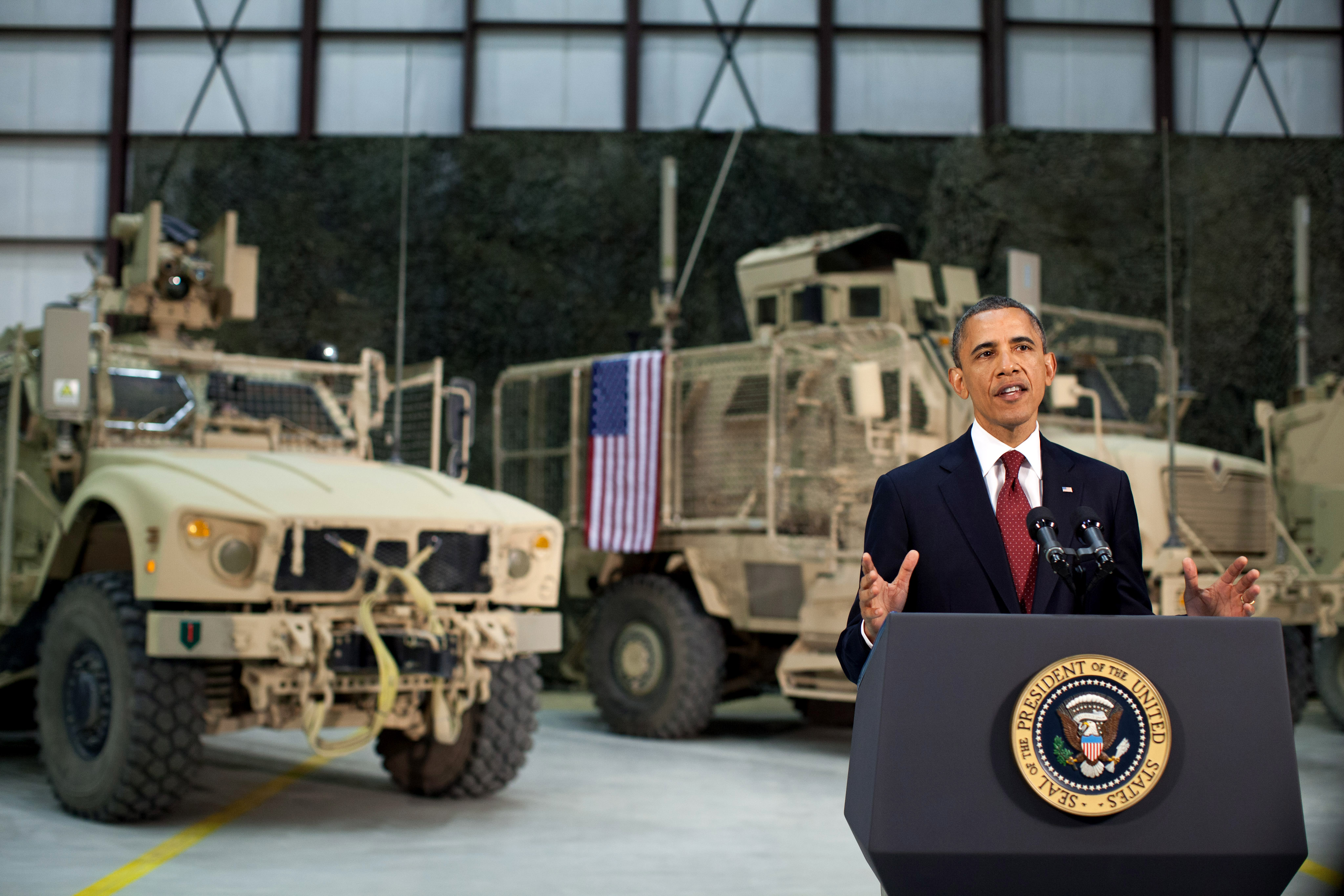
Multiple U.S. presidents visited Bagram during the war years -- George W. Bush arrived aboard Air Force One in 2006, Barack Obama addressed troops in 2012, Donald Trump celebrated Thanksgiving with soldiers in 2019. Each visit carried the implicit message that this base, and the mission it represented, mattered. The departure told a different story. The nighttime evacuation on July 1, 2021, conducted without notifying Afghan forces, ended nearly twenty years of continuous American presence. Local civilians looted the base before the Afghan National Army could secure it. Six weeks later, on August 15, Afghan troops abandoned their positions entirely, and the Taliban took control, freeing thousands of prisoners including senior Al-Qaeda and Taliban figures. The base that three superpowers had used as a foothold in Afghanistan was, once again, in Afghan hands. Its runways and blast walls stand as monuments to the recurring pattern of foreign ambition meeting Afghan reality.
From the Air
Bagram Airfield is located at approximately 34.95N, 69.27E on the Shomali Plain north of Kabul, at an elevation of roughly 4,895 feet (1,492 meters). The base features two parallel runways clearly visible from altitude, the longer one measuring 3,500 meters. The facility sits in a broad valley with the Hindu Kush mountains rising to the north and east. Kabul International Airport (OAKB) lies approximately 50 km to the south. The sprawling base infrastructure, including blast walls, parking aprons, and the detention facility compound, remains visible from cruising altitude.