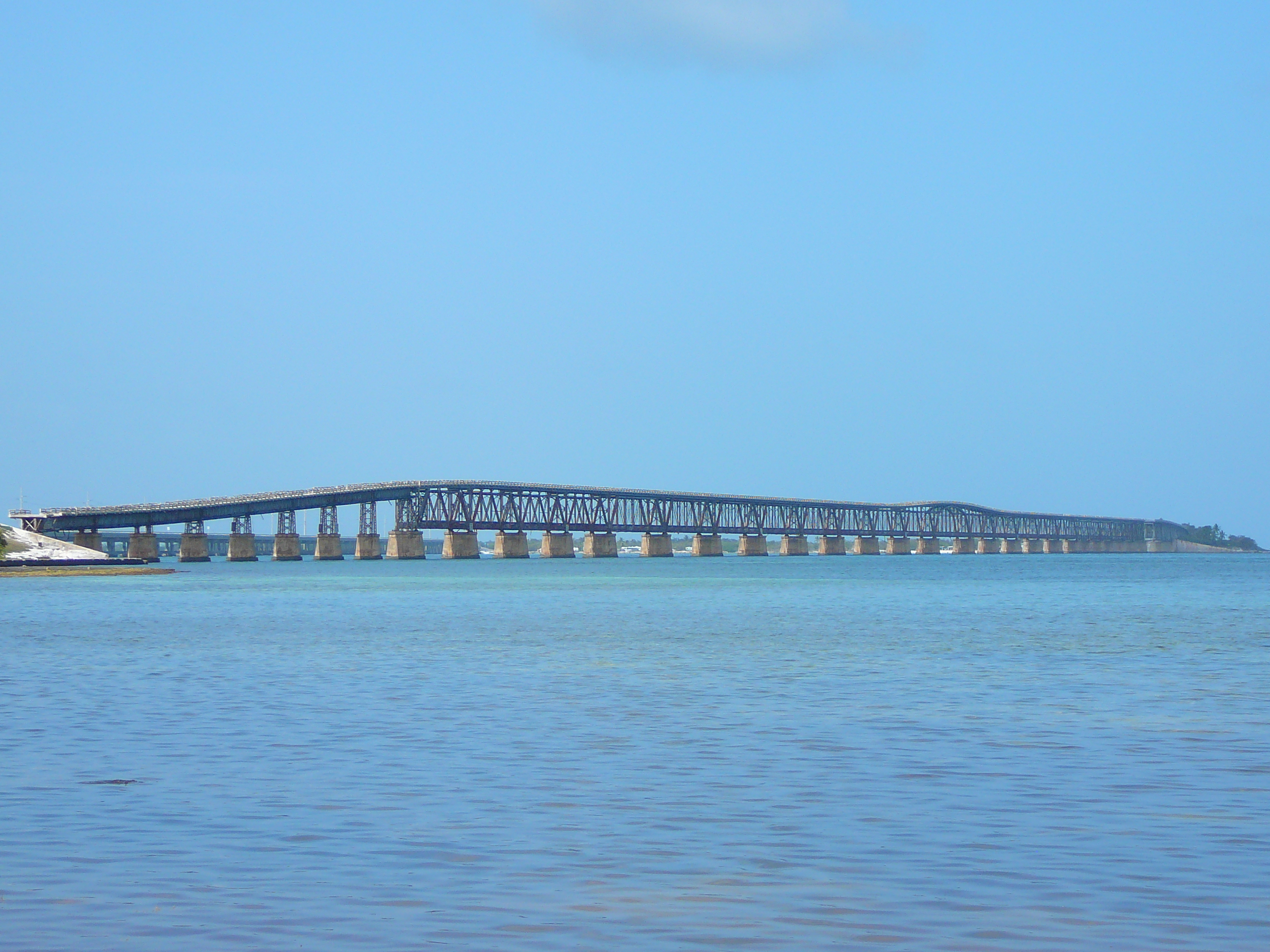
Bahia Honda Rail Bridge
It stands in salt air and silence, a cathedral of rusting steel rising from turquoise shallows between Bahia Honda Key and Spanish Harbor Key. The Bahia Honda Rail Bridge is not merely old infrastructure. It is the physical signature of one man's obsession, a Category 5 hurricane's fury, and the Florida Keys' stubborn reinvention of itself across a century of storms and ambition. Completed in 1912 as part of Henry Flagler's Overseas Railway, battered into retirement by 1935, repurposed as a highway, and finally abandoned in 1972, this bridge has lived more lives than most structures ever will.
Flagler's Deepest Challenge
Henry Flagler spent his personal fortune extending the Florida East Coast Railway from Miami to Key West across 128 miles of open ocean, shallow reef, and mangrove. Most of the Overseas Railway's bridges were concrete arches, elegant and effective. But Big Spanish Channel beneath Bahia Honda posed a problem the arches could not solve: the water was too deep, reaching at least 24 feet, the deepest crossing on the entire route. Engineers William Krome and Joseph Meredith designed a steel truss structure instead, anchoring a central Parker truss span flanked by 13 Pratt truss sections on each side, with nine plate girder sections forming the western approach. The result was the longest pin-connected truss bridge in the United States. Flagler himself rode the first train across to Key West in 1912, just a year before his death.
The Storm That Changed Everything
On Labor Day 1935, a Category 5 hurricane, the strongest to strike the United States at the time, slammed into the Upper Keys near Islamorada. Winds gusted above 200 miles per hour. More than 400 people died, including over 200 World War I veterans working on highway construction camps who never received their evacuation train in time. The storm ended the Overseas Railway forever. The damaged tracks were never rebuilt. Instead, the state of Florida purchased the bridge from the Florida East Coast Railway and engineer B.M. Duncan converted it for automobile use. Because the original rail deck sat inside the truss and was too narrow for cars, the roadway was built on top of the structure, giving drivers a thrilling perch high above the channel as part of the new Overseas Highway, which opened in 1938.
A Bridge Becomes a Ruin
The highway atop the old rail bridge served motorists for over three decades until 1972, when a new four-lane bridge opened a few hundred yards to the north. The original structure was left to the elements. Two sections have been removed entirely, and signs warn passing boats of falling debris from the deteriorating steel. Yet all remaining sections still stand, defiant against decades of salt spray and hurricane seasons. The easternmost span has been maintained by Bahia Honda State Park and remains open to pedestrians, offering one of the most photographed views in the Keys. Visitors walk out over crystalline water to a panorama of mangrove islands, the turquoise ribbon of the channel below, and the modern bridge curving alongside like a younger sibling.
Steel Bones Over Turquoise Water
From the air, the Bahia Honda Rail Bridge is unmistakable: a dark lattice of steel trusswork stretching across the brilliant blue-green of Big Spanish Channel, shadowed by the clean white line of the modern replacement bridge running parallel just to the north. The contrast tells the whole story of the Keys in a single frame. Flagler's ambition in iron and rivets, nature's indifference in rust and missing spans, and the pragmatic modern highway that keeps the chain of islands connected. Bahia Honda State Park spreads across the key to the east, its beaches consistently ranked among the finest in the United States, and the deeper waters of the channel below the bridge draw snorkelers and divers to the reef systems just offshore.
From the Air
Located at 24.655N, 81.293W in the Lower Florida Keys. The bridge spans Big Spanish Channel between Bahia Honda Key and Spanish Harbor Key, clearly visible at any altitude. Best viewed at 1,000-3,000 ft AGL where both the old rail bridge and parallel modern bridge create a striking visual pair. Nearest airports: Florida Keys Marathon Airport (KMTH) approximately 15 nm northeast, and Key West International Airport (KEYW) approximately 30 nm southwest. The bridge is at roughly Mile Marker 37 on the Overseas Highway (US-1). Look for Bahia Honda State Park on the eastern key.