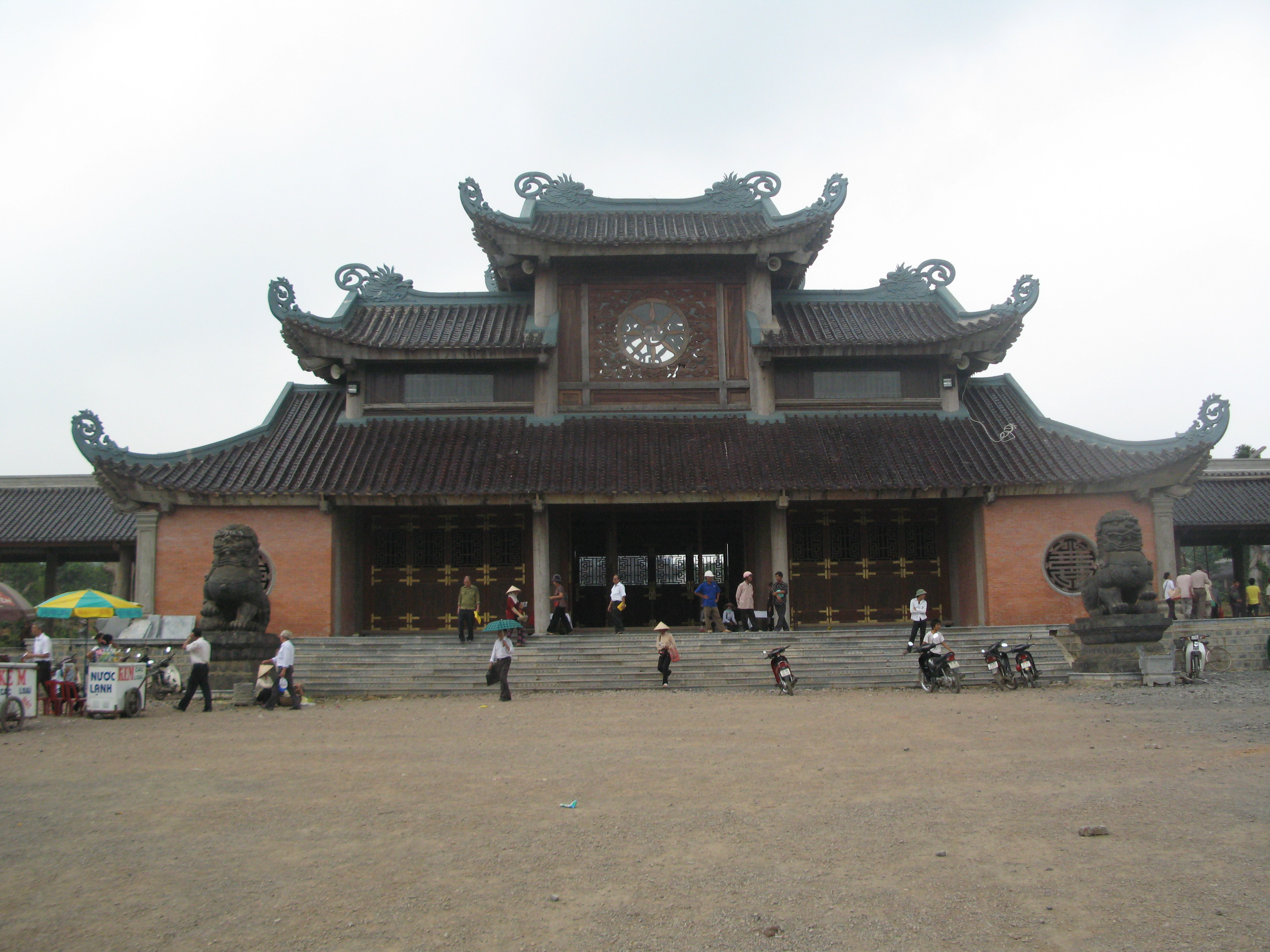
Bái Đính Temple
Five hundred stone Arhats line the corridor, each face distinct, each posture carrying its own quiet authority. The procession stretches so far that first-time visitors lose count before they reach the end. This is Bai Dinh, a Buddhist temple complex of such scale that it holds records across Vietnam and Southeast Asia -- and yet the place it grew from is a cluster of small caves on a mountainside where monks once chanted by candlelight. On Bai Dinh Mountain in Ninh Binh Province, about 90 kilometers south of Hanoi, the old and the new exist side by side: intimate devotion and monumental ambition, separated by 800 meters and several centuries of intent.
The Mountain's First Temple
The original Bai Dinh pagoda occupies a series of small limestone caves partway up the mountain's flank. Reaching it requires ascending more than 300 stone steps that pass under an ornamental gate before arriving at the entrance. Inside, Buddhist deities share space with the natural spirits of the mountains -- a blending of traditions common in Vietnamese religious practice, where Buddhism, Taoism, and animist folk belief have long coexisted. The old temple's scale is human: low ceilings shaped by geology, narrow passages where incense smoke lingers, and shrine alcoves that feel discovered rather than designed. It is a place that rewards quiet attention, and for generations it was enough.
Building on the Scale of Belief
Construction of the New Bai Dinh Pagoda began in 2003 on the Ba Rau hills near the Hoang Long River. Seven years later, when it was completed in 2010, it had become something unprecedented in Vietnamese Buddhism. The complex sprawls across 700 hectares -- more than 1,700 acres -- and its largest structure, the Tam The Hall, rises 34 meters to its roof ridge and stretches over 59 meters in length. The architecture follows traditional Vietnamese lines: curved finials and corner eaves that soar outward and upward, evoking the tail of a phoenix. But the sheer size sets Bai Dinh apart from every Buddhist pagoda that came before it in the country.
The materials were chosen to anchor the temple in its region. Locally quarried stone and timber from Ninh Binh Province form the structural bones. Tiles came from the centuries-old ceramics village of Bat Trang. Bronze sculptures were cast in Y Yen, stone carvings shaped in Ninh Van, wood carpentry joined in Phu Loc, and embroidery stitched in Ninh Hai. Reinforced concrete was employed where traditional materials could not bear the loads, but the artisanal finishing work is handmade throughout.
A Collection of Records
Bai Dinh holds a formidable list of distinctions. The complex covers 539 hectares of designated temple grounds -- 27 hectares for the ancient pagoda and 80 hectares for the new one. Its bronze bell weighs 36 tons, the largest in Vietnam. The corridor of 500 Arhat statues, each carved in stone with individual features and expressions, is unmatched in the country. The Buddhist stupa on the grounds is the tallest in Asia. Taken together, these records make Bai Dinh one of the largest Buddhist temple complexes not only in Vietnam but across Southeast Asia, a status it shares with the Tam Chuc Pagoda further north. Pilgrims travel from across the country to visit, and the complex has become a fixture on the itineraries of both the devout and the curious.
The Sixth Day of the New Year
Each year on the sixth day of the first lunar month, Bai Dinh hosts a festival that draws enormous crowds. Buddhist rites are performed in the New Temple's cavernous halls while traditional rituals unfold simultaneously at the Old Temple up the mountain. The two ceremonies run in parallel, mirroring the complex itself -- the ancient practice and the modern expression, different in scale but continuous in purpose. Ninh Binh Province has no shortage of landmarks to attract visitors: the ancient capital of Hoa Lu, the river grottoes of Tam Coc-Bich Dong, the UNESCO-listed landscape of Trang An, and the old-growth forest of Cuc Phuong National Park all lie nearby. Bai Dinh fits into this constellation as the spiritual anchor, a place where the region's deep history meets a living, expanding faith.
From the Air
Located at 20.28°N, 105.86°E on Bai Dinh Mountain in Gia Vien District, Ninh Binh Province, Vietnam. The massive temple complex is visible from altitude as a concentration of large roofed structures amid the karst landscape typical of the region. Nearest airport is Noi Bai International Airport (VVNB) in Hanoi, approximately 55 nautical miles to the north-northeast. The Trang An UNESCO World Heritage landscape and its dramatic karst towers are visible nearby. Best viewed at 3,000-6,000 feet to appreciate the temple's scale against the surrounding limestone topography.