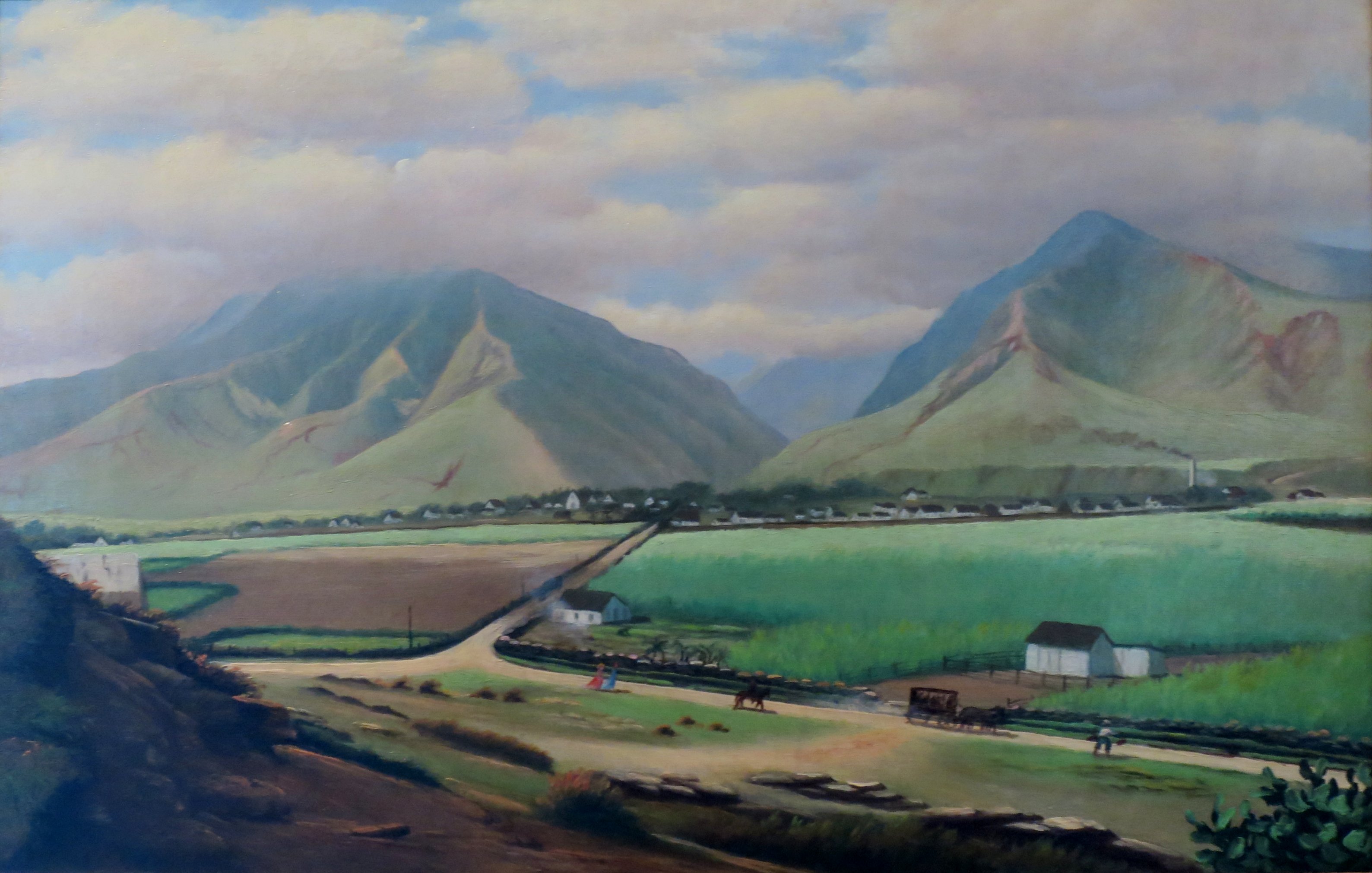
Bailey House Museum
Hidden in an upcountry cave for more than a century, a wooden statue of the Hawaiian demi-god Kamapua'a waited out the destruction of everything like it. When King Kamehameha II ordered the abolition of the traditional Hawaiian religion in 1819, carved images of the gods were burned or smashed across the islands. Somehow, this one survived -- spirited away by someone whose name is lost to history, tucked into darkness on the slopes above Wailuku. Today it stands inside a stone house at the mouth of the Iao Valley, the only wooden deity statue on Maui to have endured the purge. The house that shelters it has its own layered story.
Where Chiefs Once Lived
The stone building now known as the Bailey House sits at the entrance to the Iao Valley, one of the most sacred places on Maui. This was once the royal residence of Kahekili II, the last ruling chief of Maui, who held power here until his death around 1794. Built in 1833, the house was among the first Western-style structures in Wailuku. It served initially as a missionary seminary before the land reverted to the Hawaiian crown. The Baileys purchased it back in 1850, and the surrounding acreage eventually became sugarcane fields, folded into the Wailuku plantation and later into C. Brewer & Co., one of Hawaii's powerful trading houses. The Maui Historical Society took stewardship in 1951, and in 1991, local businessman Masaru "Pundy" Yokouchi bought the property and donated it outright. The museum opened as Hale Ho'ike'ike -- Hawaiian for "House of Display" -- on July 6, 1957.
Survivors and Vanished Species
The museum's exhibits trace the collision between Hawaiian and Western worlds with uncommon intimacy. The Kamapua'a statue, carved before the 1819 abolition, stands as both an artistic masterpiece and an artifact of religious survival. Upstairs, the Monarchy Room displays artifacts from the Kingdom of Hawaii era, while the Koa Room features furniture crafted entirely from native koa wood, including a large four-poster bed. But perhaps the most quietly devastating exhibit is the land snail shell collection assembled by David Dwight Baldwin. Hawaii once harbored hundreds of native land snail species, many found nowhere else on Earth. After the introduction of alien snail species and predators, the vast majority of these native mollusks went extinct. Baldwin's meticulously labeled shells preserve what the living islands have lost -- rows of tiny, spiral testaments to a vanished biodiversity.
A Surfboard and a Canoe
Outside the main house, a shelter protects two objects that distill different eras of Hawaiian life on the water. Duke Kahanamoku's 1919 redwood surfboard leans against its stand -- a relic from the man who brought surfing to the world's attention, carved from California redwood in the years when he was winning Olympic gold medals in swimming and demonstrating wave-riding to astonished crowds in Australia and the mainland United States. Nearby rests the Honaunau, a 33-foot outrigger canoe from the early 1900s, carved from a single koa log. It was used for fishing, and it is one of the last koa fishing canoes ever made in Hawaii. The koa trees large enough to produce such a hull have grown scarce, making the Honaunau not just a boat but an endpoint -- the final expression of a boatbuilding tradition that stretches back to the Polynesian voyagers who first settled these islands.
The Valley's Threshold
The Bailey House sits precisely where the town of Wailuku meets the wild interior of the Iao Valley, a boundary that has mattered for centuries. Behind the museum, the valley narrows into steep green walls where the Battle of Kepaniwai was fought in 1790, when Kamehameha the Great's forces drove Maui's defenders into the stream until it ran red. The museum's grounds, listed on the National Register of Historic Places and set within the Wailuku Civic Center Historic District, occupy a threshold between Maui's past and its present. Visitors walk from the gift shop of locally made artisan goods back through rooms displaying royal Hawaiian artifacts, missionary-era furniture, and the patient shells of creatures that no longer exist -- all held in a building that has served a chief, a seminary, a plantation family, and now the island's collective memory.
From the Air
Bailey House Museum is located in Wailuku, Maui at approximately 20.886°N, 156.507°W, at the mouth of the Iao Valley on the western side of the island. From the air, the Iao Valley is the dramatic green cleft in the West Maui Mountains, with the Iao Needle visible as a prominent spire. The museum grounds are at the valley entrance, within the small grid of Wailuku town. Nearest airport: Kahului Airport (PHOG), about 3 miles east. Best viewed below 3,000 feet AGL. The West Maui Mountains can generate strong updrafts and turbulence.