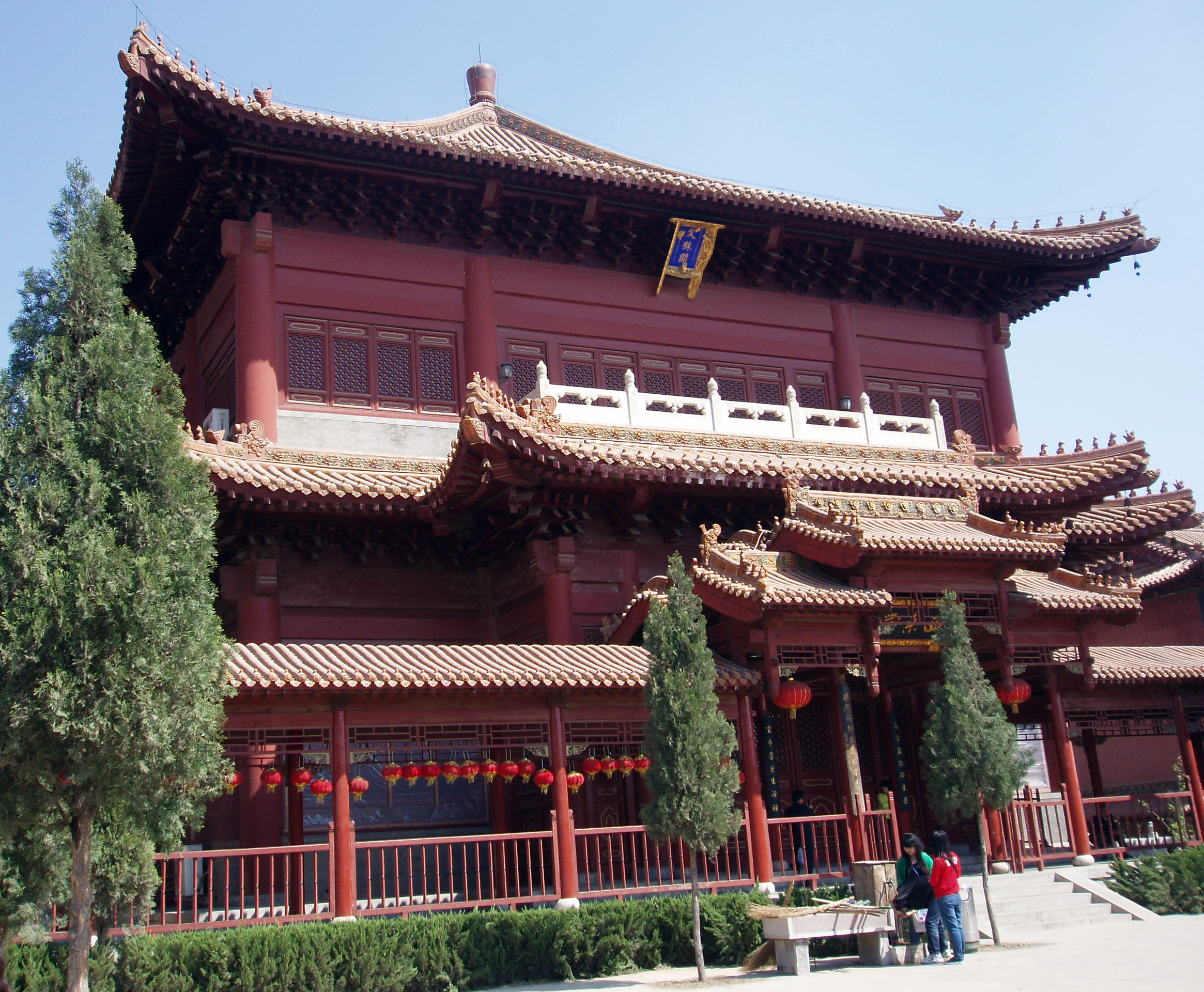
Bailin Temple (Beijing)
Somewhere inside a compound at 1 Xilou Hutong, hidden behind walls in one of Beijing's oldest neighborhoods, 78,230 wooden printing blocks sit in careful storage. Carved from high-grade pear wood beginning in 1733, during the reign of the Yongzheng Emperor, the blocks took six years to complete and contain the entire Tripitaka -- the vast canon of Buddhist scripture. In nearly 300 years, fewer than 200 copies have been printed from them, which is precisely why the blocks remain in excellent condition. This is Bailin Temple, a place that has survived seven centuries by a combination of luck, superstition, and the occasional intervention of emperors.
Born Under the Mongols
Construction of Bailin Temple began in 1347, during the final years of the Yuan dynasty, on open ground east of the Temple of Confucius in the Mongol capital of Dadu -- the city that would later become Beijing. The temple was the largest of its kind in Dadu, home to monks of the Sakya school of Tibetan Buddhism, which wielded enormous influence under Mongol rule. But fortune turned quickly. In 1355, the Sakya were overthrown in Tibet by local warlords, and thirteen years later the Yuan dynasty itself collapsed when rebel armies captured and sacked Dadu. The temple's structures mostly survived the violence, but the monastery fell into decades of neglect -- even after the Ming dynasty moved its capital north in 1421 and rechristened the city Beijing. Not until 1447 did the Zhengtong Emperor order a renovation.
In the Shadow of a Neighbor
The temple's most consequential neighbor arrived in 1694, when a palace for Prince Yong, fourth son of the Kangxi Emperor, was built directly to the west. The prince personally supervised a complete renovation of Bailin Temple in 1713, gifted it a monumental bronze bell in 1707, and in 1722 ascended the throne as the Yongzheng Emperor. That same year, he donated part of his former palace to Tibetan lamas of the Gelug school, inadvertently creating what would become the Yonghegong Lamasery -- the largest Tibetan temple outside Tibet. As the Yonghegong grew in prestige, Bailin Temple gradually slipped into its shadow, eventually becoming administratively dependent on its more famous western counterpart. Yet the Qing emperors' patronage kept Bailin in good repair. In 1758, the Qianlong Emperor ordered another lavish renovation as part of his grand project to remake Beijing.
Survived by Superstition
Twice in the 19th century, foreign armies looted Beijing, and twice Bailin Temple emerged unscathed. During the Anglo-French destruction of 1860 and again during the Eight-Nation Alliance's occupation in 1900, the invading soldiers reportedly left Tibetan Buddhist temples alone. The reason was not respect but superstition -- Tibetan Buddhism's unfamiliar rituals and imagery apparently unnerved the foreign troops enough to make them pass by. This accidental protection ended after the Qing dynasty fell in 1911. With the capital moved to Nanjing, Tibetan Buddhism came to be seen as a feudal relic, and the temple entered a long decline.
Revolution and Refugees
The most devastating blow came in August 1966, when Red Guards attacked the temple, expelled the lamas, and reorganized the buildings into housing and work units. The Drum and Bell Towers were torn down. Stone lions, Buddhist statues, and two carved stone tablets vanished. Brick structures were built inside the temple walls, and the compound was divided among government offices and private enterprises. After the catastrophic 1976 Tangshan earthquake, refugees flooded into the area, dramatically increasing the density of the already-crowded site. By the time the government designated Bailin Temple for institutional use in 1988, it bore little resemblance to its imperial past.
What Remains
The five main halls still stand along their original central axis: the main gate, the Devaraja Hall of the Heavenly Kings, the Hall of Attaining Perfection, the Mahavira Hall, and the Vimalakirti Hall. A plaque in the Kangxi Emperor's own calligraphy reading "The Everlasting Cypress Grove" still hangs on the Mahavira Hall's facade. Seven gilded Buddha images from the Ming dynasty survive in the Vimalakirti Hall, and two bronze bells cast in 1707 -- each standing 2.6 meters tall, their surfaces covered with bas-relief dragons and mantras for the dead -- still occupy an auxiliary hall. A government-funded restoration in 1992 repaired the original buildings without removing the later additions. The temple remains largely closed to the public, opening its gates only on Cultural Heritage Day, June 8. Inside its walls, the printing blocks wait -- one of the most complete sets of the Tripitaka in existence, carved during a six-year labor that began in 1733 and has outlasted every upheaval since.
From the Air
Located at 39.95°N, 116.41°E in Dongcheng District, central Beijing, near the Beixinqiao neighborhood. The temple compound is tucked among hutong alleys and is not easily distinguished from the air. The Yonghegong Lamasery is directly to the west and more visible. Best viewed at 2,000-3,000 feet AGL. Beijing Capital International Airport (ZBAA/PEK) is 13 nm to the northeast.